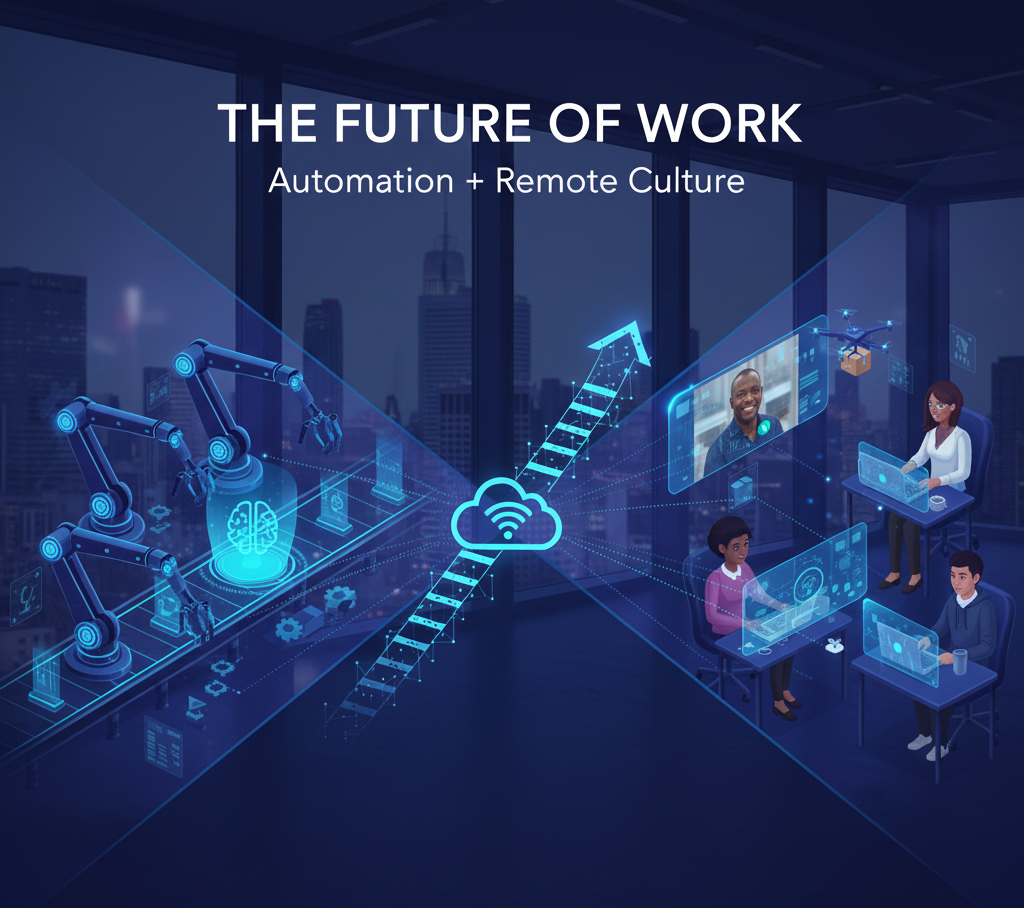
The world of work is undergoing an irreversible transformation driven by automation, artificial intelligence (AI), digitalization, and a global shift toward remote and hybrid work environments. What was once considered a slow evolution has accelerated dramatically in the past few years, influenced by rapid technological advancements, shifting worker expectations, and changing business priorities. Today, the workplace looks nothing like it did a decade ago and the next decade promises even greater change.
In this detailed analysis, we explore how automation is reshaping job roles, why remote culture is redefining workplace norms, and what skills, technologies, and mindsets will be vital for success in the future workforce.
1. Automation and AI: Redefining Job Roles Across Industries
Automation has long existed manufacturing robots, assembly-line machines, and basic software processes have been replacing manual labor for decades. But today’s automation is far more advanced, powered by AI, machine learning, and predictive analytics.
Automation is no longer physical, it is cognitive
This new generation of automation doesn’t just perform repetitive manual tasks; it also executes complex thinking tasks such as:
- Analyzing large volumes of data
- Making predictions
- Responding to customer queries
- Creating content
- Conducting financial audits
AI tools like ChatGPT, Bard, and Microsoft Copilot can create marketing copy, generate reports, write code, design presentations, and even brainstorm business strategies. This automation of cognitive labor is what truly disrupts traditional job roles.
Industries most impacted
- Customer Service:
AI chatbots now handle 70–80% of basic customer queries. Businesses use NLP-powered bots to provide instant, 24/7 support, reducing the need for large call-center teams. - Finance & Accounting:
Automated systems can reconcile accounts, detect fraud, generate financial statements, and analyze budgets in seconds, significantly reducing manual accounting tasks. - Healthcare:
AI diagnostics analyze X-rays, MRI scans, and medical histories with striking accuracy. Robots assist surgeons, and AI tools help in early disease detection. - Retail & Logistics:
Self-checkout systems, warehouse robots, automated inventory trackers, and drone deliveries are transforming how goods are sold and transported. - Software Development:
AI-assisted coding tools generate scripts, debug errors, and help engineers build applications faster than ever.
Automation isn’t replacing all jobs it’s transforming them
While automation may reduce demand for some roles, it simultaneously creates new ones. For example:
- Data analysts
- AI trainers
- Automation supervisors
- Cybersecurity specialists
- Prompt engineers
- Digital workflow architects
Jobs that require emotional intelligence, creativity, leadership, and decision-making remain in high demand. Instead of replacing employees, AI often enhances productivity acting as a powerful assistant that handles repetitive work.
2. The Urgent Need for Reskilling and Upskilling
As automation accelerates, skills become the new currency of employment.
Traditional degrees are becoming less important than demonstrated skill proficiency. Employers now value candidates who can adapt quickly, learn continuously, and work comfortably with technology.
Skills in high demand
Technical Skills
- Data science and analytics
- AI and machine learning
- Cloud computing
- Cybersecurity
- UI/UX design
- Automation engineering
- Software development
Soft Skills
- Leadership and empathy
- Adaptability
- Complex problem-solving
- Critical thinking
- Creativity
- Project management
Why reskilling matters
According to global workforce studies, by 2030, nearly 800 million jobs may be transformed by automation, making reskilling essential for career survival.
Governments, corporations, and educational institutions have responded with:
- Online learning platforms (Coursera, Udemy, edX)
- Corporate training programs
- Government-funded skill initiatives
- Workforce development grants
The ability to learn continuously is now a lifelong requirement, not a choice.
3. Remote Work and Hybrid Culture: The New Work Norm
The COVID-19 pandemic acted as a massive stress test for global workplaces. Within months, millions of employees transitioned to remote work, revealing that productivity did not decline in many cases, it improved.
Why remote work succeeded
- Reduced commuting stress
- Flexible schedules
- Access to global job markets
- Better work-life balance
- Increased autonomy
- Diverse talent pools for employers
Remote work opened opportunities for workers worldwide to participate in global economies, eliminating geographical limitations.
Hybrid work: The best of both worlds
Many companies now prefer hybrid models where employees split their time between office and home. This offers:
- Collaboration and team bonding
- Independent work on deep-focus tasks
- Reduced operational costs
- Balanced employee satisfaction
Hybrid culture is expected to dominate future workplaces, especially in tech, finance, marketing, consulting, and creative industries.
Challenges of remote and hybrid work
While beneficial, remote work also brings challenges:
- Digital burnout
- Lack of social interaction
- Overworking due to blurred boundaries
- Security threats
- Home-office setup limitations
Companies now invest heavily in wellness programs, engagement initiatives, and digital security to support distributed teams.
4. Digital Collaboration Tools Changing Workplace Productivity
The rise of remote work gave birth to a massive ecosystem of collaboration tools that enable global teams to work seamlessly.
Key tools transforming work
- Zoom & Google Meet: Real-time communication
- Slack & Microsoft Teams: Messaging and team collaboration
- Notion & Confluence: Knowledge management
- Trello, Asana & ClickUp: Project management
- Figma & Miro: Creative collaboration
These tools break down communication barriers and help teams operate across different time zones.
Cloud computing as the backbone
Cloud technologies ensure employees can:
- Access documents from anywhere
- Work on shared files in real time
- Use secure storage solutions
- Collaborate on large-scale projects
Companies that adopt these systems report higher productivity, seamless operations, and better project visibility.
5. The Rise of the Gig Economy and Freelance Work
Traditional full-time employment is no longer the only path to success. The gig economy has opened new opportunities for people seeking flexibility, independence, or multiple income streams.
Why freelancing is booming
- Remote work flexibility
- Global client access
- Higher earning potential in specialized niches
- Freedom to choose projects
- Better work-life balance
Popular gig roles include:
- Content creators
- Graphic & web designers
- Developers
- Digital marketers
- Consultants
- Data analysts
- Tutors
- Virtual assistants
Platforms like Upwork, Fiverr, Freelancer, and Toptal have democratized access to global work opportunities.
Companies benefit, too
Businesses turn to freelancers because:
- They reduce hiring costs
- They provide specialized expertise
- They work on-demand
- They enable rapid scaling
This shift reshapes traditional HR models and expands workforce flexibility.
6. Employee Well-being, Mental Health, and Work-Life Balance
As work becomes more digital and fast-paced, mental well-being is now a top priority.
Rising concerns
- Remote work burnout
- Digital fatigue
- Anxiety and isolation
- Performance pressure
- Work-life imbalance
How companies are responding
Forward-thinking organizations are investing in:
- Employee assistance programs
- Mental health leave
- Wellness workshops
- Counseling services
- Flexible hours
- Ergonomic home-office reimbursements
Healthy employees are more engaged, creative, and loyal making well-being a core part of future workplace strategy.
7. Preparing for the Future Workforce: What Comes Next?
The workplace of the future will be shaped by several major trends:
Human–AI collaboration
Instead of replacing humans, AI will work alongside them taking over routine tasks and enhancing creativity, speed, and efficiency.
Skills-based hiring
Companies will prioritize skills over degrees. Portfolios, certifications, and practical demonstrations will matter more than formal qualifications.
Global remote teams
Workforces will be borderless. Companies can hire top talent from any country, allowing diverse teams to collaborate virtually.
Flexible and adaptive work models
Rigid 9-to-5 schedules will become outdated. Flexible hours, hybrid work, and asynchronous collaboration will become the norm.
Continuous learning culture
Employees will need to regularly update their skills to stay relevant. Lifelong learning will become embedded in every career.
Conclusion: A New Work Era Has Begun
The future of work is not a distant concept it is unfolding right now. Automation and AI are transforming how jobs operate, remote work is redefining workplace structure, and a global shift toward flexibility and digital collaboration is changing what workers expect from employers.
Success in this new world will require:
- Openness to change
- Continuous learning
- Digital adaptability
- Strong communication skills
- Emotional intelligence
- Technological awareness
The workplace of the future will be more dynamic, innovative, inclusive, and interconnected than ever before. Those who embrace this transformation will thrive not just survive in the evolving global economy.