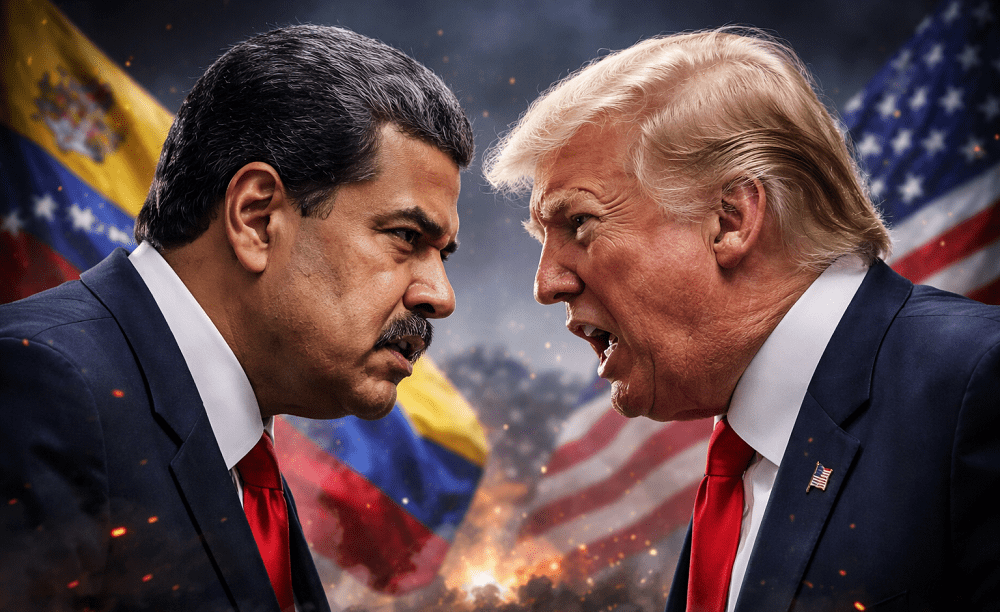
In the first days of January 2026, Venezuela a nation already facing deep economic collapse and political turmoil erupted into a new phase of crisis as United States military forces launched a large-scale operation inside Venezuelan territory. This unprecedented intervention resulted in the capture of President Nicolás Maduro, the removal of his government’s leadership, and a new chapter of geopolitical conflict in the Western Hemisphere.
The Operation and Capture of Maduro
According to official statements from the U.S. administration, the military mission described by President Donald Trump as a “large scale strike” involved coordinated airborne, naval, and special forces elements. The U.S. claims the operation successfully seized Maduro and several key figures in his security apparatus, after which they were transported out of Venezuela.
Venezuela’s government responded with shock and condemnation, asserting that the U.S. military strikes caused significant casualties. Caracas’ Interior Minister announced that about 100 people were killed in the operation, including members of the Venezuelan military and Cuban personnel stationed in the country. Maduro himself was injured (reportedly in the leg), and his wife sustained a head injury.
The move marks the first time in modern history that U.S. forces have removed the sitting leader of a sovereign Latin American state in such a direct military fashion.
Background: Years of Crisis and International Pressure
To understand the significance of the 2026 incident, it’s essential to recognize the years of political instability that preceded it.
Since 2014, Venezuela has endured an economic and humanitarian catastrophe marked by hyperinflation, shortages of basic goods, crumbling infrastructure, and mass migration. Human rights organizations report widespread abuses including political repression, arbitrary detentions, and a rise in forced disappearances under the Maduro government.
Maduro’s re-election in 2024 was widely criticized by international observers and opposition figures amid allegations of irregularities. Despite these concerns, Maduro was sworn in for a new term in January 2025 a presidency that would be cut short by events in early 2026.
International Reactions and Global Fallout
The U.S. action in Venezuela triggered mounting global responses, reflecting deep divisions among world powers and regional blocs.
Latin American nations expressed alarm. Governments in Brazil, Mexico, Chile, and Colombia condemned the military operation, warning it risks further destabilizing the region. Cuba and Nicaragua denounced it as “state terrorism” and a violation of sovereignty.
Russia and China, both long-standing allies of Venezuela, issued strong condemnations. Moscow demanded Maduro’s release and branded the seizure of a Venezuelan-linked Russian-flagged tanker as piracy, while Beijing criticized the intervention as a breach of international law and a threat to regional peace.
The United Nations has underscored the humanitarian dimension of the ongoing crisis. Agencies continue relief operations across Venezuela, striving to deliver food, medical aid, clean water, and shelter to millions in need even as political uncertainty complicates logistics and funding. Nearly 8 million Venezuelans still require urgent assistance, and displacement across Latin America remains one of the largest migration crises in the world.
Wider Military and Geopolitical Dimensions
Beyond the dramatic capture of Maduro, U.S. actions extended to global energy and maritime security. Washington recently seized multiple oil tankers linked to Venezuelan crude including a Russian-flagged vessel pursued for weeks across the Atlantic. These moves highlight a broader push by the U.S. to enforce sanctions and control Venezuela’s oil revenues, which President Trump stated would be managed under American oversight.
The naval and aerial footprint around Venezuela remains significant. While some U.S. warships have begun withdrawing following initial objectives, thousands of personnel are still stationed in the Caribbean to secure key infrastructure and deter hostile actions.
Legal and Ethical Debates
The legality of the U.S. intervention is fiercely debated. Critics, including Cuba’s ambassador to India, labeled the actions a “violation of international law” and demanded Maduro’s immediate release. Others argue that international norms were breached by using military force against a sovereign nation.
Conversely, U.S. officials justify the operation on grounds including combatting international narcotics trafficking, protecting regional security, and dismantling regimes accused of systemic corruption and terror support. Independent fact-checking outlets have challenged some official U.S. claims, highlighting discrepancies and potential misinformation used to justify the raid.
Human Cost and Internal Venezuelan Impact
On the ground in Venezuela, the aftermath of the incident has been tense and unpredictable. Reports of explosions and gunfire in Caracas and other cities reflected the immediate shock. The death toll, in addition to military losses, includes civilian casualties underscoring the high human cost of the intervention.
Politically, Vice President Delcy Rodríguez was sworn in as acting president by Venezuela’s Supreme Court shortly after Maduro’s removal. However, internal legitimacy and authority remain contested, with parallel claims by both Maduro loyalists and opposition supporters at odds over who truly governs Venezuela.
Economic and Regional Consequences
Financial markets reacted swiftly. Venezuela’s stock market soared sharply after news of the U.S. action, fueled by speculation that political change could lead to sanctions relief and a revival of its long-dormant oil sector.
Economic analysts suggest that if Venezuela stabilizes politically, its oil output could rebound significantly potentially transforming global oil supply over the coming decade. However, infrastructure decay and political uncertainty pose major obstacles.
Regionally, fears persist that Venezuela’s crisis could spill across borders, influencing migration, trade, and diplomatic alignments throughout Latin America. The incident may also reinvigorate discussions on international law, sovereignty, and the role of external powers in domestic political disputes.
Conclusion: A Defining Moment for Venezuela and Beyond
The 2026 Venezuela incident defined by direct U.S. military action, the capture of a sitting president, and deep geopolitical repercussions represents a historic inflection point. It has thrust Venezuela’s enduring crisis back into the global spotlight, raising urgent questions about sovereignty, international norms, humanitarian priorities, and energy geopolitics.
As events continue to unfold, the world watches a nation at a crossroads: whether this dramatic intervention will usher in a new chapter of peace and reform, or deepen existing fractures that have long plagued Venezuela and its people.