
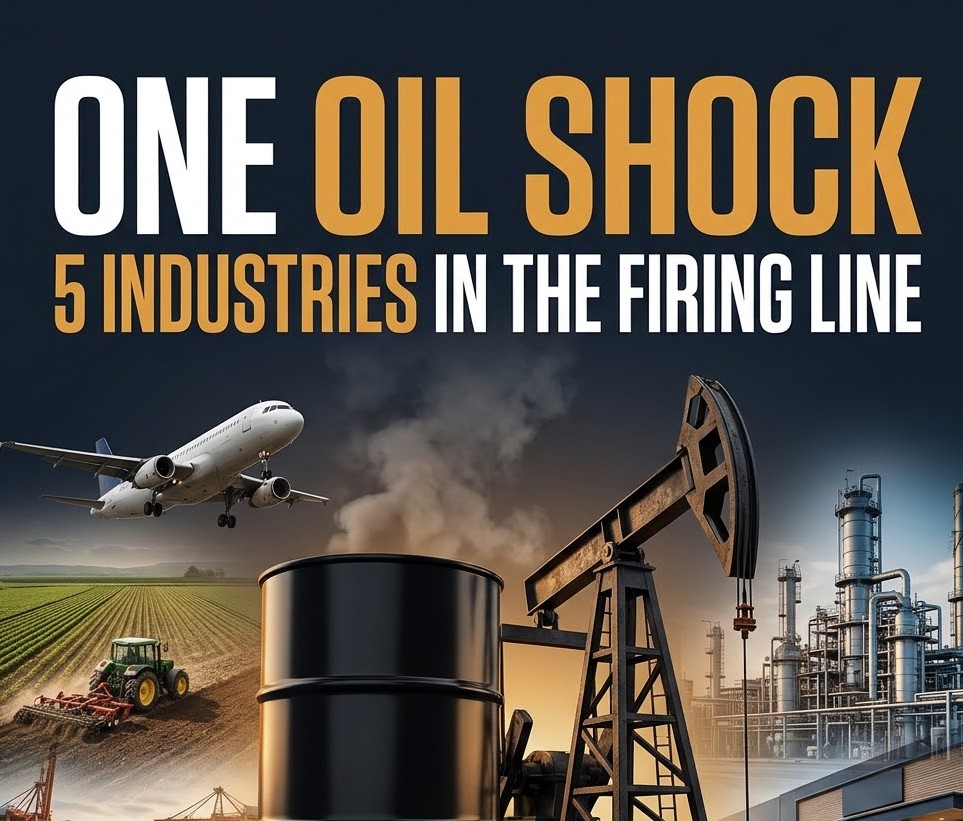
Oil is more than a fuel that powers cars, trucks and airplanes. It is one of the invisible forces holding the global economy together, influencing how food reaches supermarket shelves, how airlines price tickets, how factories manufacture products and how much consumers pay for everyday essentials. When oil prices rise sharply, the consequences rarely remain confined to the energy market. They spread across supply chains, squeeze business margins, influence inflation and eventually reach household budgets around the world.
An oil shock can begin with a geopolitical conflict, an unexpected supply disruption, sanctions, shipping restrictions or growing uncertainty in major oil-producing regions. Whatever the trigger, the economic consequences can travel surprisingly quickly. Businesses that depend on fuel, petroleum-based materials and international transportation suddenly face higher operating costs, while consumers may find themselves paying more for products and services they previously took for granted. The scale of the impact depends on how long prices remain elevated, how much supply is disrupted and whether businesses can pass their additional costs on to customers.
The most important question is not simply how high oil prices might climb, but which industries are most exposed when energy becomes more expensive. Five sectors stand out: aviation, agriculture and food production, logistics and transportation, chemicals and manufacturing, and consumer retail. Each faces a different set of challenges, but they share one underlying vulnerability: when the cost of energy rises, the economics of doing business can change almost overnight.
1. Aviation: When Every Flight Becomes More Expensive
Few industries feel the immediate pressure of rising oil prices as directly as aviation. Jet fuel is one of the largest operating expenses for airlines, making the sector particularly sensitive to sudden changes in energy markets. When crude oil becomes more expensive, jet fuel prices can rise as well, increasing the cost of operating passenger flights, cargo services and international routes. For airlines that already operate with narrow profit margins, even a relatively modest increase in fuel expenses can create a substantial financial challenge.
The difficulty is that airlines cannot always respond by raising ticket prices immediately. Airfares are influenced by competition, passenger demand, seasonality, route capacity and advance bookings. A carrier that increases fares too aggressively risks losing customers to competitors, while one that absorbs the additional fuel expense may protect passenger numbers at the cost of profitability. This creates a delicate balancing act, particularly for budget airlines that depend on high passenger volumes and price-sensitive travellers.
Fuel surcharges and higher ticket prices are among the possible responses, although their use varies by airline, route and market. Carriers may also reduce flight frequencies, reconsider less profitable routes or adjust their schedules to manage expenses. Travellers can feel the impact through more expensive holiday bookings, costlier business trips and fewer affordable options during peak travel periods. Cargo airlines face a similar challenge because higher fuel costs can increase the price of transporting goods across international markets.
The consequences extend beyond airlines themselves. Hotels, tourism operators, airport retailers and travel booking platforms may experience indirect pressure if higher fares discourage discretionary travel. A family planning an international holiday may shorten its trip, choose a closer destination or postpone travelling altogether. Business travellers may switch to virtual meetings where practical. An oil shock, therefore, can become a broader test of demand across the global travel economy, not simply a fuel-cost problem for airlines.
2. Agriculture and Food Production: From Oil Wells to Dinner Plates
Food prices are often discussed in terms of weather, harvests and agricultural output, but energy costs are another important part of the equation. Modern agriculture depends on diesel-powered machinery, irrigation systems, transportation networks, processing facilities and energy-intensive inputs. Oil prices can also influence the cost of producing and distributing fertilisers and other agricultural chemicals, although the relationship differs by product and depends heavily on natural gas, electricity, feedstocks and regional supply conditions.
When fuel becomes more expensive, farmers may pay more to operate tractors, harvest crops and transport produce to storage facilities or markets. Food processors can face higher expenses for manufacturing, refrigeration, packaging and distribution. These additional costs can accumulate at multiple stages of the supply chain before a product reaches a supermarket or restaurant. The effect may be particularly significant for products that require refrigeration, travel long distances or have limited shelf lives.
The impact is not uniform across the agricultural sector. Some farmers may have access to fuel contracts, government support or more efficient equipment that reduces their exposure to sudden price increases. Others, especially smaller producers with limited bargaining power, may have less flexibility to absorb higher operating costs. If energy prices remain elevated, producers may eventually adjust planting decisions, input usage or selling prices, potentially influencing future production and food availability.
For consumers, the result can be a gradual increase in the cost of everyday groceries. Bread, dairy products, packaged foods, fresh produce and processed meals can all be exposed to different combinations of transportation, energy, fertiliser and packaging costs. However, an oil price increase does not automatically translate into an immediate or equal rise in every food price. Harvest conditions, currency movements, retailer contracts, competition and government policies also matter.
The wider concern is the pressure on household purchasing power. When food becomes more expensive at the same time as fuel, electricity or transport costs rise, families have less money available for discretionary spending. Lower-income households are often particularly vulnerable because food and essential expenses account for a larger share of their budgets. In this way, an energy shock can become a cost-of-living challenge with consequences that extend far beyond the agricultural sector.
3. Logistics and Transportation: The Rising Cost of Moving Everything
Global trade depends on the ability to move goods efficiently, whether they travel by road, rail, sea or air. Oil prices influence several of these transportation networks, particularly road freight and maritime shipping, where diesel and marine fuels are essential operating inputs. When fuel costs rise, logistics companies must decide how much of the increase they can absorb and how much they need to pass on to customers. For an industry built around tight delivery schedules, competitive contracts and cost efficiency, that decision can have significant financial consequences.
Road freight operators are often among the first businesses to experience the pressure. Trucking companies must continue paying drivers, maintaining vehicles and meeting delivery commitments even when diesel prices climb. Some contracts include fuel surcharges that allow transport providers to recover part of the increase, but these arrangements may not apply to every customer or shipment. Smaller logistics operators can be particularly exposed when they lack the financial resources, purchasing power or contractual flexibility available to larger competitors.
Shipping companies face a different set of challenges. International maritime trade connects manufacturing centres, distribution hubs and consumer markets across continents, meaning that disruptions to fuel costs or important shipping routes can affect businesses thousands of kilometres away. If an oil shock coincides with geopolitical instability around major maritime chokepoints, the consequences can become more complicated. Longer routes, higher insurance premiums, congestion and additional fuel consumption may compound the original increase in energy prices. The final cost depends on the location and severity of the disruption rather than oil prices alone.
For businesses that depend on international supply chains, higher transportation expenses can make imported materials and finished goods more expensive. Manufacturers may need to reconsider sourcing strategies, while retailers could face longer replenishment cycles or increased inventory costs. Companies that operate on a just-in-time model may be particularly sensitive to unexpected delays because they have less inventory available to cushion disruptions.
The consumer impact is easy to overlook because transportation costs are rarely displayed separately on a supermarket receipt or an online shopping checkout page. Yet moving a product from a factory to a warehouse, from a warehouse to a store and finally to a customer’s home involves multiple stages of distribution. When each stage becomes more expensive, the cumulative pressure can influence final prices, delivery fees and business profitability. In a connected global economy, the cost of moving goods can become just as important as the cost of manufacturing them.
4. Chemicals and Manufacturing: The Hidden Petroleum Connection
Oil is not only a source of energy; it is also a critical raw material for numerous industrial products. Petrochemical manufacturers use petroleum-derived feedstocks to produce materials that eventually become plastics, synthetic fibres, coatings, solvents, adhesives and components used across modern industry. These materials are found in everything from vehicle interiors and electronics to clothing, medical packaging and household appliances. Consequently, a sustained increase in oil prices can influence manufacturing costs even in businesses that do not consume large quantities of fuel directly.
The relationship between crude oil and petrochemical prices is not automatic. Different products rely on different feedstocks, production technologies and regional energy systems. Some manufacturers depend more heavily on natural gas or natural-gas-derived inputs, while others are more directly exposed to petroleum-linked raw materials. Nevertheless, when oil prices increase significantly, producers may face a combination of higher feedstock expenses, more expensive transportation and rising costs across parts of their supply chains.
Consider a company manufacturing plastic packaging. It may need to pay more for certain petroleum-based materials while simultaneously facing higher freight expenses to transport packaging to food producers, cosmetics brands or e-commerce businesses. If the company cannot recover these increases through higher selling prices, its profit margins may narrow. If it raises prices instead, customers must decide whether to accept the increase, negotiate alternative contracts or explore different materials.
The challenge is especially complex for manufacturers operating under long-term supply agreements. Prices may be fixed for a certain period, preventing companies from passing on additional costs immediately. Businesses that purchase materials in advance may initially be protected by existing inventory, but that advantage can disappear when they need to replenish supplies at higher prices. Companies with substantial pricing power may be better positioned to manage the transition, while smaller suppliers may have limited room to manoeuvre.
Manufacturers may respond by improving energy efficiency, redesigning packaging, reducing material waste or negotiating with alternative suppliers. In some circumstances, an oil shock can accelerate investment in recycling, bio-based materials and other alternatives to conventional petroleum-derived inputs. However, replacing established materials requires testing, investment and supply-chain adjustments, so these changes rarely happen overnight.
The broader lesson is that energy prices can affect industrial competitiveness in ways that are not immediately visible. A manufacturer may appear insulated from the oil market because it does not sell fuel, yet its products may depend on petroleum-derived materials at several stages of production. The more interconnected its supply chain, the harder it can be to isolate the financial consequences of a prolonged energy shock.
5. Consumer Retail: When Higher Costs Meet Cautious Spending
Retailers occupy an uncomfortable position during periods of rising oil prices because they can face pressure from both sides of their business. On one side, transportation, warehousing, packaging and distribution become more expensive. On the other, consumers may have less disposable income after paying more for fuel, groceries, heating and other essential expenses. The combination can create a difficult environment for retailers that must protect their margins without making their products unaffordable.
Fashion, beauty, electronics and homeware businesses may experience the effects differently, depending on where their products are manufactured, how far they travel and how much packaging or petroleum-derived material they use. An international fashion brand, for example, may face increased costs associated with transporting garments from manufacturing facilities to distribution centres and retail stores. An electronics company may be exposed to shipping costs, plastic components and packaging expenses. These pressures can occur even when the retail price of the finished product has little direct relationship with the price of crude oil.
Retailers then face a difficult pricing decision. Increasing prices can help recover higher costs, but consumers may respond by delaying purchases, switching to cheaper alternatives or waiting for promotional discounts. Keeping prices unchanged may preserve customer loyalty, yet it can reduce margins if expenses continue to rise. For retailers competing in crowded online marketplaces, even a small price difference can influence purchasing decisions.
Consumer behaviour also tends to change when households become uncertain about the economy. Shoppers may prioritise essentials, compare prices more carefully and reduce spending on non-essential products. Premium purchases, large home upgrades and discretionary fashion spending can become easier to postpone. Discount retailers and value-focused brands may benefit from customers trading down, while businesses that depend on frequent impulse purchases may find demand less predictable.
E-commerce companies are not necessarily protected from these pressures. Online retailers must still pay for warehousing, packaging, fulfilment and last-mile delivery. Free-shipping offers can become more expensive to maintain when transportation costs rise, forcing companies to reconsider minimum order values, delivery fees or promotional strategies. Some businesses may invest in regional fulfilment centres and more efficient delivery routes to reduce their exposure, although these solutions require time and capital.
The pressure can ultimately spread into marketing and business strategy. Retailers may become more selective with advertising expenditure, focus on products with stronger margins and place greater emphasis on customer retention. Brands that understand changing consumer priorities can adapt their product ranges and promotional messages more effectively than those that simply increase prices. In an environment where shoppers are increasingly conscious of value, communicating why a product is worth its price can become as important as the product itself.
The Bigger Picture: An Oil Shock Is More Than an Energy Story
The consequences of an oil shock rarely remain confined to the five industries discussed above. Higher energy prices can influence inflation, business investment, consumer confidence and the direction of monetary policy. If companies across multiple sectors pass higher costs on to customers, overall price pressures may persist for longer. Central banks can then face a difficult balancing act between controlling inflation and supporting economic growth, particularly if households and businesses are already experiencing financial strain.
Oil-importing economies may face additional pressure because more expensive crude increases the amount they must spend on energy imports. Currency movements can amplify the effect when a country’s currency weakens against the US dollar, in which oil is commonly traded. Governments may respond through targeted support, tax adjustments, strategic stock releases or measures designed to reduce energy demand, although the effectiveness and affordability of these policies vary.
Not every oil shock produces the same outcome. A brief increase that quickly reverses may create a temporary cost burden, while a prolonged disruption can force businesses to rethink their operating models. The severity also depends on the initial cause, available inventories, spare production capacity, alternative energy sources and the broader condition of the global economy. Businesses with strong balance sheets, flexible supply chains and diversified energy sources may be better equipped to withstand volatility than companies already operating under financial pressure.
For investors and business leaders, the important task is to look beyond the daily movement in crude prices. Monitoring fuel expenses, freight rates, commodity inputs, inventory levels and consumer demand can offer a clearer picture of where pressure is building. Companies that prepare contingency plans before costs rise may have more options than those that wait until margins begin to deteriorate.
Conclusion: One Shock, Five Industries, One Connected Economy
An oil shock demonstrates how closely the modern economy is connected. Higher fuel prices can raise airline operating expenses, increase the cost of producing and transporting food, strain logistics networks, push up certain manufacturing inputs and challenge retailers already navigating cautious consumer spending. The mechanisms differ from one industry to another, but the underlying problem is similar: businesses must decide how to manage rising costs without losing customers or sacrificing profitability.
The effects are not always immediate, and higher oil prices do not guarantee that every product will become more expensive. Contracts, inventories, competition, government policy and consumer behaviour all influence how the pressure spreads. Yet if energy costs remain elevated for an extended period, the cumulative impact can become difficult for businesses and households to ignore.
Ultimately, the next oil shock will not be measured only by the price displayed on an energy-market screen. It will also be measured by the cost of a plane ticket, the price of groceries, the expense of shipping a container, the profitability of a factory and the amount consumers are willing to spend. That is what makes oil such a powerful economic force: when the cost of energy moves, the consequences can reach almost every corner of the global marketplace.