
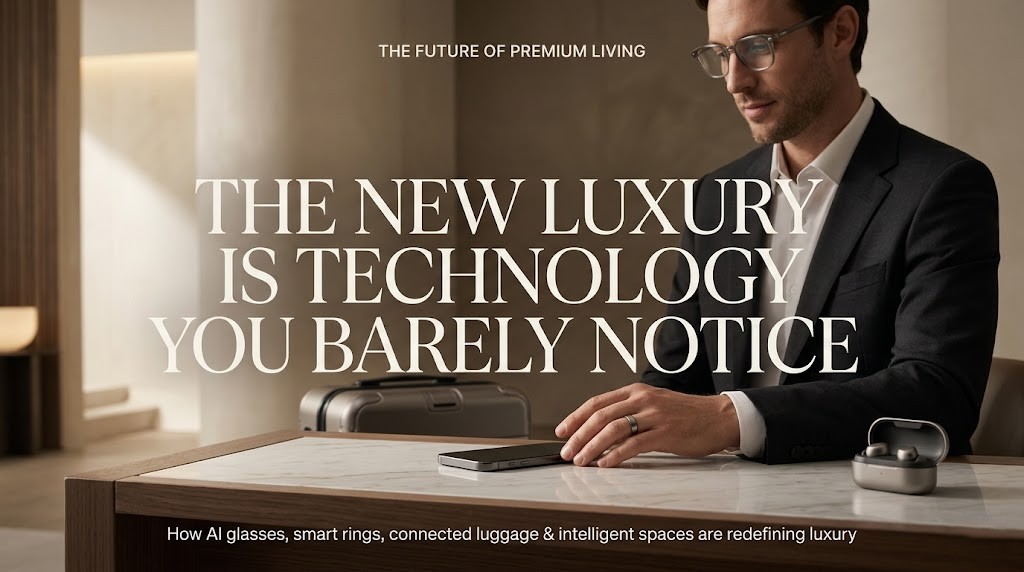
Luxury has always been associated with things people can see: a beautifully tailored suit, a Swiss watch, a designer handbag, or a car that turns heads the moment it arrives. But the meaning of premium living is changing. Increasingly, some of the most luxurious products are the ones that do not demand attention at all. They simply make everyday life easier, smarter, and more seamless.
Think about the difference between carrying a traditional watch and wearing a smart ring that quietly tracks your activity, sleep, recovery, and other personal metrics without putting a glowing screen on your wrist. Or consider glasses that look almost ordinary but can capture photos, play audio, translate information, or connect you to an AI assistant. The technology is there, but it does not necessarily look like technology. That subtlety is becoming part of the appeal.
This is where the idea of “invisible luxury” comes in. The new premium consumer is not always looking for something extravagant. They are often looking for something intelligently designed, beautifully made, and useful enough to become part of their routine without interrupting it.
The New Definition of Premium Living
For years, luxury technology often meant bigger screens, faster processors, more powerful cars, and increasingly complicated features. The message was straightforward: more technology meant more value. Today, the conversation is becoming more nuanced.
A premium product is increasingly judged by how naturally it fits into someone’s life. The best technology may be the technology you stop thinking about after using it for a few weeks.
Apple has demonstrated this idea particularly well with products such as the Apple Watch and AirPods. Neither product fundamentally changed because it looked dramatically futuristic. Their appeal came from how easily they integrated into routines people already had. Checking a notification without reaching for a phone, taking a call while walking, listening to music without dealing with cables—small conveniences gradually became part of everyday behavior.
That is an important shift in luxury. Convenience itself has become aspirational.
AI Glasses Are Making Technology Personal Again
One of the most interesting examples is the rise of AI-powered smart glasses. Products such as Ray-Ban Meta show how technology can move away from screens and into the environment around us.
At first glance, the glasses can look like a familiar pair of Ray-Bans. There is no giant display covering the lens and no obvious futuristic hardware demanding attention. Yet they can connect to a smartphone, capture hands-free photos and videos, play audio, and provide access to AI features.
Imagine walking through Rome and seeing an architectural detail that catches your attention. Instead of pulling your phone out, opening the camera, taking a picture, and putting it away again, you can capture the moment from your own perspective. The experience becomes more natural.
That matters because luxury travel is increasingly about experiences rather than possessions. A traveller does not necessarily want to spend a beautiful afternoon looking down at a phone. Technology that allows people to document, communicate, or access information while remaining present in the moment can feel far more premium than another device demanding their attention.
The interesting part is that the product does not scream “technology.” It looks like eyewear first and technology second.
Smart Rings: The Quietest Wearable
If smart glasses represent technology moving toward the face, smart rings represent technology becoming almost invisible
The Oura Ring is one of the clearest examples of this category. Unlike a smartwatch, it does not place notifications, messages, or a constantly active screen directly in front of you. It looks much closer to a traditional piece of jewellery.
Yet underneath that minimalist exterior is a collection of sensors designed to monitor different aspects of personal health and activity. Users can review information related to sleep, readiness, activity, and other measurements through the accompanying app.
This changes the psychology of wearable technology. Instead of constantly asking the user to interact with the device, the ring quietly collects information and allows the user to review it later.
For a busy executive, frequent traveller, entrepreneur, or professional athlete, that can be more appealing than another screen. The value is not necessarily in showing everyone what the device can do. The value is in giving the wearer information they can use to make better decisions.
That is very close to the traditional philosophy of luxury watchmaking: craftsmanship that does not need to explain itself every second.
Smart Luggage Is Turning Travel Into an Experience
Travel is another area where premium technology is becoming increasingly practica
For frequent travelers, luggage is not simply something that carries clothes. It becomes part of the entire journey—from leaving home to checking in at the airport, moving through security, waiting at the gate, and finally reaching the hotel.
Modern premium luggage brands have experimented with features such as built-in charging systems, tracking capabilities, lightweight materials, compression systems, and increasingly sophisticated organizational designs.
Take a traveller rushing through an airport with a phone battery approaching zero. A suitcase that can provide convenient charging is not necessarily revolutionary technology, but in that particular moment, it can feel invaluable.
The same applies to tracking. Losing luggage is one of the most frustrating travel experiences, particularly when you have a connecting flight or an important meeting waiting at the other end. Technology that helps you locate your belongings turns something that once created uncertainty into something more manageable.
This is an important lesson for luxury brands: the most valuable innovation does not always have to be spectacular. Sometimes it simply removes friction from a stressful moment.
The Luxury Car Is Becoming a Digital Space
The transformation is even more obvious in premium automobiles.
Modern luxury cars from brands such as Mercedes-Benz, BMW, Porsche, and others increasingly function as sophisticated digital environments. The experience is no longer limited to leather seats, powerful engines, or exterior design.
Inside a premium vehicle, software can influence everything from navigation and entertainment to climate control, driver assistance, ambient lighting, and personalized settings. Electric vehicles have pushed this transformation even further because their identities are often closely connected to software and digital interfaces.
Mercedes-Benz, for example, has invested heavily in creating an interior experience where the dashboard becomes a major part of the vehicle’s personality. Large displays, voice interaction, connected services, and personalized controls make the cabin feel closer to a private digital lounge than a conventional car interior.
But the deeper luxury is not necessarily the size of the screen. It is the feeling that the vehicle understands the driver’s preferences and reduces unnecessary effort.
That is where premium technology is heading: personalization without constant manual input.
Luxury Audio Is Becoming About Atmosphere
Sound is another category where technology has quietly changed premium living.
A high-end audio system once meant a dedicated room filled with large speakers and complicated equipment. Today, premium audio can be far more discreet.
Brands such as Bang & Olufsen, Sonos, Bose, and Apple have helped normalize the idea that sophisticated sound can exist throughout a home without making the technology visually dominant.
Imagine entering a hotel suite and having your preferred music automatically continue from your headphones to the room’s audio system. Or walking into your home after work and having lighting, temperature, and music adjusted according to your preferences.
None of these experiences necessarily looks extravagant. Yet they create something luxury has always promised: an environment designed around you.
The product becomes less important than the feeling it creates.
The Smart Home Is Becoming Less “Smart” Looking
The irony of premium smart-home technology is that the best systems may become increasingly difficult to notice.
Early smart-home products often looked exactly like what they were—gadgets. There were screens, flashing lights, cables, sensors, and devices placed around the house.
Modern luxury interiors are moving in another direction. Smart lighting can be integrated into architectural design. Speakers can disappear into ceilings. Climate systems can adjust automatically. Curtains can open based on schedules or environmental conditions. Security systems can work quietly in the background.
For someone staying in a high-end hotel, this is already familiar. Walk into a premium room and the environment may automatically become part of the experience. Lighting creates a particular mood, curtains frame the view, temperature feels comfortable, and entertainment is immediately available.
The technology is successful precisely because the guest does not have to think about it.
Luxury Is Also About Saving Time
Perhaps the most valuable luxury technology provides is not entertainment or status. It provides time.
Consider a founder managing a company, a consultant traveling between cities, or a creative professional balancing several projects. Their most limited resource may not be money. It may be attention.
A device that removes ten small inconveniences from a day can therefore have enormous perceived value.
Noise-cancelling headphones allow someone to work in a busy airport. A smartwatch allows a quick response without opening a laptop. AI assistants can summarize information or help organize tasks. Smart-home systems can automate repetitive actions. Connected travel technology can reduce uncertainty during a journey.
Individually, none of these features sounds extraordinary. Together, they create something increasingly valuable: mental space.
And mental space has become one of the most understated forms of modern luxury.
The Rise of “Quiet Status”
There is also a cultural change happening underneath this technology.
Traditional luxury often relied on visibility. A recognizable logo could communicate status immediately. A luxury car could be spotted from across the street. A designer handbag could signal its brand before the owner even spoke.
Technology is creating another kind of status: quiet status.
A person wearing a minimalist smart ring may not attract attention because of it. Someone using AI glasses may look like they are simply wearing sunglasses. A premium electric vehicle may be almost silent on the road.
But these products communicate something different. They suggest that the owner values design, innovation, convenience, and personalization.
This is particularly relevant to younger affluent consumers, who increasingly associate luxury with experiences, wellness, technology, sustainability, and individuality rather than simply conspicuous consumption.
The question is shifting from “How expensive does this look?” to “How intelligently does this improve my life?”
The Real Future of Luxury Technology
The future may not belong to products that add more screens, buttons, and notifications to our lives. It may belong to products that know when to stay out of the way.
AI glasses could eventually become more useful while becoming visually indistinguishable from ordinary eyewear. Smart rings could become more capable while remaining almost indistinguishable from jewellery. Cars could become increasingly autonomous while requiring less active input from drivers. Homes could respond to their residents without requiring dozens of apps and commands.
That is the paradox of invisible technology: as it becomes more sophisticated, it may become less noticeable.
The most impressive technology of the future might not be the device everyone is talking about. It could be the device you completely forget is there.
So, What Does Luxury Really Mean Now?
Luxury used to be about owning something rare. Then it became about owning something beautiful. Today, it is increasingly about owning something that understands how you live.
A pair of AI glasses that captures a memory without interrupting it. A smart ring that quietly turns personal data into useful insights. A suitcase that makes airport travel slightly less stressful. A car that remembers your preferences. A home that adjusts itself before you even ask.
These products are not luxurious simply because they are expensive. Their appeal comes from the combination of design, intelligence, convenience, and experience.
And perhaps that is where luxury is heading next.
Not louder.
Not bigger.
Not necessarily more visible.
Just smarter, more personal, and remarkably effortless.
The question is no longer whether technology can make life more futuristic.
It is whether it can make life feel better without making itself the center of attention.
Which piece of invisible luxury would you actually bring into your everyday life—AI glasses, a smart ring, smart luggage, or something completely different?