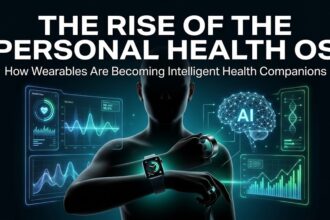
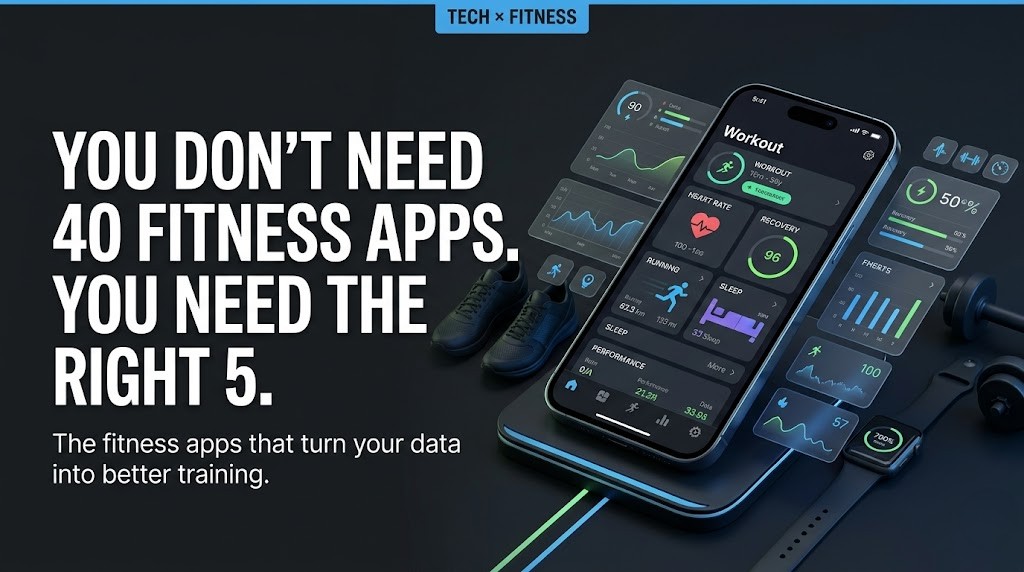
There was a time when getting serious about fitness meant little more than a pair of running shoes, a notebook, and perhaps a stopwatch. Today, your phone can measure your steps, estimate your sleep, track your workouts, monitor your heart rate, count calories, suggest recovery days, and tell you whether yesterday’s training was actually a good idea.
The problem is that more data does not automatically mean better fitness.
In fact, the opposite can happen. Download five different fitness apps and suddenly your attention is divided between calorie targets, readiness scores, exercise streaks, heart-rate graphs, sleep percentages, and notifications reminding you that you have not completed today’s goal. You can become very good at tracking fitness without actually becoming fitter.
That is why the smartest approach is not to find the app with the longest feature list. It is to find a small group of tools that answer the questions you genuinely need answered.
Do you need help becoming stronger? Do you want to understand your running performance? Are you struggling with consistency? Or are you training hard but constantly feeling exhausted?
The right app should solve a problem—not create another dashboard for you to check.
1. Strong — For People Who Actually Want to Understand Their Lifting
Strength training looks simple from the outside. You pick up a weight, perform an exercise, put it down, and repeat.
But progressive strength training is really a long-term experiment.
If you bench press 60 kg today and 65 kg three months later, something worked. The challenge is remembering what happened between those two numbers. How many sets did you perform? How many repetitions? How difficult did the final set feel? What did you do the previous week?
That is where a dedicated strength-training tracker such as Strong becomes useful.
Instead of relying on memory, you can record your exercises, sets, reps, weight and rest periods. Over time, those individual workouts become a record of your progression.
Imagine someone who starts strength training after spending years sitting at a desk. During the first few weeks, they might feel stronger simply because their body is adapting to training. Eventually, however, progress becomes less obvious. They might think they have hit a plateau.
Looking back at their workout history can reveal something different: perhaps their squat has increased steadily, but their upper-body movements have barely changed. Suddenly, the problem is not “fitness isn’t working.” The problem is specific.
That distinction matters.
The best fitness data gives you something you can act on. If your numbers show that your training volume has increased but your performance has stalled for six weeks, you have a reason to reconsider your programme, recovery or nutrition.
The app is not making you stronger.
Your training is. The app simply makes the training visible.
2. Strava — When Fitness Becomes a Social Habit
Some people are motivated by numbers.
Others are motivated by people.
That is part of what makes Strava interesting. It is not simply a place to record a run or bike ride; it turns exercise into something that can have a social dimension.
For a runner, seeing a familiar name appear on a local route can create a surprisingly powerful psychological effect. You might have planned to run 3 km, notice that a friend completed 7 km that morning, and decide to push yourself a little further.
There is also something useful about looking back at your own history. A slow 5 km run that felt disappointing at the time can look completely different six months later when you realise that you have become significantly faster.
That is one of the most overlooked benefits of fitness tracking: perspective.
Consider someone preparing for their first half marathon. Their individual runs will not all feel impressive. Some mornings will involve heavy legs, bad weather or a pace that feels painfully slow. If they only judge themselves by how they felt that day, motivation can disappear.
But six months of recorded activity tells a different story.
The short runs were building consistency. The slower sessions were developing endurance. The longer weekend runs were preparing the body for distance.
The data creates a narrative that emotion alone cannot.
Of course, social features can also become unhealthy when every workout turns into a competition. The goal is not to beat strangers on a leaderboard every week.
The useful question is simpler:
Is the social element making you more consistent, or more anxious?
If it gets you outside when you would otherwise stay on the sofa, it is doing its job.
3. Nike Training Club — For People Who Don’t Know What to Do Next
One of the biggest barriers to exercise is not motivation.
It is uncertainty.
You walk into a gym and see dozens of machines. You open YouTube and find thousands of workout videos. You search for “best leg workout” and suddenly have 17 different opinions about squats, lunges, Bulgarian split squats and whether you should train to failure.
For beginners especially, too much choice can become its own obstacle.
Nike Training Club is useful because it reduces that decision fatigue by offering structured workouts across different goals and fitness levels.
Think about someone who has just started working from home. They know they need to move more, but they do not have a clear exercise routine. Without structure, they might spend Monday searching for a workout, Tuesday skipping it because they are busy, Wednesday trying a random routine and then abandoning the whole idea by Friday.
A guided workout changes the question from:
“What should I do today?”
to:
“Can I give myself 30 minutes?”
That is a much easier decision.
This is particularly valuable for people who do not yet have enough experience to design their own programmes. Over time, they may learn which movements they enjoy, what their body responds to and how much training they can realistically handle.
The best beginner fitness tool eventually becomes something you need less—not because it failed, but because it taught you enough to become independent.
4. MyFitnessPal — When Nutrition Is the Missing Piece
There is an uncomfortable truth about fitness: you can train extremely hard and still struggle to reach your goals if your nutrition consistently works against them.
That does not mean everyone needs to count every calorie forever. It means that understanding what you actually eat can be useful, especially when your expectations and reality are very different.
Consider someone who says, “I barely eat anything, but I’m not losing weight.”
They might genuinely feel that way.
But when they track their meals for a couple of weeks, patterns often become visible. The breakfast may be small, but the afternoon coffee comes with a pastry. Dinner may be reasonable, but weekend meals are much larger. A handful of nuts here, a sugary drink there, and frequent restaurant meals can add up without feeling like a lot of food.
The value of an app such as MyFitnessPal is not that it gives you permission to obsess over numbers.
It gives you information.
That distinction is important.
Someone trying to build muscle may discover that they are consistently under-eating protein. Someone trying to lose weight may realise that their weekday diet is not the problem at all—the weekend is where most of their surplus is coming from.
The data turns vague assumptions into something measurable.
But there is a point where tracking becomes counterproductive. Food is also culture, enjoyment, family, celebrations and social connection. A healthy relationship with nutrition should not require a spreadsheet for every meal.
Use the data to learn your habits.
Then decide how much tracking you actually need.
5. WHOOP — For Those Who Train Hard but Recover Poorly
The most sophisticated fitness plan in the world cannot compensate for poor recovery.
This is where recovery-focused platforms such as WHOOP have become increasingly interesting.
Instead of focusing only on how much exercise you completed, they attempt to provide a broader picture of how your body is responding to training, sleep and daily stress.
Imagine a person who normally goes for a hard run every morning. They sleep badly for several nights because of work deadlines, their resting metrics change, and they wake up feeling exhausted.
Their instinct might be to push harder because they believe consistency means never taking a day off.
But sometimes the more disciplined decision is to slow down.
That could mean replacing a hard interval session with an easy walk, going to bed earlier or simply recognising that recovery is part of training rather than an interruption to it.
This is where wearable data becomes genuinely useful.
Not because a device knows your body better than you do, but because it can highlight patterns that are difficult to notice day to day.
If your sleep quality has been poor for a week and your training performance is dropping, that information deserves attention.
However, recovery scores should not become another source of anxiety. A number on your wrist is an estimate, not a medical diagnosis and not a command.
Your body still gets a vote.
The Bigger Lesson: Data Is Only Valuable When It Changes Behaviour
This is where most fitness apps fail—not technically, but psychologically.
They give us plenty of information and very little interpretation.
You can know that you walked 8,742 steps yesterday. You can know your average heart rate during a run. You can know how many calories you logged. You can know your sleep score.
But what are you going to do with that information?
If the answer is “nothing,” then you are collecting data for entertainment.
The strongest fitness habit is not checking an app every morning.
It is noticing patterns and making better decisions because of them.
Maybe your workout log shows that you perform better when you sleep seven to eight hours. Maybe your running history shows that increasing mileage too quickly leaves you exhausted. Maybe your nutrition tracking reveals that you are not eating enough on training days. Maybe your recovery data shows that your body needs more rest than your ego wants to admit.
Those insights are valuable.
The individual numbers are not.
The Five-Question Test
Before downloading another fitness app, ask yourself five questions.
What am I trying to improve?
What information would help me improve it?
Will I actually use that information?
Does this app make my routine easier or more complicated?
And most importantly: Will the data change what I do tomorrow?
If you cannot answer that last question, you probably do not need the app.
Fitness technology has reached an interesting point. We no longer have a shortage of information. We have a shortage of attention.
The future of personal fitness is therefore unlikely to belong to the person with 40 apps installed on their phone. It belongs to the person who understands which few numbers actually matter to them—and ignores the rest.
Because the goal was never to build the perfect fitness dashboard.
The goal was to build a healthier body, a stronger routine and a lifestyle you can actually maintain.
Track less. Understand more. Train better.