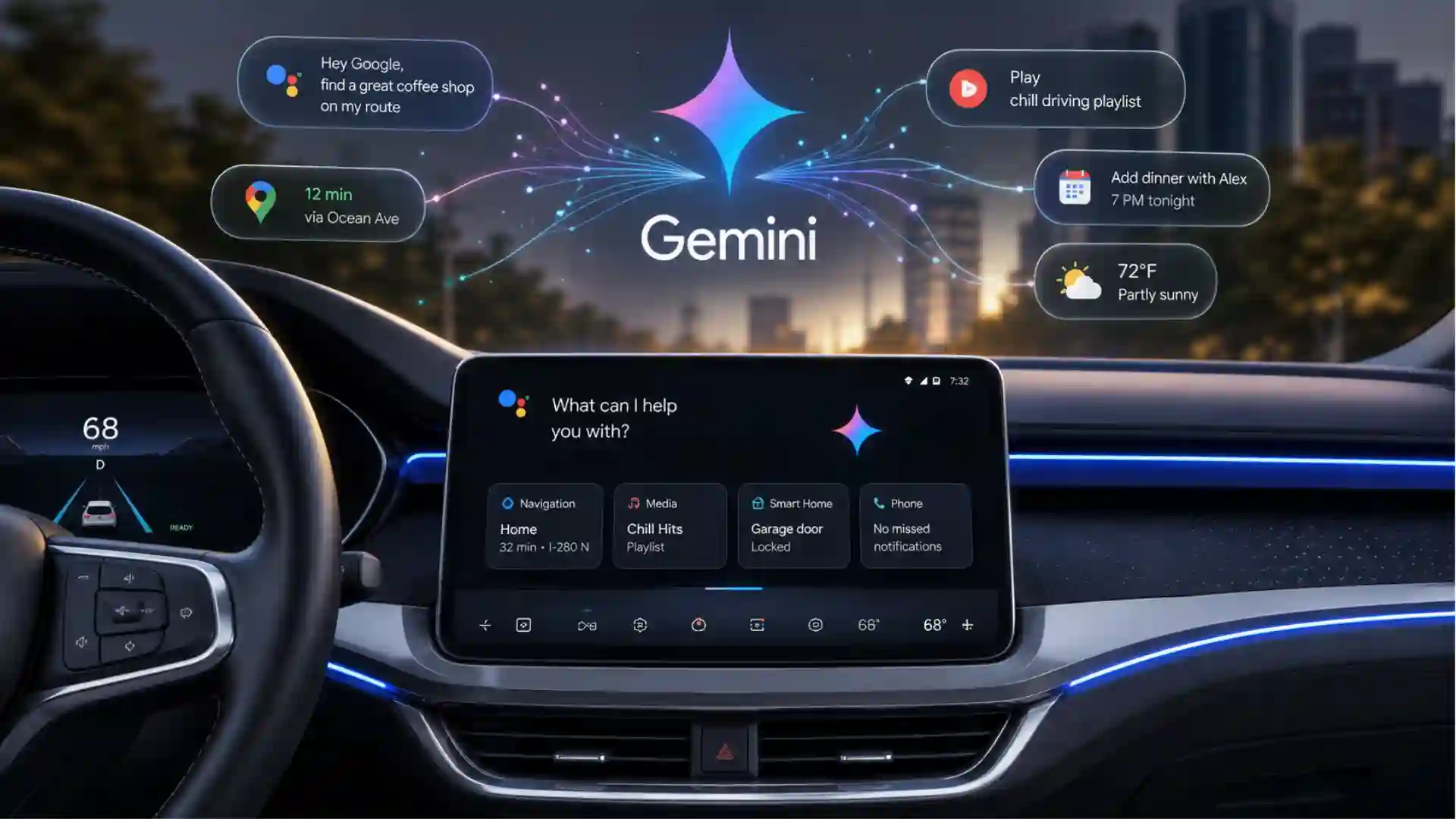
Imagine asking your car to find a restaurant that suits your taste, locate a flight confirmation buried in your email, or guide you to a place you saved in a photograph all through a natural conversation. That is the experience Google wants to bring to the road with Gemini.
Your car’s voice assistant has traditionally been good at a few basic tasks: playing music, making calls, and finding directions. But what happens when you want something more complicated? Perhaps you need to find a coffee shop along your route, check whether a flight is delayed, or remember the name of a restaurant someone recommended last week. Until now, those tasks often meant switching between apps, searching through messages, or asking several separate questions. Google is aiming to change that experience by bringing its Gemini AI assistant deeper into the driving environment.
As of October 20, 2026, Google has announced the global availability of Gemini in Android Auto and cars with Google built-in, alongside the rollout of Personal Intelligence, a feature designed to make the assistant’s responses more relevant to individual users. With permission, Gemini can draw on information from supported Google services to answer questions that require more than a standard search. The result is a move towards a more conversational, context-aware driving companion rather than a voice assistant that simply reacts to fixed commands.
From Voice Commands to Natural Conversations
For years, in-car voice assistants have promised hands-free convenience, but the experience has often depended on knowing the right phrase or issuing one instruction at a time. Drivers might ask for directions, request a song, or make a call, but more nuanced requests could quickly become frustrating. Gemini introduces a more conversational approach, allowing users to explain what they need in everyday language and follow up with additional questions without necessarily starting the interaction from scratch.
Imagine driving through an unfamiliar city and deciding to stop for lunch. Instead of searching through a list of restaurants, you could ask Gemini to find a highly rated place along your route with outdoor seating and vegetarian options. You could then ask about parking or whether the restaurant requires a significant detour. Rather than treating every request as an isolated command, the assistant is designed to handle a more natural exchange that reflects what you are trying to accomplish. Google has previously demonstrated conversational navigation, messaging, and music controls through its Android Auto experience.
This change may sound subtle, but it reflects a much larger shift in how people interact with technology. The goal is no longer simply to put a digital assistant on a dashboard. It is to make that assistant better at understanding context, interpreting multi-step requests, and helping drivers complete everyday tasks without repeatedly reaching for their phones. If the experience works reliably, it could make voice interaction feel less like operating a machine and more like speaking to a capable digital companion.
The Biggest Upgrade: Gemini Can Use Your Personal Context
The most interesting part of Google’s latest announcement is Personal Intelligence. With the user’s permission, this feature can connect Gemini to supported Google services, including Gmail and Google Calendar, Google Photos, Google Maps, YouTube, and Search. This gives the assistant access to relevant information that a conventional navigation system might not know, potentially allowing it to answer questions by combining details from different sources rather than relying exclusively on a fresh web search.
Consider a common airport journey. You might know which airport you are heading to but have forgotten your flight details. Instead of opening Gmail to search for the booking confirmation and then checking another service for updates, you could ask Gemini to find your flight gate and check whether the flight is on time. The assistant can attempt to retrieve the relevant details from your connected information and respond in one conversation. That is the difference between an assistant that simply searches the internet and one that can help you make sense of information already associated with your day.
Personal context could also make navigation more useful during road trips. Perhaps you photographed a car wash last week but never saved its address, or a friend recommended a coffee shop during a conversation the previous evening. You may remember the photograph or the discussion but not the business name. With the appropriate connected information, Gemini is designed to help retrieve those details and navigate to the relevant location. Instead of manually searching your camera roll, messages, and saved places, you can describe what you remember and let the assistant help connect the pieces
This is where AI-powered navigation becomes more interesting than simply finding the fastest route. The system starts to understand the relationship between a destination, a user’s preferences, and the information they have already encountered. It is an early example of how personal AI assistants could reduce the small but constant friction of everyday digital life.
Smarter Navigation That Understands What You Actually Want
Google Maps has long been central to the connected-car experience, but Gemini could make the process of choosing where to go more flexible. A traditional navigation search usually begins with a destination or category, such as a petrol station, restaurant, or charging point. A conversational assistant can potentially handle a more detailed request, combining several preferences into a single instruction and allowing the driver to refine the result through follow-up questions.
For example, someone on a long drive might want a quick meal without leaving the highway for too long. Another driver might prefer a quiet café near a charging station, while a family could be looking for a restaurant with outdoor seating and options for different dietary preferences. Instead of searching separately for each requirement, the user can explain the situation and ask Gemini to suggest suitable stops. The assistant can use available information from Google Maps to help identify relevant options, although drivers should still confirm the details before committing to a route.
Personal Intelligence adds another layer to this experience by allowing recommendations to draw on preferences or details from supported connected services. Someone who regularly looks for vegetarian restaurants, for instance, may find a personalised request more useful than a generic list of nearby dining options. The appeal is not simply that the assistant can return information faster; it is that it may be able to narrow down the information to something more relevant to the person asking.
There are practical limits, of course. Restaurant information can change, road conditions can shift, and an AI-generated response is not a guarantee that a business is open or that a route is ideal. Drivers should continue to use their judgement, follow road signs, and prioritise safe driving. Gemini is best understood as an additional layer of assistance, not an infallible replacement for attention or common sense.
Your Emails, Calendar and Photos Could Become Part of the Journey
The connected-car experience is gradually moving beyond navigation and entertainment. Many drivers already rely on digital calendars, booking confirmations, saved locations, and personal photographs to organise their lives. Yet accessing that information while travelling can be inconvenient, particularly when it involves switching between applications on a phone. Gemini’s Personal Intelligence feature is designed to make relevant information easier to retrieve through voice interaction, provided the user has enabled the necessary connections.
Picture a morning when you are running late for an appointment. You may remember the meeting but not the exact address, or perhaps the location was shared in a calendar invitation several days earlier. A conversational assistant could help retrieve the relevant information and guide you towards the destination. Similarly, someone travelling for work might need to find a hotel address from an email or recall the name of a place saved on Google Maps. Instead of navigating several apps manually, the driver can describe what they need and ask Gemini to help.
These capabilities point towards a broader idea: a car that understands the journey in the context of the rest of your day. The destination is no longer just a point on a map. It may be connected to a meeting, a reservation, a photograph, a flight, or a conversation that happened earlier. Bringing those pieces together could make the vehicle’s digital interface considerably more useful for people whose routines already revolve around connected services.
However, the experience depends on which apps are connected, what permissions are enabled, and whether the relevant information is available. Personal Intelligence is not a licence for the assistant to know everything automatically. Users need to choose which services they want to connect, and the feature’s availability depends on account eligibility and rollout conditions.
Gemini Could Make Long Drives More Engaging
A journey is not always about getting somewhere as quickly as possible. Long road trips can leave drivers with hours of open road, unfamiliar landscapes, and questions about the places they pass. Google has also introduced Gemini Live as a conversational experience that can support open-ended discussion, brainstorming, and learning. In the car, that creates possibilities beyond asking for a destination or changing a playlist.
Imagine driving through a historic town and wanting to understand why it became famous. You could ask Gemini for a brief overview, then follow up with questions about a landmark or an interesting person connected to the area. If you are planning a weekend getaway, you might ask for ideas for scenic stops, outdoor activities, or places worth exploring near your destination. The appeal is that a conversation can develop naturally, allowing curiosity to guide the discussion instead of forcing every question into a separate search.
Entertainment is another part of the connected-car experience. Drivers can use voice requests to find music by mood, genre, or occasion, rather than remembering an exact station name or playlist title. Asking for upbeat music for a mountain drive, for example, is more natural than navigating several menus to find the right soundtrack. Gemini’s broader conversational approach could make these interactions feel more flexible, particularly when the user wants to refine a request after hearing the first result.
Safety remains essential, however. A conversation with an AI assistant should never become a distraction that takes attention away from traffic. The most valuable interactions will be those that can be completed through concise voice exchanges, with visual complexity kept to a minimum while the vehicle is moving. The technology should make driving more convenient, not encourage drivers to multitask in ways that increase risk.
Android Auto vs Cars With Google Built-In: What Is the Difference?
Although the two experiences may look similar on a dashboard, Android Auto and cars with Google built-in work differently. Android Auto connects a compatible Android phone to a vehicle’s infotainment system and projects supported apps onto the car display. Cars with Google built-in, by contrast, integrate Google’s automotive software directly into the vehicle, allowing supported services such as Google Maps and Gemini to run through the car’s own system rather than relying on the same phone-projection model. Google has continued to develop both platforms as part of its wider connected-car strategy.
For Android Auto users, the latest announcement brings Gemini’s personalised capabilities into the phone-connected driving experience. For vehicles with Google built-in, Google says Personal Intelligence will arrive over the coming months. That distinction matters because the availability and timing of features may vary according to the type of system installed in the car, software updates, account settings, and regional support. A vehicle that supports Android Auto does not necessarily have the same integrated capabilities as a car equipped with Google built-in.
Drivers should therefore avoid assuming that every car will receive every feature at the same time. Before expecting Gemini to work in a particular vehicle, it is worth checking the car’s infotainment compatibility, the current software version, and Google’s latest availability information. The broader direction is clear, but the actual experience will depend on the hardware and services available in each vehicle.
Privacy and Reliability: The Questions Drivers Should Ask
The more personal an AI assistant becomes, the more important it is to understand what information it can access. Connecting Gmail, Calendar, Photos, Maps, and other services can make Gemini more useful, but it also means users should pay attention to permissions and account settings. Google says the relevant apps are not connected to Personal Intelligence until the user chooses to enable the feature, and the connections can be turned off in Gemini settings. In cars with Google built-in, personalised responses also depend on the phone being connected to the vehicle. <Cite refs={[“turn189099view0”]}/>
For drivers, the practical approach is to connect only the services they genuinely want to use and review those settings periodically. People who prefer not to link their personal information can still use standard driving features, including navigation, music, calls, and general questions, although the answers will not be personalised in the same way. That choice is important because convenience should not require every user to adopt the same level of data sharing.
Accuracy is another consideration. AI systems can misunderstand requests, provide incomplete answers, or retrieve information that needs verification. A flight detail, business address, or navigation suggestion should not automatically be treated as correct simply because it came from a conversational assistant. Users should confirm important information whenever possible, particularly when a mistake could lead to a missed connection, an unnecessary detour, or a safety issue.
There is also the question of regional availability. Google’s October 2026 announcement describes Gemini as globally available in cars, but Personal Intelligence has its own eligibility and rollout conditions. Google says its initial rollout applies to eligible personal Google accounts belonging to users aged 18 or older, while excluding the European Economic Area, Switzerland, the United Kingdom, and Nigeria at this stage. Business, enterprise, and education accounts are also excluded from that Personal Intelligence rolloutAs a result, individual features may not be accessible to every driver, even where Gemini itself is available.
The Future of Connected Cars Is Becoming More Personal
The arrival of Gemini in cars reflects a larger change in automotive technology. Vehicle software is increasingly expected to evolve after purchase, with navigation, entertainment, voice assistance, and other digital services improving through updates. The car is becoming more than a machine that transports people from one place to another; it is also turning into a connected interface that links everyday routines, personal information, and digital services.
For automakers, more capable AI assistants could become an important part of the ownership experience. For drivers, the potential benefit is straightforward: fewer steps to find information, more natural voice interactions, and recommendations that better reflect the journey they are taking. Yet the real measure of success will not be how impressive an AI demonstration looks. It will be whether the assistant works consistently, protects user choice, and helps people stay focused on the road.
Google Gemini is not transforming every car into a self-driving vehicle, nor does its arrival mean that drivers can stop paying attention to navigation or traffic. It is an upgrade to the way people interact with their vehicle’s digital services. By combining conversational AI with maps and, where enabled, personal context from connected Google apps, Google is trying to make the driving experience more intuitive and less dependent on manual searching.
The most meaningful change may be that drivers will no longer need to think so carefully about how to phrase a command or which app contains the information they need. They can simply explain the task and let the assistant help. If Google can deliver that experience reliably while keeping privacy and road safety at the centre, Gemini could become one of the more useful upgrades to the modern connected car not because it makes the dashboard more complicated, but because it makes everyday interactions feel simpler.
The bottom line: Google Gemini is bringing conversational AI and personalised assistance deeper into the car. The promise is not just smarter voice commands, but a driving experience that can better connect your route, your preferences, and the information you already use. How useful it becomes will depend on compatibility, availability, accuracy, and the choices drivers make about their data.