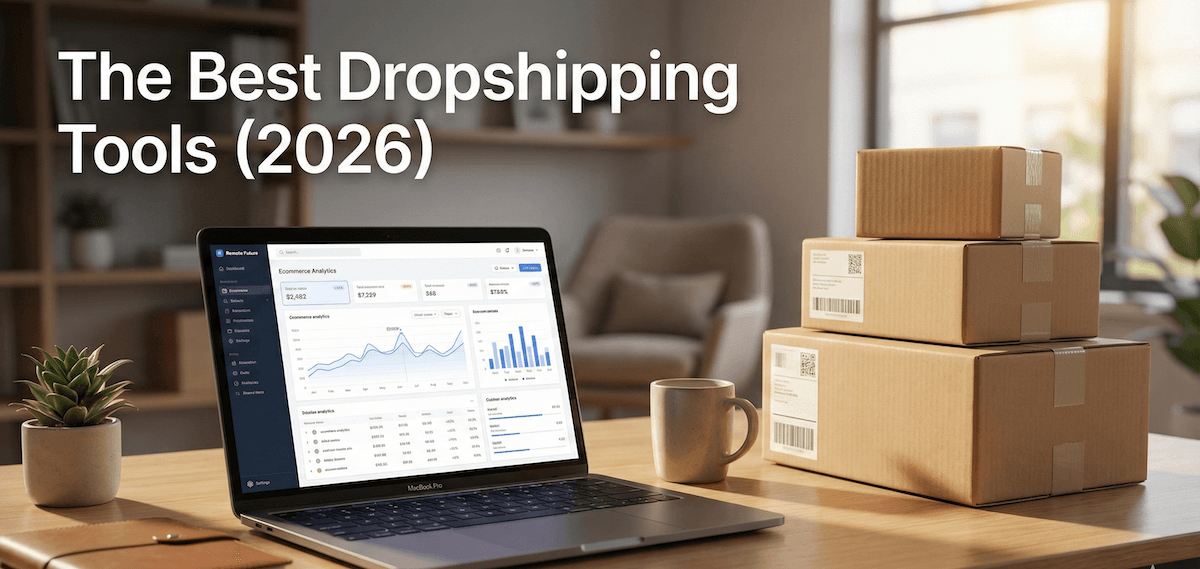
Dropshipping has changed. A few years ago, starting a store could mean spending hours searching for products, comparing suppliers, copying product details, placing orders manually, and tracking shipments one by one. In 2026, that approach is increasingly difficult to sustain. The competitive advantage is no longer simply finding a product that looks promising; it is building a system that can identify opportunities, manage suppliers, automate repetitive work, and deliver a reliable customer experience.
That is where dropshipping tools come in. The right software can connect your ecommerce store with suppliers, synchronize inventory, automate order processing, update tracking information, and make product research considerably faster. Shopify’s current 2026 guidance also highlights automation as a major part of modern dropshipping, particularly around sourcing, inventory management, fulfillment, and tracking.
But there is a catch: having more tools does not automatically make a dropshipping business better. Too many subscriptions can eat into margins, while overlapping platforms can make your workflow unnecessarily complicated. The smarter strategy is to choose tools based on the exact problem they solve.
Here are five dropshipping tools worth considering in 2026, each with a distinct role in building a more efficient ecommerce operation.
1. DSers — Best for AliExpress Dropshipping
If AliExpress remains an important part of your sourcing strategy, DSers is one of the most practical tools to have in your stack. It is the official AliExpress partner for Shopify and is designed around the operational problems that appear when a store starts handling multiple products and order
The biggest advantage is bulk order processing. Instead of opening individual supplier pages and manually placing every order, merchants can process multiple orders through a single workflow. DSers also helps compare suppliers, import products, and synchronize tracking information, making it particularly useful for entrepreneurs who want to build a store around the AliExpress ecosystem without turning fulfillment into a daily administrative task.
Its Supplier Optimizer is another useful feature because supplier selection can have a major impact on profitability. A product may look attractive at one price, but shipping costs, supplier reliability, processing time, and product quality can completely change the economics. DSers gives sellers a more structured way to compare those options before committing.
For beginners, DSers is also appealing because it has a free plan, while paid plans are available for stores that need greater capacity. Shopify’s 2026 overview lists DSers as a strong option for AliExpress sourcing, bulk ordering, and supplier management
Best for: Beginners, AliExpress-focused stores, and merchants handling growing order volumes.
Why it matters in 2026: Automation reduces repetitive fulfillment work, allowing sellers to spend more time on product positioning, advertising, customer experience, and brand building.
2. AutoDS — Best for All-in-One Automation
AutoDS takes a broader approach. Rather than focusing primarily on one supplier ecosystem, it positions itself as an all-in-one platform covering product research, importing, pricing, fulfillment, and tracking.
That makes it particularly interesting for entrepreneurs who want to reduce the number of separate tools in their workflow. According to AutoDS, the platform provides access to a large product database, product research capabilities, automated fulfillment, tracking updates, and pricing optimization.
The appeal is simple: automation becomes more valuable as your store grows. Manually checking whether a supplier has changed a product’s price is manageable with ten products. It becomes a completely different problem when you have hundreds of listings across several suppliers. The same applies to inventory and order tracking.
AutoDS is also built with multi-platform selling in mind, which can make it more attractive to sellers who do not want their entire business tied to one sales channel. Shopify’s 2026 dropshipping guide also lists AutoDS among the tools capable of importing products from multiple marketplaces and automating fulfillment and tracking
However, all-in-one does not mean automatically better for everyone. If you are running a small test store with only a handful of products, paying for a large automation ecosystem may be unnecessary. The value becomes clearer when the amount of operational work starts increasing.
Best for: Growing stores, multi-supplier businesses, and entrepreneurs who want deeper automation.
Why it matters in 2026: The less time a seller spends on repetitive operational tasks, the more time can be invested in marketing, creative testing, customer retention, and growth.
3. Spocket — Best for US and European Suppliers
Speed has become an increasingly important part of ecommerce. Customers have become accustomed to knowing when their order will arrive, and long or uncertain delivery windows can create friction at checkout.
Spocket addresses this issue by focusing heavily on suppliers in markets such as the US and Europe. Shopify’s 2026 research notes that Spocket is designed for US- and EU-focused catalogs where faster shipping and branded invoicing can be important advantages.
This makes Spocket particularly relevant for sellers targeting customers in North America and Europe. Instead of building a store entirely around products that may take weeks to arrive, merchants can explore suppliers positioned closer to their primary customer markets.
Spocket also supports automatic inventory updates and Shopify integration, helping reduce one of the classic dropshipping problems: selling an item that is no longer available from the supplier. Its current Shopify listing highlights US and European suppliers, automated product importing, inventory synchronization, branded invoicing, and AliExpress integration
There is another reason Spocket can be useful: branding. In a crowded dropshipping market, simply offering a product is rarely enough. A cleaner supplier experience, consistent product presentation, and branded invoices can help a store feel more like a real ecommerce brand rather than a temporary product-testing website.
Best for: US and European markets, faster-shipping strategies, and stores focused on building a more polished customer experience.
Why it matters in 2026: Delivery experience is becoming part of the brand. A great advertisement cannot compensate for an unreliable fulfillment experience.
4. Zendrop — Best for a Simplified Dropshipping Experience
Zendrop takes a more beginner-friendly approach to the dropshipping ecosystem. Its platform combines product discovery, sourcing, fulfillment, ecommerce integration, and additional resources designed to help merchants get a store operational without stitching together too many separate services.
Its current platform highlights product discovery, sourcing products from across the internet, print-on-demand customization, and US warehousing
That combination can be valuable for sellers who are more interested in building a brand than learning the technical details of supplier management. A modern dropshipping business is not just about finding a product and adding a markup. Merchants increasingly need to think about product pages, positioning, creative assets, fulfillment, customer expectations, and repeat purchases.
Zendrop’s US warehousing option is especially relevant for businesses targeting American customers. Faster domestic fulfillment can make a meaningful difference when competing against stores offering similar products.
The platform also provides tools aimed at making the initial setup easier, including AI-assisted store creation and product discovery. That does not mean the software can replace strategic thinking. A beautifully generated store will not automatically produce sales. Product-market fit, advertising, pricing, creative quality, and customer trust still determine whether a business succeeds.
Best for: Beginners, US-focused sellers, branded ecommerce concepts, and entrepreneurs looking for a simpler operational setup.
Why it matters in 2026: Technology can shorten the distance between an idea and a functioning store, but the winning advantage remains how well the seller understands the customer.
5. Shopify — The Foundation Behind Your Dropshipping Stack
A list of dropshipping tools would be incomplete without the ecommerce platform that holds the entire operation together. Shopify is not a traditional supplier marketplace, but it can act as the central infrastructure connecting your store, payment system, product catalog, apps, analytics, marketing tools, and fulfillment workflow.
Shopify’s own 2026 guidance emphasizes that merchants can combine dedicated dropshipping applications with Shopify Flow and other integrations to automate different parts of the business. These workflows can include supplier routing, inventory management, fulfillment, marketing, and customer service.
That ecosystem is important because successful dropshipping rarely depends on one application. Think of your business as a machine. A sourcing tool finds the products. A fulfillment system handles orders. Your analytics show what customers are doing. Your advertising platform brings traffic. Shopify becomes the central storefront where those pieces come together.
The platform also offers Shopify Collective for eligible merchants, allowing stores to source products from other Shopify brands with features such as inventory synchronization and automated order routing
For someone building a long-term ecommerce brand, this broader ecosystem can be more valuable than choosing a tool simply because it has the largest product catalog.
Best for: Entrepreneurs building a scalable ecommerce store and merchants who want one central platform for their technology stack.
Why it matters in 2026: The strongest dropshipping businesses are increasingly becoming ecommerce brands, not just product-reselling websites.
How to Choose the Right Dropshipping Tool
The biggest mistake beginners make is choosing software based on the number of features rather than the problem they actually need to solve.
If your business is centered on AliExpress, DSers may be enough to handle sourcing and fulfillment. If you need broader automation across suppliers, AutoDS may make more sense. If shipping speed in the US or Europe is central to your proposition, Spocket or Zendrop could be more relevant. And if you are building the entire store infrastructure, Shopify should sit at the center of the system.
Cost also deserves more attention than it usually gets. A $20 or $40 monthly subscription may seem insignificant, but several subscriptions can quickly become a meaningful fixed expense. The right question is not simply, “How much does this tool cost?” It is, “How much time, operational work, or revenue does this tool help me create or protect?”
Inventory synchronization is another critical factor. Selling a product that has suddenly gone out of stock can create cancellations, refunds, disappointed customers, and unnecessary support requests. Modern dropshipping software increasingly addresses this problem through automated inventory and price updates
Finally, consider your customer before choosing your supplier. A product that takes three weeks to arrive may be acceptable in one market and completely uncompetitive in another. Your supplier strategy should follow your target customer, not the other way around.
The Bottom Line
Dropshipping in 2026 is less about finding a secret product and more about building an efficient commercial system. The tools above solve different pieces of that system: DSers simplifies AliExpress operations, AutoDS focuses on broader automation, Spocket emphasizes US and European suppliers, Zendrop offers a streamlined sourcing and fulfillment experience, while Shopify provides the foundation that connects the entire store.
The best setup is rarely the one with the most software. It is the one where every tool has a clear purpose.
As ecommerce becomes more automated, the technology itself will become easier to access. That means the real differentiator will move somewhere else: product judgment, brand positioning, customer understanding, creative execution, and the ability to turn a simple transaction into a reason for someone to come back.
“In 2026, the smartest dropshippers won’t be the ones doing more work—they’ll be the ones building systems that make better work possible.”