Managing leads sounds simple until a business starts receiving hundreds of enquiries every week. Sales teams have to respond to prospects, update customer records, send follow-ups, qualify potential buyers, prepare reports and keep track of conversations across multiple platforms. The problem is not always a lack of effort. More often, it is the amount of repetitive work competing for the same limited hours.
This is where AI and business automation are changing the way companies manage their sales processes. Instead of asking employees to manually complete every routine task, businesses can use automation to handle repetitive activities while their teams focus on conversations, strategy and customer relationships.
The real opportunity is not to replace people. It is to remove the unnecessary work that prevents people from doing their best work.
From automated lead qualification to personalised follow-ups, modern AI tools can help businesses respond faster, organise customer information and reduce the number of prospects that disappear simply because nobody followed up at the right time.
Here are five practical AI automation ideas businesses should consider.
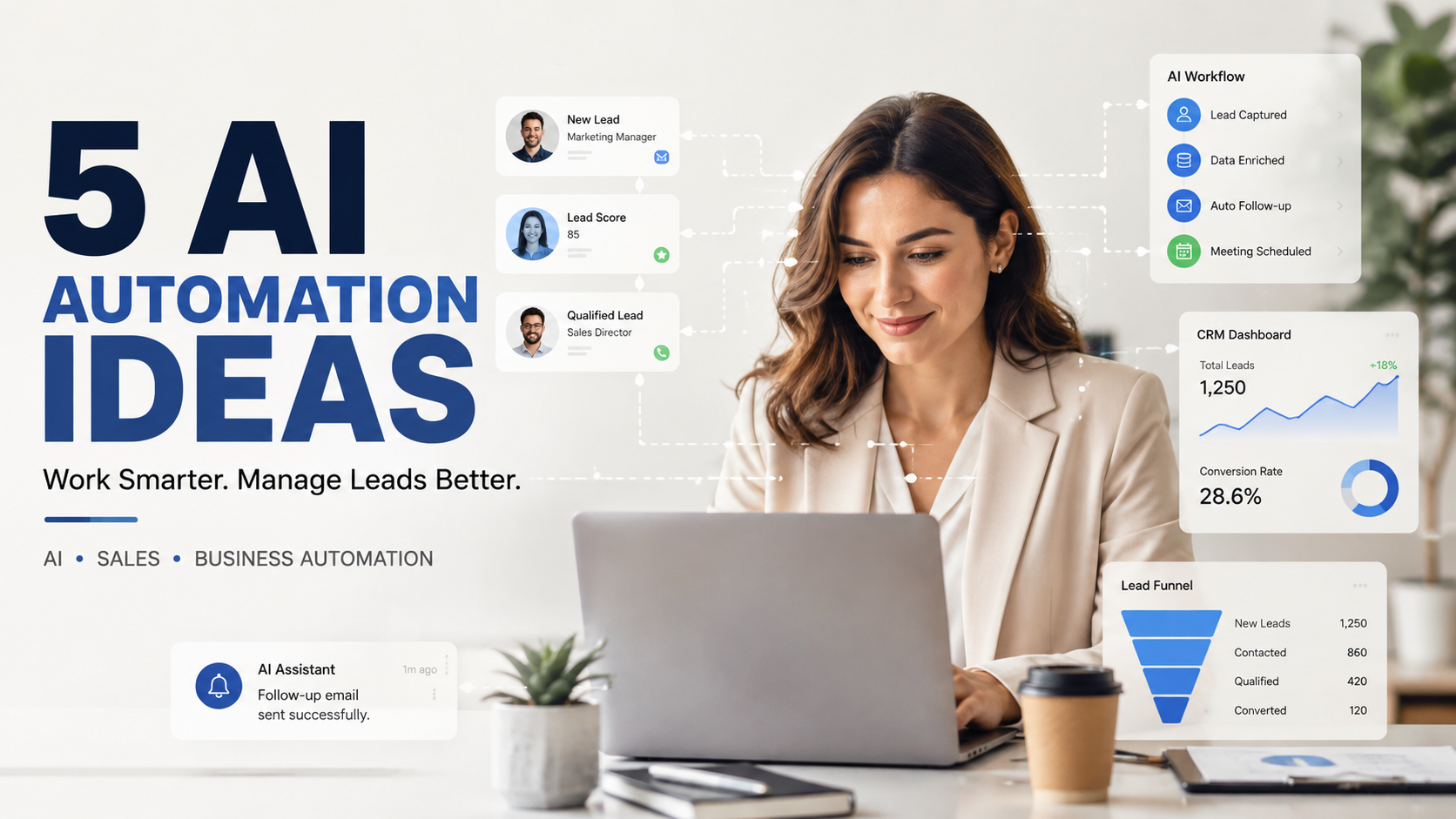
1. Automate Lead Qualification Before Sales Teams Get Involved
Not every lead deserves the same level of attention. A company may receive enquiries from serious buyers, casual visitors, existing customers, students, competitors and people who are simply exploring their options. Expecting a sales representative to manually examine every enquiry can quickly become inefficient.
AI-powered lead qualification can help businesses identify which prospects are most likely to become customers.
Instead of treating every lead equally, an automated system can examine information such as the customer’s industry, company size, location, previous interactions, product interest and engagement with emails or websites. Leads can then be categorised according to their potential value or buying intent.
For example, imagine a software company receiving 500 enquiries every month. A salesperson could spend hours sorting those leads manually. An automated system can perform the first layer of analysis almost instantly, allowing the sales team to concentrate on prospects that demonstrate stronger buying signals.
This does not mean AI should make every final sales decision. Human judgement still matters, particularly when the product is expensive or the customer relationship is complex. Automation simply ensures that valuable information is surfaced before it gets buried inside a spreadsheet or CRM.
The result can be a much more efficient sales process: fewer hours spent sorting leads and more time spent actually selling.
2. Use AI to Personalise Follow-Ups at Scale
Following up with leads is one of the simplest ideas in sales and one of the easiest things to neglect.
A prospect might download a report today, receive a product demonstration next week and then disappear from the sales team’s radar. The salesperson may be busy with another client, forget to send the promised message or simply lose track of the conversation.
Automation can make this process far more consistent.
AI tools can help businesses create follow-up messages based on where a prospect is in the customer journey. Someone who has requested pricing should not receive the same message as someone who has only visited a blog post. Personalisation makes the communication more relevant without requiring employees to write every message from scratch.
Consider an online education company. A potential student who has looked at a particular course several times could receive a message addressing that specific course, while someone who has only subscribed to the company’s newsletter might receive educational content designed to build awareness.
The difference is subtle but important.
Automation should not make communication feel robotic. The goal is actually the opposite: use technology to give businesses enough time to create more meaningful interactions.
As marketing technology continues to develop, the strongest businesses will not necessarily be those sending the most messages. They will be the ones sending the most relevant message at the right moment.
3. Let AI Handle Repetitive CRM Updates
One of the least glamorous parts of sales is also one of the most important: keeping customer information accurate.
Sales representatives often have to update CRM records after meetings, add notes from conversations, change lead stages and record follow-up dates. None of these tasks are particularly difficult, but they consume valuable time when repeated hundreds of times.
This is an ideal area for automation.
AI can assist with turning conversations, emails and meeting information into structured CRM data. Instead of manually entering every detail after a meeting, a salesperson can review automatically generated notes and confirm the relevant information.
For a growing business, this can make a significant difference.
Imagine a sales representative completing six customer calls in a day. If each call requires another 15 minutes of administrative work, the business is losing 90 minutes every day from one employee alone. Multiply that across a sales department and the hidden cost becomes much larger.
The benefit is not simply saving time. Better CRM data can also improve decision-making.
When sales managers can trust their dashboards and customer records, they can identify bottlenecks, understand conversion rates and see where prospects are dropping out of the sales funnel.
In other words, automation can turn CRM management from an administrative burden into a more useful source of business intelligence.
4. Build an AI-Powered Customer Response System
Speed matters when someone is interested in a product.
A potential customer who sends a question at 11 p.m. may not expect an employee to respond immediately. However, they may still expect the business to acknowledge their enquiry and provide useful information.
AI-powered chatbots and automated response systems can bridge that gap.
A well-designed system can answer common questions, provide product information, collect basic customer details and direct more complex enquiries to the appropriate employee. This allows businesses to remain responsive without requiring their teams to be available around the clock.
The key phrase here is well-designed.
Customers quickly become frustrated when chatbots are unable to understand simple questions or repeatedly provide irrelevant answers. Automation should therefore be designed around actual customer needs rather than implemented simply because AI is popular.
For example, an e-commerce company could automate responses about delivery times, return policies, product availability and order status. A human support representative can then focus on unusual problems that require empathy, judgement or negotiation.
This creates a useful division of labour.
Machines handle predictable questions. People handle situations where human understanding matters.
That approach can improve efficiency without making the customer experience feel impersonal.
5. Use AI to Turn Business Data Into Actionable Insights
Automation becomes even more valuable when it moves beyond completing tasks and starts helping businesses understand what is happening.
Most companies already have enormous amounts of data. The challenge is turning that data into useful decisions.
AI tools can analyse customer interactions, sales activity, campaign performance and lead behaviour to identify patterns that may be difficult to spot manually.
For instance, a company might discover that leads generated from one marketing channel convert at twice the rate of leads from another channel. Another business might find that customers who attend a product demonstration are significantly more likely to purchase within 30 days.
These insights can influence where the company spends its marketing budget, how sales teams prioritise prospects and which parts of the customer journey need improvement.
Google’s Gemini ecosystem is an example of how generative AI can be incorporated into everyday productivity and business workflows. Rather than thinking about AI as a separate destination where employees occasionally ask questions, businesses are increasingly exploring ways to integrate AI into the tools and processes they already use.
The larger shift is important.
AI becomes more useful when it is connected to the workflow instead of being treated as another application employees have to remember to open.
What Businesses Should Automate First
The biggest mistake businesses can make is trying to automate everything at once.
A better approach is to start with tasks that are repetitive, predictable and time-consuming. Lead sorting, appointment reminders, CRM updates, routine customer questions and basic reporting are often strong starting points because they follow relatively clear processes.
Once those workflows are working reliably, businesses can gradually introduce more sophisticated AI capabilities.
The objective should always be the same: use technology to remove friction, not remove human value.
Salespeople still need to understand customers. Marketers still need creativity. Managers still need judgement. Customer service teams still need empathy.
Automation simply gives these people more time to use those skills.
The Real Advantage of AI Automation
The conversation around AI often focuses on impressive technology. But for most businesses, the greatest value may come from something much simpler: getting ordinary work done faster and more consistently.
A lead should not be forgotten because someone missed an email. A salesperson should not spend an hour copying information between systems. A customer should not wait until the next morning for an answer to a basic question.
These are small problems individually. Collectively, they can become expensive.
Businesses that approach automation strategically can create smoother workflows, faster responses and better experiences without necessarily expanding their teams at the same rate as their workload.
The companies that benefit most will not be the ones that automate simply because they can. They will be the ones that understand which tasks should be handled by technology and which tasks still require people.
After all, efficiency is not about making people work harder.
It is about making sure their time is spent where it creates the most value.
“The best automation is not about replacing people. It is about giving people more time to do what only people can do.”