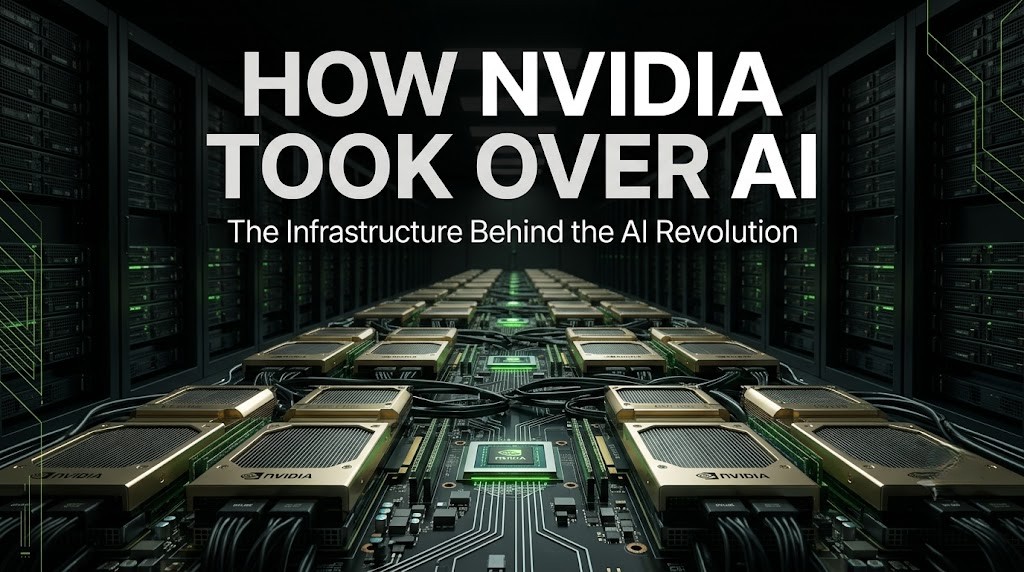
Artificial intelligence may be the biggest technology story of the decade, but behind the chatbots, image generators, autonomous systems, and AI-powered software lies a less visible story: infrastructure. Someone has to build the machines powerful enough to train increasingly sophisticated AI models, and for much of the modern AI boom, that company has been NVIDIA.
What began as a company best known for graphics processing units, or GPUs, has evolved into one of the most important technology businesses in the world. NVIDIA did not invent artificial intelligence, nor did it suddenly become dominant when generative AI exploded. Its position was built over decades through a combination of hardware innovation, software development, developer adoption, and a remarkably early bet on the idea that GPUs could become general-purpose engines for computing.
Today, NVIDIA sits at the center of the AI infrastructure stack. Its chips power massive data centers where companies train and run AI models, while its networking technologies, software libraries, development platforms, and complete AI systems increasingly connect the pieces together. The result is something much bigger than a successful semiconductor business. NVIDIA has helped create the infrastructure layer on which the modern AI economy is being built.
The Bet That Changed NVIDIA’s Future
NVIDIA was founded in 1993 with a focus on graphics computing, at a time when the gaming industry was becoming increasingly sophisticated. GPUs were originally designed to handle the enormous number of mathematical calculations required to render realistic graphics quickly.
But NVIDIA’s leadership saw something that would eventually become far more important than video games: the same ability to perform many calculations simultaneously could be useful beyond graphics.
That insight became increasingly valuable as researchers began using GPUs for scientific computing and machine learning. Traditional CPUs were excellent at handling a wide variety of sequential tasks, but AI workloads often involve performing enormous numbers of similar mathematical operations in parallel. GPUs were naturally suited to that environment.
NVIDIA’s CUDA platform became a crucial part of this transition. Rather than treating the GPU as a specialized graphics component, CUDA allowed developers to program NVIDIA GPUs for broader computational workloads. This created an ecosystem around NVIDIA hardware and gave researchers a practical way to experiment with GPU-accelerated computing.
That software layer turned out to be just as important as the silicon.
Why GPUs Became the Engine of Modern AI
Modern AI models depend heavily on matrix multiplication and other computationally intensive operations. As neural networks became larger and more capable, the amount of computing required to train them grew dramatically.
GPUs offered a solution because they could execute huge numbers of operations simultaneously.
The breakthrough was not simply that GPUs were faster than CPUs. It was that the entire architecture of AI development increasingly aligned with what GPUs were designed to do.
When researchers began training neural networks on large datasets, NVIDIA’s hardware became increasingly attractive. As more researchers used NVIDIA GPUs, more software and tools were developed around them. As the ecosystem expanded, switching to another hardware platform became more complicated.
This created a powerful feedback loop: better hardware attracted developers, developers strengthened the software ecosystem, and the stronger ecosystem increased demand for the hardware.
By the time generative AI became mainstream, NVIDIA had already spent years building the foundation needed to take advantage of the opportunity.
The Deep Learning Moment
One of the most important moments in NVIDIA’s history came in the early 2010s, when deep learning began demonstrating its potential in areas such as image recognition.
Researchers discovered that neural networks could become dramatically more capable when trained with large datasets and significant computing power. GPUs were particularly effective at accelerating this process.
NVIDIA recognized the significance of deep learning early and began positioning its technology around AI rather than waiting for the market to develop on its own.
The company worked closely with researchers, universities, cloud providers, and AI developers. Its hardware became increasingly specialized for machine learning workloads, while its software stack evolved alongside it.
This was a long-term strategy. NVIDIA was not merely selling a faster chip. It was building an environment in which AI developers could build their businesses around NVIDIA technology.
That distinction matters.
Then Generative AI Changed Everything
The arrival of ChatGPT and the broader generative AI boom transformed AI from a specialized research field into a mainstream technology category.
Suddenly, companies across industries wanted AI capabilities. Technology giants began investing billions of dollars in AI infrastructure. Startups started building businesses around large language models, AI agents, image generation, coding assistants, enterprise automation, and search.
All of these systems require computing power.
Training a large AI model can require enormous clusters of accelerators working together. Running those models for millions of users also requires substantial computing capacity.
NVIDIA was already positioned directly in the middle of this demand.
Its data-center GPUs became essential infrastructure for companies racing to build and deploy AI. The company’s opportunity expanded from selling individual processors to supplying complete systems capable of connecting thousands of GPUs into enormous computing clusters.
This is where NVIDIA’s strategy became particularly powerful.
NVIDIA Is Selling More Than a Chip
It is easy to describe NVIDIA simply as a GPU company. That description is increasingly incomplete.
Modern AI infrastructure involves multiple layers: compute, memory, networking, storage, software, cooling, system design, and orchestration. NVIDIA has expanded across many of these areas.
Its accelerator platforms provide the computational horsepower. Its networking technologies help connect processors so they can operate as a coordinated system. Its software ecosystem helps developers optimize AI applications. Its enterprise platforms help businesses deploy AI without having to build every layer themselves.
This creates a vertically integrated AI infrastructure ecosystem.
For customers, that can simplify deployment. Instead of assembling dozens of unrelated technologies and ensuring that they work together, organizations can increasingly purchase a coordinated NVIDIA-based infrastructure stack.
That strategy also makes NVIDIA harder to compete with.
A rival company may develop a powerful AI accelerator, but matching NVIDIA’s entire ecosystem is a much larger challenge.
CUDA: The Moat Behind the Hardware
One of NVIDIA’s greatest competitive advantages is arguably not a physical product.
It is CUDA.
For years, developers have built software, libraries, workflows, and expertise around NVIDIA’s computing platform. AI frameworks and applications have increasingly been optimized for NVIDIA hardware.
This creates what economists might call switching costs. If a company has an enormous AI infrastructure investment built around one ecosystem, moving to another platform is not simply a matter of purchasing different chips. Developers may need to modify software, retrain teams, optimize workloads, and rebuild parts of their infrastructure.
That makes the ecosystem itself a competitive advantage.
In technology, the best platform is often not the one with a single superior feature. It is the one that developers, businesses, and partners already know how to use.
NVIDIA understood that principle early.
The Data Center Became the New Battlefield
The AI revolution has changed the role of the data center.
Traditional data centers were built primarily around CPUs and conventional enterprise workloads. AI data centers increasingly require specialized accelerators, high-speed interconnects, massive amounts of memory, and sophisticated networking.
Training an advanced model is not like running a typical business application. Thousands of processors may need to communicate with one another continuously. Any bottleneck can reduce the efficiency of the entire system.
This is why NVIDIA’s networking strategy has become increasingly important.
The company has invested heavily in technologies designed to move data between GPUs and across large computing clusters. Its acquisition of Mellanox strengthened its position in high-performance networking and helped NVIDIA move beyond the processor itself.
The bigger opportunity was becoming the company that connects the AI factory together.
NVIDIA’s Real Product: AI Infrastructure
There is a deeper way to understand NVIDIA’s transformation.
The company is not simply selling GPUs. It is selling accelerated computing infrastructure for the AI era.
That includes processors, networking, systems, software, developer tools, enterprise platforms, and increasingly complete AI infrastructure solutions.
This is important because AI demand is shifting from experimentation toward industrial-scale deployment.
A company may begin by testing an AI model. Eventually, if that model becomes part of its product or business operation, it needs reliable infrastructure to run it continuously.
That creates recurring demand for computing capacity.
AI is therefore becoming less like a single software product and more like an industrial ecosystem. NVIDIA’s role is increasingly similar to that of an infrastructure provider supplying the machinery behind that ecosystem.
Why Every Major Technology Company Wants AI Compute
From cloud providers to social platforms, search companies, automotive businesses, and enterprise software companies, organizations are competing to build AI capabilities.
Some are developing their own chips. Others are purchasing accelerators from multiple suppliers. Cloud platforms are offering AI computing as a service.
This competition actually reinforces the importance of infrastructure.
The AI race is no longer simply about who can build the smartest model. It is also about who has access to enough computing power, energy, networking capacity, data, and engineering talent to train and operate those models economically.
NVIDIA’s position gives it exposure to this broader competition.
Whether one company wins the race to build the best AI assistant or another dominates AI search, coding, robotics, or autonomous driving, many of those systems still require significant computing infrastructure.
NVIDIA effectively sells the picks and shovels of the AI economy.
The Economics of the AI Infrastructure Boom
The extraordinary demand for AI computing has changed how investors and technology executives think about semiconductor companies.
Historically, chips were often viewed as components inside larger products. AI accelerators are increasingly becoming strategic assets.
Companies are willing to spend enormous amounts on computing infrastructure because AI can potentially transform revenue generation, productivity, customer service, software development, research, and automation.
But this also creates an important question: how much AI infrastructure will the world ultimately need?
NVIDIA’s future depends partly on the continued growth of AI workloads. If AI applications become more capable and widespread, computing demand could continue expanding. If companies discover that some workloads can be handled much more efficiently, or if alternative chips become competitive, the market could become more challenging.
The AI infrastructure race is therefore far from finished.
Competition Is Coming From Every Direction
NVIDIA’s dominance does not mean it operates without serious competitors.
Companies such as AMD and Intel are developing competing accelerator technologies, while major cloud providers are designing their own AI chips. Google has its Tensor Processing Units, Amazon has developed custom accelerators, and other technology companies are investing heavily in specialized silicon.
There is also growing interest in software optimization and smaller, more efficient AI models.
The competitive question is shifting from simply “Who has the fastest chip?” to something more complex: Which platform can deliver the best combination of performance, cost, energy efficiency, software compatibility, networking, availability, and developer support?
NVIDIA’s advantage is that it competes across many of these dimensions simultaneously.
That makes the company difficult to displace overnight.
The Energy Problem Behind AI
There is, however, another side to the AI infrastructure boom.
Power.
AI data centers require enormous amounts of electricity, particularly as computing clusters become larger and models become more sophisticated. Cooling systems, networking equipment, storage, and backup infrastructure add to the energy requirements.
This means the future of AI is also connected to the future of energy infrastructure.
More efficient processors can reduce the energy required for a given workload, but rising AI demand can offset those efficiency gains. Data center operators are therefore looking for better cooling technologies, improved power management, renewable energy sources, and more efficient computing architectures.
For NVIDIA, energy efficiency is becoming increasingly important because performance alone is no longer enough.
The next phase of AI infrastructure will be measured not only by how much computing power a system provides, but by how efficiently it delivers that power.
From Graphics Company to AI Infrastructure Giant
NVIDIA’s transformation is one of the clearest examples of how a technology company can benefit from anticipating a platform shift before it becomes obvious to the broader market.
The company started with graphics. It then recognized that GPU architecture could accelerate general-purpose computing. It invested in CUDA and developer ecosystems. It embraced deep learning before AI became mainstream. And when generative AI exploded, NVIDIA already had much of the infrastructure the industry needed.
That sequence is what makes its rise so significant.
NVIDIA did not simply win the AI hardware race after ChatGPT arrived. It spent years constructing the track.
Today, the company’s influence reaches from individual developers experimenting with AI to some of the world’s largest data centers. Its technology sits behind models, applications, cloud services, research projects, and emerging AI systems that most consumers never directly see.
The most visible part of the AI revolution may be the chatbot on your screen.
But behind that interface is an enormous industrial machine.
And NVIDIA has become one of the companies building it.
The Bigger Lesson
NVIDIA’s story offers a broader lesson about technology markets: the biggest winners are not always the companies creating the most visible consumer product.
Sometimes, the real power sits underneath.
Search engines need servers. Streaming needs data centers. Smartphones need semiconductor ecosystems. And artificial intelligence needs extraordinary amounts of computing infrastructure.
NVIDIA recognized that infrastructure could become the defining business of the AI era.
Its greatest achievement may therefore not be creating the world’s most powerful GPU. It may be creating an ecosystem so deeply connected to AI development that hardware, software, networking, developers, and data centers reinforce one another.
The AI revolution is still in its early chapters. New architectures will emerge. Competitors will become stronger. AI models may become dramatically more efficient. And the economics of computing will continue to evolve.
But one fact is difficult to ignore: before AI could become an everyday technology, someone had to build the machinery that made it possible.
NVIDIA didn’t just build a faster computer.
It helped build the infrastructure on which the AI age is running.
“The companies that shape the future are often the ones building what the future needs before everyone else realizes they need it.”