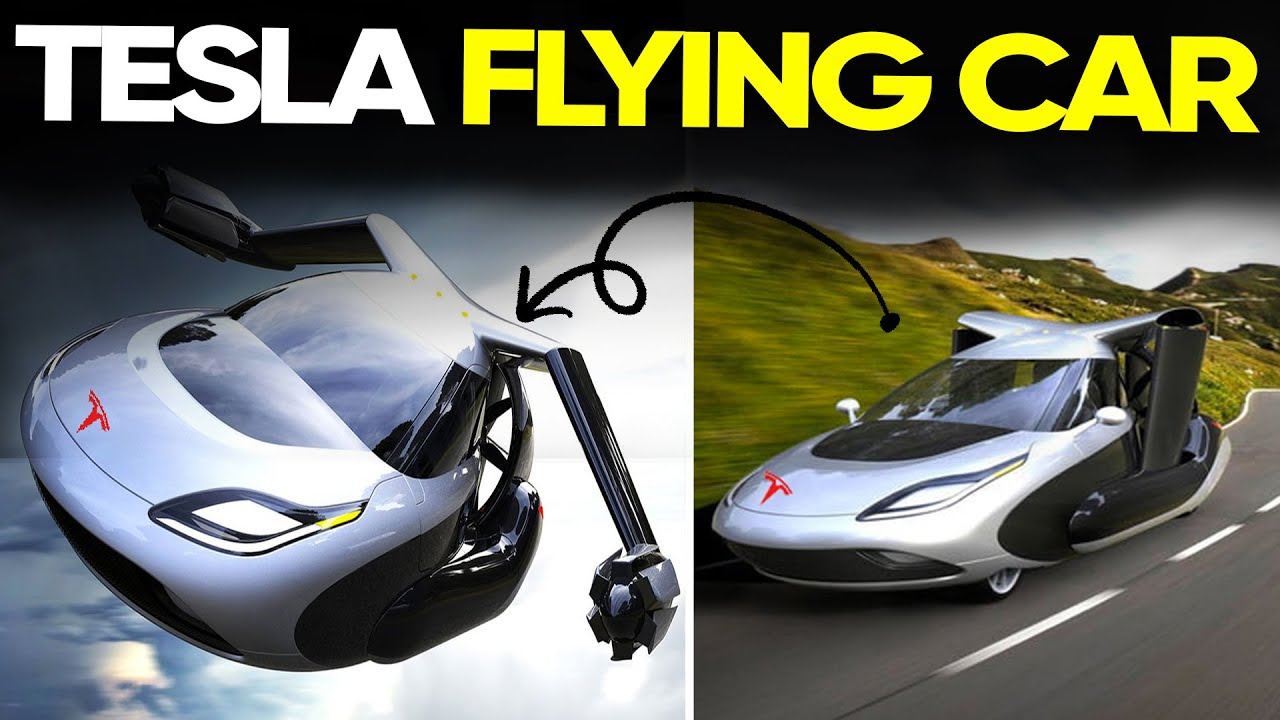
The idea of a car that can leave a crowded highway behind, rise into the air and move above traffic has fascinated people for generations. What once belonged to science-fiction films and futuristic concept drawings is now becoming a serious subject of technological experimentation. Electric vehicles have already transformed how the automotive industry thinks about power, performance and sustainability, but the possibility of a flying car introduces an entirely different ambition: combining the freedom of personal transportation with the extraordinary capabilities of aerospace engineering. For years, the question has been whether such a machine could ever become practical. Now, attention has turned towards Tesla and its long-anticipated next-generation Roadster, a project that has brought the flying-car conversation back into the spotlight.
In October 2026, Tesla demonstrated a version of its next-generation Roadster at a SpaceX facility in Texas, showcasing a vehicle that appeared to lift into the air using rocket-inspired thruster technology. The demonstration was presented as a glimpse of what might be possible when automotive engineering meets aerospace innovation. However, the distinction between a vehicle that briefly leaves the ground and a fully functional flying car is important. The demonstration was not proof that consumers can soon drive and fly a Tesla wherever they want. Instead, it offered a striking look at an experimental concept that still
The Tesla Roadster and the Dream of a Flying Car
Tesla has built much of its public identity around challenging conventional expectations. From popularising premium electric vehicles to pursuing advanced driver-assistance technology, the company has repeatedly positioned itself as a manufacturer interested in reshaping the future rather than simply improving existing products. The next-generation Roadster fits into this image, combining the promise of extraordinary acceleration with a design philosophy that reaches beyond traditional sports-car engineering. Its flying-car concept takes that ambition one step further, raising the possibility that a high-performance automobile could borrow technologies normally associated with rockets and experimental aircraft.
The idea gained fresh momentum after Elon Musk teased a remarkable product demonstration in 2025, suggesting that the next Roadster could include technology unlike anything found in conventional cars. Those comments generated considerable curiosity because the Roadster had already spent years in development, with its anticipated launch repeatedly pushed back. The October 2026 demonstration provided a more tangible glimpse of the concept, although it did not establish that the vehicle was ready for commercial production or everyday flight. Tesla has indicated that production is planned for 2028, but a proposed production timeline should not be mistaken for a guaranteed delivery date.
What makes the idea particularly fascinating is that Tesla is not simply imagining a car with wings attached. The demonstrated concept draws on SpaceX-inspired propulsion technology, suggesting a different approach to short-duration lift and movement through the air. That distinction matters because traditional flying cars generally attempt to combine road transportation with the familiar principles of aviation, using wings, rotors or dedicated lift systems. A rocket-assisted vehicle follows a different engineering path, one that raises new questions about control, energy use, stability and the circumstances in which such a machine could safely operate.
How Could a Tesla Flying Car Actually Work?
A conventional electric car uses battery power to drive electric motors, which turn the wheels and move the vehicle along the road. A flying vehicle must solve a much more demanding problem: generating enough upward force to overcome gravity while maintaining stability and directional control. Depending on its design, it may need wings to generate lift, rotors to push air downwards or another propulsion system capable of supporting its weight. Simply making a car faster or more powerful does not automatically make it capable of sustained flight.
The Tesla Roadster concept has attracted attention because of its reported use of high-pressure gas thrusters. During the October demonstration, the vehicle used rocket-inspired technology to perform brief airborne manoeuvres, rather than demonstrating the conventional flight profile of an aeroplane or a passenger-carrying electric aircraft. Thrusters can produce force by expelling gas, but their practical use in a road-going vehicle raises difficult questions about propulsion efficiency, pressure storage, control systems and passenger safety. A short demonstration of lift is therefore very different from proving that a vehicle can take off, travel a meaningful distance, navigate changing weather conditions and land reliably.
Another major challenge is balancing the requirements of driving and flying. A road car needs a strong structure, crash protection, tyres, suspension and systems that can withstand repeated contact with uneven surfaces. Aircraft, meanwhile, must carefully manage weight because every additional kilogram affects the force and energy required to remain airborne. Combining these competing requirements in one machine is far more complicated than placing an experimental propulsion system inside a sports-car body. Engineers would need to consider how the vehicle behaves during sudden changes in movement, how its systems respond to failures and how passengers remain protected during both road travel and airborne manoeuvres.
For Tesla, the challenge is not only to make the technology work once. The real test would be developing a system that performs consistently, can be inspected and maintained, and meets rigorous safety standards. A dramatic prototype can capture public attention, but a commercially viable flying vehicle must demonstrate repeatable performance under controlled and clearly defined operating conditions.
Why Tesla’s Flying Car Is Different from an Electric Air Taxi
The phrase flying car often brings to mind a vehicle that can drive through city streets before transforming into an aircraft at the push of a button. However, several companies are exploring a different interpretation of the concept: electric aircraft designed to carry passengers over short distances, particularly between airports, business districts and urban transport hubs. These vehicles are commonly known as electric vertical take-off and landing aircraft, or eVTOLs, and they represent one of the most promising approaches to urban air mobility.
Unlike a conventional car equipped with experimental thrusters, an eVTOL aircraft is designed specifically for flight. Many concepts use multiple electric motors and rotors to take off vertically, hover and transition into forward flight. Companies such as Joby Aviation and Archer Aviation are developing aircraft intended to support future air-taxi services. Their approach focuses on moving people through the air, rather than preserving the full functionality and appearance of a traditional road car.
Tesla’s Roadster concept is different because its appeal lies partly in the combination of a high-performance sports car and rocket-inspired technology. This makes it an intriguing engineering experiment, but it does not necessarily make it a more practical solution to everyday transportation. An air taxi could eventually follow designated routes between approved landing sites, whereas a road-going flying vehicle would have to accommodate two very different environments. It would need to function safely on public roads and, if flight were permitted, operate within an entirely different set of aviation requirements.
The comparison reveals an important point about the future of flying cars: there may not be one universal design that replaces conventional vehicles. Instead, personal flying vehicles, commercial air taxis and specialised aircraft could develop as separate categories, each serving a different purpose. Tesla’s experiment is one possible direction, not a blueprint that the entire industry must follow.
Could a Flying Tesla End Traffic Jams?
Few modern transport problems are as familiar as spending hours moving through congested roads. In major cities, traffic delays affect work schedules, business productivity, airport transfers and everyday quality of life. It is easy to understand why the prospect of travelling above traffic has such an appealing promise. If personal vehicles could safely take to the air, some journeys might become faster, particularly where geographical barriers or heavily congested road networks make ground transportation inefficient.
Imagine leaving a busy business district and travelling to an airport without navigating several kilometres of slow-moving traffic. Or picture a future in which specialised aircraft connect suburban communities with commercial centres, allowing commuters to bypass certain road bottlenecks. These scenarios are central to the appeal of urban air mobility, and they explain why investors, engineers and transportation companies continue to explore the potential of airborne travel.
However, the existence of a flying vehicle would not automatically eliminate congestion. Airspace has limited capacity, and aircraft cannot simply move in every direction without coordination. Safe flight requires route planning, communication, separation between vehicles and suitable places for take-off and landing. If thousands of private vehicles attempted to fly over the same city simultaneously, managing them would create a complicated transportation problem of its own.
There is also the question of accessibility. Early flying vehicles are likely to be expensive, while operating costs, maintenance requirements and specialised infrastructure could further limit their availability. Even if the technology becomes commercially successful, it may initially serve enthusiasts, wealthy customers or specialised transport services rather than ordinary commuters. Flying cars could eventually complement road networks, but there is little reason to assume that they will replace conventional transport on a large scale in the immediate future.
The Biggest Challenge: Safety, Regulation and Public Acceptance
The engineering challenge of getting a vehicle off the ground is only one part of the journey. Before a flying car could become a normal consumer product, manufacturers would need to demonstrate that it can operate safely and reliably. The requirements would extend far beyond those associated with ordinary road vehicles, particularly if the machine were intended to carry passengers through controlled airspace.
In the United States, the October 2026 Roadster demonstration prompted questions about how a vehicle with airborne capabilities would be classified and regulated. The Federal Aviation Administration stated that the demonstrated Tesla vehicle did not meet its definition of an aircraft, while aviation experts highlighted the wider certification and airspace issues that could arise if a production vehicle were designed to fly. Tesla’s reported plans also distinguish the proposed flying configuration from a conventional road-legal vehicle.
This distinction is crucial for potential buyers. A vehicle may demonstrate a technical capability without being authorised to use that capability in public. Any future flying Tesla would need a clearly defined operating framework, including where it could take off, where it could land, who would be permitted to operate it and what safety procedures would apply. Depending on its final configuration and jurisdiction, aviation licensing, certification and additional permissions could be required. Rules governing road use would not automatically grant permission to fly.
Public acceptance would matter just as much. People may be excited by the idea of personal flight, but they are also likely to question the risks of airborne mechanical failures, noise, emergency landings and falling debris. Communities would want assurances that these vehicles could operate without creating unacceptable dangers for people on the ground. Manufacturers would therefore need to demonstrate not only impressive performance but also dependable safeguards, clear accountability and responsible operating practices.
The Price Question: Will Flying Cars Be a Luxury Only?
For all the excitement surrounding futuristic transportation, affordability will ultimately influence whether flying cars become widely adopted. Tesla’s Roadster has long been positioned as a high-performance sports car rather than an entry-level electric vehicle. Its proposed flying capability adds another layer of technical complexity, potentially involving specialised propulsion equipment, additional maintenance and requirements that would not apply to a standard electric car.
Tesla has not established a confirmed retail price and delivery schedule for a commercially available flying Roadster. The production target announced during the October 2026 demonstration is 2028, but the eventual price, final specifications and availability remain important uncertainties. Consumers should therefore be cautious about social media posts that present speculative prices, guaranteed delivery dates or claims that a fully functional flying Tesla is already available for everyday use.
Even if the initial purchase price falls within the reach of wealthy enthusiasts, ownership could involve expenses beyond the vehicle itself. Depending on its final design, owners might need specialised servicing, insurance, training, approved storage or access to designated operating facilities. These costs could make personal flight substantially more expensive than driving an electric vehicle on ordinary roads.
The longer-term picture could look different if flying technology becomes more mature. Advances in battery systems, lightweight materials, electric motors, manufacturing processes and automated flight controls may help reduce costs across the wider aviation industry. However, lower production costs alone will not solve every challenge, because infrastructure, regulation and operational safety will continue to influence the economics of flying transportation. The most affordable path towards everyday air mobility may ultimately involve shared air-taxi services rather than individual ownership of a flying car.
What Does This Mean for the Future of Electric Vehicles?
The flying-car conversation also highlights how the automotive industry is expanding beyond the traditional idea of a car. Electric vehicles, autonomous-driving systems, artificial intelligence and aerospace technologies are increasingly discussed as connected parts of a wider mobility ecosystem. Tesla’s collaboration-inspired approach to the Roadster concept reflects this shift, bringing together expertise associated with electric propulsion and rocket engineering to explore a radically different vehicle experience.
Yet the future of mobility will not be determined by technological spectacle alone. The most successful innovations will need to solve real problems, whether that means reducing travel time, improving accessibility, lowering operating costs or making transportation safer. An impressive airborne demonstration may generate headlines, but a product’s long-term value depends on whether customers can use it reliably and whether it offers a meaningful advantage over existing alternatives.
For electric vehicle manufacturers, there is also a broader lesson in the relationship between innovation and execution. Consumers increasingly expect ambitious products to move beyond prototypes and promotional announcements into dependable commercial offerings. Production timelines, product specifications, service networks and regulatory approvals all matter. The next phase of the flying-car story will therefore depend less on how extraordinary the concept looks and more on whether the engineering can be translated into a product that works consistently outside a demonstration environment.
At the same time, the technology being developed for electric aviation could produce benefits even if personal flying cars remain relatively rare. Research into lightweight structures, efficient electric motors, advanced control systems and energy management may contribute to other transportation technologies. These developments could support specialised aircraft, urban air-taxi services and other forms of mobility that address specific travel needs more effectively than a vehicle designed to do everything.
Tesla Flying Car: A Glimpse of Tomorrow, Not Yet Everyday Reality
The dream of flying cars has survived for generations because it represents something more profound than a new mode of transportation. It reflects humanity’s desire to overcome physical limitations, reclaim time and rethink the boundaries of everyday life. Tesla’s Roadster demonstration has given that dream a fresh technological reference point, bringing rocket-inspired propulsion into a conversation traditionally dominated by futuristic illustrations and experimental aircraft.
Nevertheless, the difference between a remarkable demonstration and a practical transportation revolution remains substantial. Sustained flight, passenger protection, operating costs, infrastructure, certification and public acceptance will all influence whether the concept progresses beyond a specialised performance vehicle. The proposed 2028 production target offers a milestone to watch, not a guarantee that consumers will soon be flying above their daily commutes.
The most realistic future may not involve every household owning a vehicle that switches effortlessly between road and sky. Instead, transportation could gradually evolve into a network of electric cars, autonomous services, specialised aircraft and air taxis, each designed to handle particular journeys. Personal flying vehicles may eventually find a place in that ecosystem, but their role will depend on practical performance rather than futuristic appeal alone.
For now, Tesla’s flying-car concept is best understood as an ambitious experiment at the intersection of automotive and aerospace engineering. It challenges conventional assumptions about what a car can do, while exposing the formidable barriers that remain between a technological breakthrough and everyday usability. The future of transportation may indeed include vehicles that leave the ground, but the real revolution will begin when flying becomes not merely possible, but safe, affordable and genuinely useful.