
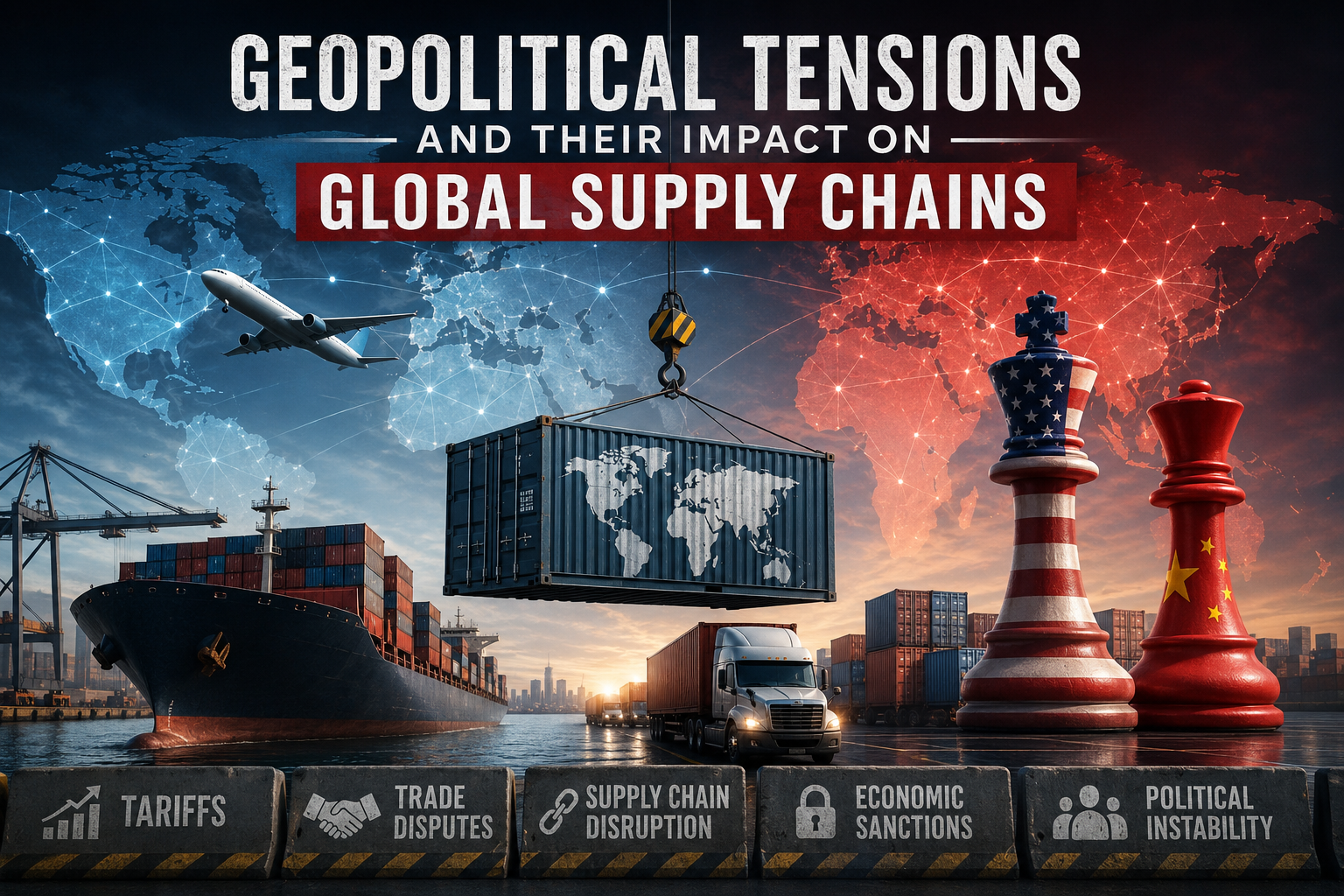
For decades, globalization enabled businesses to build highly efficient supply chains spanning multiple continents. Companies sourced raw materials from one region, manufactured products in another, and distributed them worldwide. This interconnected model helped reduce costs, improve productivity, and expand access to international markets.
However, recent geopolitical tensions, trade disputes, armed conflicts, economic sanctions, and pandemic-related disruptions have exposed significant vulnerabilities within global supply networks. Events that occur in one part of the world can now trigger widespread consequences across industries and regions. As a result, supply chain resilience has become a strategic priority rather than a purely operational concern.
Organizations worldwide are reassessing their supply chain structures to ensure continuity, reduce risk, and maintain competitiveness in an increasingly uncertain environment. The challenge is no longer simply achieving efficiency; it is building supply chains capable of withstanding disruptions while continuing to deliver value.
Understanding the Growing Impact of Geopolitical Tensions
Geopolitical tensions refer to conflicts, disputes, policy disagreements, and strategic rivalries between nations that affect economic and commercial activities. In today’s interconnected economy, these tensions have a direct influence on global supply chains.
Key Sources of Geopolitical Risk
Several factors contribute to geopolitical uncertainty:
- Trade wars and tariff disputes
- Economic sanctions and export restrictions
- Regional conflicts and military confrontations
- Political instability and regime changes
- Strategic competition over critical resources
- National security regulations affecting technology transfer
These developments can disrupt production, transportation, sourcing, and market access, creating significant challenges for businesses operating internationally.
How Geopolitical Tensions Disrupt Global Supply Chains
1. Trade Restrictions and Tariffs
One of the most immediate effects of geopolitical disputes is the introduction of tariffs, import duties, and trade barriers.
When countries impose tariffs on imported goods, businesses face increased procurement costs. Companies that depend heavily on international suppliers may experience reduced profit margins and pricing challenges.
Trade restrictions can also force organizations to rapidly identify alternative suppliers, often resulting in higher operational expenses and delays.
Business Impact
- Increased sourcing costs
- Reduced competitiveness
- Supplier replacement expenses
- Delayed product deliveries
2. Economic Sanctions and Export Controls
Governments increasingly use economic sanctions and export controls as foreign policy tools. While these measures are designed to influence political behaviour, they often create unintended consequences for global businesses.
Companies may suddenly lose access to suppliers, customers, technologies, or financial systems. Organizations operating across multiple jurisdictions must also navigate complex compliance requirements.
Business Impact
- Interrupted supply networks
- Regulatory compliance risks
- Reduced access to strategic markets
- Technology procurement challenges
3. Transportation and Logistics Disruptions
Geopolitical conflicts can significantly affect transportation routes and logistics networks.
Maritime shipping lanes, air cargo routes, and land transportation corridors may become inaccessible due to security concerns or government restrictions. The closure of critical routes often causes congestion elsewhere, increasing transportation costs and transit times.
Recent disruptions have demonstrated how vulnerable global trade remains to regional instability.
Business Impact
- Longer delivery times
- Rising freight costs
- Inventory shortages
- Reduced customer satisfaction
4. Resource and Energy Supply Risks
Many industries depend on a stable supply of energy, minerals, and raw materials sourced from specific regions.
Geopolitical tensions can limit access to these resources through sanctions, export bans, or production disruptions. Energy price volatility frequently affects manufacturing, transportation, and overall operating costs.
Business Impact
- Increased production expenses
- Raw material shortages
- Volatile commodity prices
- Reduced manufacturing output
Lessons Learned from Recent Global Disruptions
The Pandemic’s Supply Chain Shock
The COVID-19 pandemic highlighted the fragility of highly optimized global supply chains. Factory shutdowns, labour shortages, transportation bottlenecks, and changing consumer demand created unprecedented disruptions.
Businesses discovered that excessive dependence on single suppliers or specific geographic regions significantly increased operational risk.
Key lessons included:
- Diversification is essential.
- Visibility across supply networks matters.
- Inventory buffers can provide protection.
- Digital tools improve decision-making during crises.
Regional Conflicts and Economic Uncertainty
Recent geopolitical conflicts have further reinforced the need for resilient supply chain strategies. Energy market volatility, commodity shortages, and transportation disruptions have affected industries worldwide.
Organizations have realized that geopolitical risk management must be integrated into long-term business planning rather than treated as a temporary concern.
Why Supply Chain Resilience Has Become a Strategic Priority
Moving Beyond Cost Efficiency
Historically, many organizations focused on minimizing costs through lean inventory models and concentrated sourcing strategies.
While efficient during stable periods, these approaches often struggle during disruptions.
Today, leading companies recognize that resilience and flexibility can be just as valuable as cost optimization.
A resilient supply chain enables organizations to:
- Maintain operations during disruptions
- Protect customer relationships
- Reduce financial losses
- Recover faster from unexpected events
- Preserve brand reputation
Strategies for Building Resilient Supply Chains
1. Supplier Diversification
One of the most effective resilience strategies is reducing dependence on a single supplier or geographic region.
Organizations increasingly adopt multi-sourcing approaches that distribute procurement across multiple suppliers and countries.
Benefits
- Reduced supplier concentration risk
- Improved supply continuity
- Greater negotiation flexibility
- Enhanced operational stability
Diversification may increase complexity, but it significantly improves resilience during disruptions.
2. Nearshoring and Regionalization
Many companies are moving portions of their supply chains closer to key markets.
Nearshoring involves relocating production to nearby countries, while regionalization creates supply networks within specific geographic regions.
Benefits
- Shorter transportation routes
- Faster response times
- Reduced geopolitical exposure
- Improved customer service
Although labour costs may be higher in some locations, businesses often gain greater reliability and agility.
3. Increased Supply Chain Visibility
Organizations cannot manage risks they cannot see.
Supply chain visibility involves obtaining real-time information about suppliers, inventory levels, transportation status, and potential disruptions.
Advanced technologies now allow companies to monitor their supply networks more effectively than ever before.
Key Technologies
- Cloud-based supply chain platforms
- Internet of Things (IoT) sensors
- Artificial intelligence
- Predictive analytics
- Digital twins
Enhanced visibility enables faster decision-making and proactive risk management.
4. Strategic Inventory Management
The “just-in-time” inventory model became popular because it minimized storage costs. However, recent disruptions revealed the risks of maintaining extremely low inventory levels.
Many organizations are now adopting hybrid approaches that balance efficiency with resilience.
Resilience Measures
- Safety stock reserves
- Strategic inventory placement
- Buffer inventories for critical components
- Regional distribution centers
These measures provide protection against unexpected supply interruptions.
5. Risk Assessment and Scenario Planning
Leading organizations continuously evaluate potential risks across their supply networks.
Risk assessment includes analysing:
- Supplier reliability
- Political stability
- Transportation vulnerabilities
- Regulatory changes
- Environmental threats
Scenario planning helps organizations prepare responses before disruptions occur.
Companies that regularly conduct simulations and stress tests are often better equipped to manage crises.
The Role of Technology in Supply Chain Resilience
Artificial Intelligence and Predictive Analytics
Artificial intelligence is transforming supply chain management by identifying patterns and predicting potential disruptions.
AI-powered systems can analyse large volumes of data from multiple sources, including:
- Weather forecasts
- Trade policies
- Shipping activity
- Economic indicators
- Market trends
This enables organizations to anticipate problems and take preventive action.
Blockchain for Transparency
Blockchain technology can improve supply chain transparency by creating secure, traceable records of transactions and product movements.
Benefits include:
- Enhanced supplier verification
- Reduced fraud
- Improved compliance
- Greater traceability
As regulatory requirements increase, blockchain may become an important component of resilient supply chain strategies.
Automation and Smart Logistics
Automation improves efficiency while reducing dependence on labor-intensive processes.
Examples include:
- Automated warehouses
- Robotics in manufacturing
- Autonomous transportation technologies
- Smart inventory management systems
These technologies help organizations maintain operations even during workforce shortages or disruptions.
Balancing Resilience and Cost
Building resilient supply chains often requires investment.
Supplier diversification, additional inventory, advanced technologies, and regional manufacturing can increase short-term expenses. However, the cost of major disruptions frequently exceeds the investment required to improve resilience.
Business leaders must evaluate supply chain decisions through a broader risk-management perspective.
Questions organizations should consider include:
- What is the financial impact of a major disruption?
- Which suppliers are most critical?
- How quickly can operations recover?
- What level of resilience is appropriate for the business?
The objective is not eliminating risk entirely but creating an acceptable balance between efficiency and resilience.
The Future of Global Supply Chains
Global supply chains are unlikely to become less interconnected. International trade remains essential to economic growth and business expansion.
However, the structure of supply chains is evolving.
Future supply networks are expected to be:
More Diversified
Companies will reduce dependence on single-country sourcing models.
More Regionalized
Production and distribution activities will increasingly be located closer to end markets.
More Digital
Technology will provide greater visibility, forecasting capability, and operational control.
More Risk-Aware
Geopolitical considerations will play a larger role in sourcing and investment decisions.
More Flexible
Organizations will prioritize adaptability alongside efficiency.
These changes represent a significant shift in how businesses approach supply chain management.
Conclusion: Resilience as a Competitive Advantage
Geopolitical tensions and global disruptions have fundamentally reshaped supply chain strategy. Events ranging from trade disputes and economic sanctions to regional conflicts and pandemics have demonstrated that supply chain vulnerabilities can quickly become business vulnerabilities.
Organizations that continue to prioritize cost efficiency alone may face increasing risks in an unpredictable global environment. By contrast, companies that invest in supplier diversification, regionalization, technology adoption, risk management, and supply chain visibility are better positioned to withstand disruptions and maintain operational continuity.
In the years ahead, resilience will not simply be a defensive measure—it will become a source of competitive advantage. Businesses capable of adapting quickly, managing uncertainty effectively, and maintaining reliable operations during periods of disruption will be best equipped to succeed in the evolving global marketplace.