The Evolving Landscape of SEO in 2026
SEO in 2026 looks very different from the formula many marketers relied on a few years ago. Ranking is no longer simply a matter of choosing a keyword, placing it in a headline, building a few backlinks and waiting for Google to reward the effort. Search has become more contextual, competitive and increasingly influenced by artificial intelligence.
The bigger change is not that search engines have become “smarter” in isolation. It is that people have changed the way they search. Users move between traditional search, AI-generated answers, social platforms, visual discovery and increasingly conversational interfaces. A customer might discover a product through Instagram, compare it through Google, ask an AI assistant for alternatives and finally visit a brand’s website before making a decision. SEO now sits inside that much larger discovery journey.
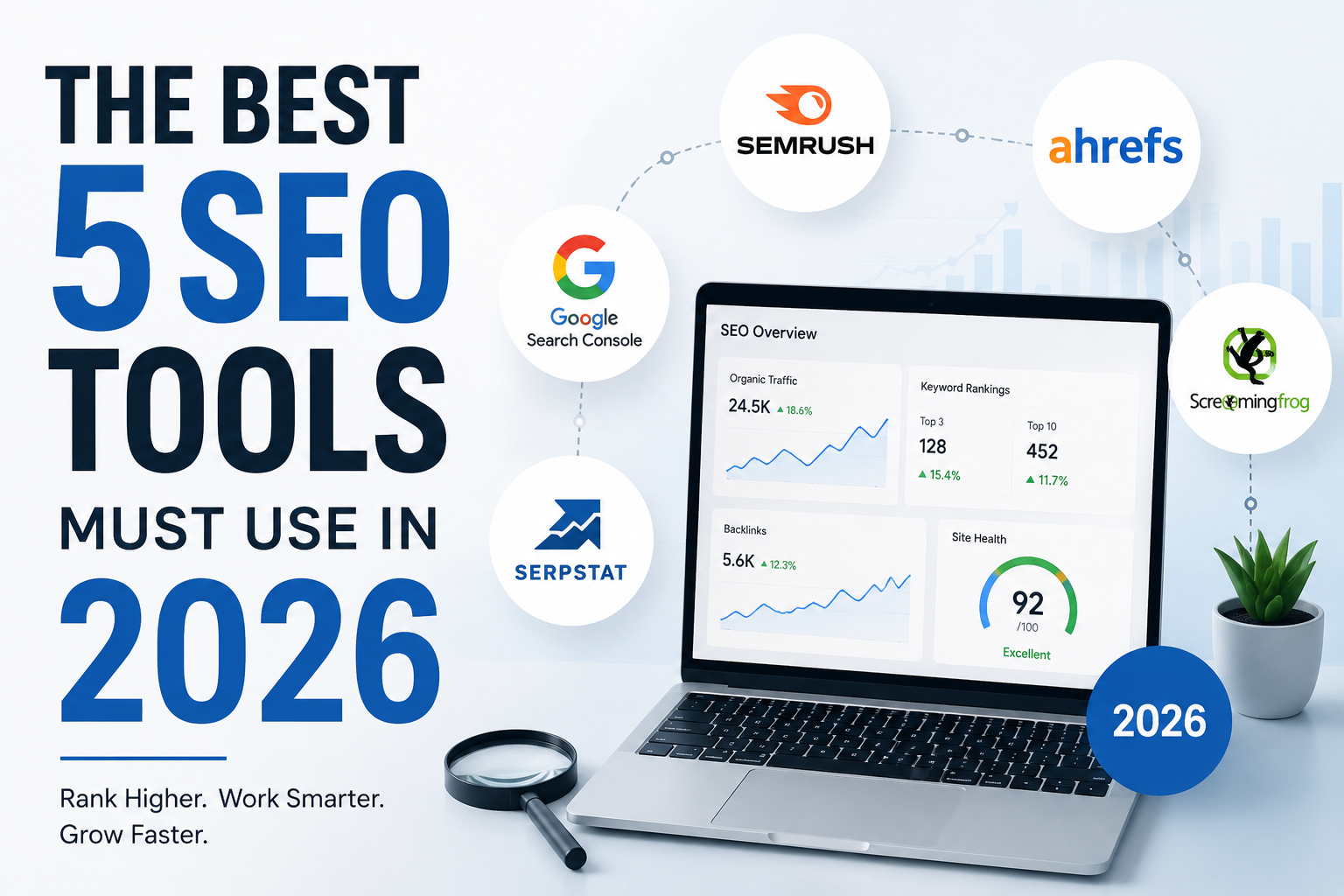
For digital marketers, this creates an interesting challenge. The objective is no longer simply to rank for a list of keywords. It is to understand what people want, create genuinely useful content, make websites technically accessible and build enough authority for a brand to remain visible across an increasingly fragmented search ecosystem. That is where SEO tools become valuable. The best platforms do more than produce keyword lists. They help marketers investigate competitors, identify content opportunities, diagnose technical problems, monitor rankings and understand whether their work is actually producing meaningful visibility. The following five tools stand out because they approach SEO from different angles. Used together, they can give a marketing team a much clearer picture of what is happening before, during and after a search campaign.
1. Semrush: The Strategic Command Center
Semrush has evolved into one of the broadest platforms for modern digital marketing, and its strength lies in bringing multiple layers of SEO research into one environment. Keyword research, competitor analysis, rank tracking, backlink analysis and technical auditing can all form part of the same workflow. Its current platform also extends into AI-search visibility, making it particularly relevant as marketers begin measuring how brands appear in AI-generated answers as well as traditional search results. For a marketer starting a new campaign, Semrush can function almost like a research desk. Instead of asking, “Which keyword should we target?”, the better question becomes, “Where is the opportunity?” Its keyword tools can reveal search volume, competition, related queries and keyword gaps, while competitor research can show the terms and pages helping rival brands gain visibility.
That distinction matters. High-volume keywords often look attractive on a spreadsheet but may be completely unrealistic for a smaller website. A more intelligent strategy may involve finding a cluster of specific, commercially relevant searches where the competition is weaker and the user’s intent is clearer. Semrush becomes particularly useful when SEO is connected to a broader marketing strategy. A marketer can move from keyword research into competitor intelligence, content planning and performance tracking without constantly switching between platforms. For agencies and larger marketing teams, that centralized approach can save considerable time. Its biggest advantage, therefore, is not one individual feature. It is the ability to connect the dots. SEO works best when keyword research, competitive intelligence, content and measurement are treated as parts of the same strategy rather than isolated tasks.
2. Ahrefs: Where Competitor Intelligence Gets Serious
Ahrefs has long been associated with backlink analysis, but its modern toolkit goes much further. Its Site Explorer allows marketers to investigate competitors’ organic traffic, ranking keywords, backlink profiles and paid activity, while Keywords Explorer is designed to uncover search opportunities and evaluate metrics such as search volume, keyword difficulty and traffic potential. The real value of Ahrefs is the perspective it provides. Your own analytics tell you what happened on your website. Competitive intelligence can help explain what is happening around it. Imagine a competitor suddenly begins receiving substantial organic traffic. Rather than simply watching the gap grow, a marketer can investigate which pages are responsible, which keywords those pages rank for and which websites are linking to them. That turns competitor research from passive observation into strategic intelligence.
Backlinks remain another major reason marketers turn to Ahrefs. A strong backlink profile can reveal which publications, websites and communities are willing to reference a competitor. Those discoveries can lead to outreach opportunities, partnership ideas or content strategies that would otherwise remain hidden. Ahrefs has also expanded into AI-search visibility, allowing marketers to examine how brands and competitors surface across newer search experiences. Its current platform includes tools for AI visibility, content gaps, rank tracking and Google Search Console insights alongside its traditional SEO capabilities. For marketers who enjoy digging beneath surface-level metrics, Ahrefs is particularly powerful. It encourages a research mindset: don’t simply look at who ranks first; investigate why they rank, what supports their visibility and where the weaknesses are.
3. Google Search Console: The Data Straight From Search
If the first two tools help marketers understand the competitive landscape tells them what is happening with their own presence in Google Search. And there is something uniquely valuable about that distinction: Search Console provides first-party search performance data for your site. Its Performance report includes clicks, impressions, click-through rate and average position, while marketers can break performance down by queries, pages and countries This makes Search Console one of the most important tools in an SEO stack, even though it may appear less sophisticated than commercial platforms.
Consider a page receiving thousands of impressions but relatively few clicks. That is not necessarily a failure. It could indicate that the page is appearing for relevant searches but its title or description is not compelling enough. Alternatively, the page may be ranking for queries that do not closely match the content. The same data can reveal opportunities that traditional keyword research misses. A page may already be receiving impressions for several related searches without deliberately targeting them. Those queries can become clues for improving the existing page, creating supporting content or restructuring an entire topic cluster. Search Console also forces marketers to confront reality. SEO software may estimate traffic and rankings using large datasets, but Search Console shows how Google’s search ecosystem is actually interacting with your property. That makes it less of a planning tool and more of a diagnostic instrument. It is where marketers can test whether their strategy is producing real search visibility rather than simply impressive-looking projections.
4. Screaming Frog: The Technical SEO Detective
Great content cannot compensate for a website that search engines struggle to crawl, understand or index. This is where earns its place. Screaming Frog’s SEO Spider is a website crawler designed to uncover technical and on-page SEO problems. The platform can identify hundreds of issues involving links, redirects, metadata, indexing, site architecture and other elements that influence website health and user experience What makes it particularly useful is the level of detail. Instead of looking at a website as a single domain-level score, marketers can inspect individual URLs and understand what is happening underneath the surface.
Broken links, redirect chains, duplicate or missing metadata, problematic canonicals and indexing-related issues can quietly weaken an SEO campaign. These problems are not always visible to a visitor, but they can create friction for search engines and users alike. Modern websites make technical auditing even more important. Many sites rely heavily on JavaScript frameworks and dynamic content. Screaming Frog supports JavaScript rendering, allowing marketers to crawl websites built with technologies such as React, Angular and Vue and examine the rendered version of pages.
This is where the tool feels less like a marketing dashboard and more like a detective’s toolkit. It does not tell you that your website “needs better SEO” in vague terms. It helps uncover the specific technical details that may be getting in the way. For technical SEO, migrations, large websites and agency audits, that level of granularity can be invaluable.
5. Surfer: Turning Content Optimization Into a Process
Technical SEO gets a website ready for search. Research identifies the opportunity. But someone still has to create the content. Surfer focuses heavily on that part of the process, helping marketers evaluate and optimize content against search results. Its Content Score measures optimization across factors such as relevance, topical coverage, structure and keyword usage, while its current methodology also incorporates signals related to AI-powered search. The appeal is straightforward: content teams often struggle to translate SEO research into an actual article. Knowing that a topic is valuable is one thing. Knowing whether a draft adequately covers the subject, addresses search intent and competes with the pages already ranking is another.
Surfer provides a framework for that evaluation. Rather than treating keywords as isolated words that need to be inserted repeatedly, the platform looks at broader topical coverage and how a piece of content compares with high-performing pages. That approach reflects a larger shift in content marketing. Search engines have become considerably better at interpreting context, meaning the strongest content strategy is rarely about repeating the same phrase dozens of times. It is about answering the reader’s question comprehensively, demonstrating relevance and making the information easy to understand.
The important caveat is that optimization tools should remain assistants, not authors. A content score can identify areas for improvement, but it cannot replace original thinking, experience, strong storytelling or a genuine understanding of the audience. The best marketers use tools like Surfer to strengthen their writing not to make every article sound like it was assembled from the same SEO template.
The Real SEO Advantage: How These Tools Work Together
The biggest mistake marketers can make in 2026 is searching for one “perfect” SEO tool. No single platform can completely replace strategic judgment. A stronger workflow starts with research. Semrush can help uncover keyword opportunities and competitive gaps. Ahrefs can deepen that investigation by revealing competitor pages, backlinks and search performance. Google Search Console then provides the reality check: which queries and pages are actually generating visibility for your own website. Once the content and website begin to grow, Screaming Frog can uncover technical problems that may be limiting performance. Surfer can then help content teams refine important pages around search intent, topical relevance and competitive content patterns. The result is not five disconnected subscriptions. It is a potential SEO operating system. More importantly, these tools should not dictate the strategy. Data should inform decisions, not make them automatically. A keyword with impressive search volume may attract the wrong audience. A competitor’s most successful page may not fit your brand. A high content score does not guarantee that readers will remember what they read.
The human layer remains the differentiator.
Future-Proofing SEO Beyond 2026
The next phase of SEO will belong to marketers who stop thinking exclusively about rankings and start thinking about discoverability. Google remains enormously important, but the search journey is expanding. AI assistants, conversational search, social discovery, visual search and other interfaces are changing where people find information and how they decide which sources to trust. Tools are already beginning to measure visibility beyond conventional blue-link rankings, reflecting this broader transition.
That does not make traditional SEO obsolete. It makes good SEO more demanding. Brands still need technically sound websites. They still need authoritative links, useful content, clear information architecture and a strong understanding of what audiences are searching for. What is changing is the definition of visibility.
In 2026, the smartest SEO strategy is not “How do I rank number one?” It is a more ambitious question: “How do I become the source people and the systems helping people find answers choose to trust?”
Semrush, Ahrefs, Google Search Console, Screaming Frog and Surfer can provide the data, diagnostics and optimization support to pursue that goal. But the competitive advantage will ultimately come from what marketers do with the information. The future of SEO will not belong to the brand with the most tools. It will belong to the brand that understands its audience best, creates something genuinely worth discovering and uses technology intelligently enough to make that value visible.