
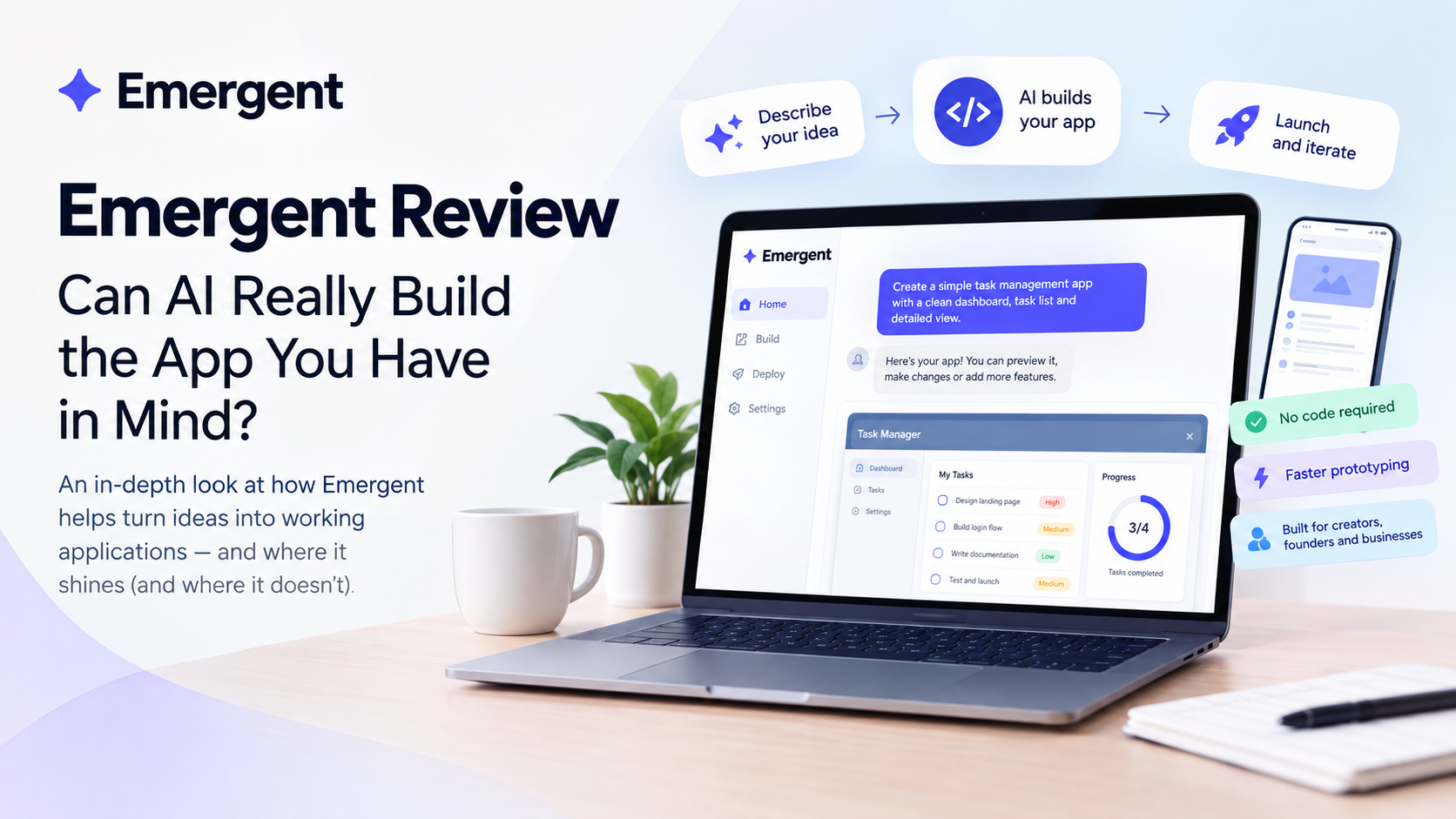
Artificial intelligence is changing the way people approach software development. What once required a team of developers, designers, and technical specialists can increasingly be started with something much simpler: a conversation with an AI tool. Emergent is part of this growing category of AI-powered development platforms, designed to help users turn an idea into a functional application by describing what they want in natural language.
That proposition is particularly interesting for people who have a good product idea but don’t necessarily have the technical skills or budget to build it from scratch. Instead of beginning with lines of code, frameworks, databases, and development environments, users can begin by explaining the product they want to create. But while the idea sounds impressive, there is a more important question to consider: how useful is Emergent when you move beyond the initial concept and actually try to build something practical?
After looking at the platform from an editorial perspective, Emergent is best viewed as an AI-assisted development environment that can reduce the distance between an idea and a working application. It has plenty of potential, particularly for entrepreneurs, creators, small businesses, and developers looking to speed up parts of the development process. At the same time, it is important to understand what the platform can realistically deliver and where traditional development expertise is still necessary.
What Is Emergent?
Emergent is an AI-powered platform designed to help users create software applications using natural-language instructions. Rather than requiring users to manually write every part of an application, the platform allows them to describe the product, functionality, and experience they want to create, while AI handles much of the technical implementation.
This approach is part of a broader movement toward AI-assisted development and what is often described as “vibe coding.” The basic idea is relatively straightforward: instead of thinking primarily in terms of programming languages and technical syntax, users communicate their requirements in everyday language and allow AI to translate those requirements into software.
For a non-technical entrepreneur, this can be a significant change. Someone might have an idea for a customer dashboard, booking platform, internal business application, productivity tool, or online service but have no idea how to start building it. Traditionally, they would need to learn programming, hire a developer, or work with an agency. Emergent provides another route by allowing the user to start with the idea itself.
Of course, describing an application is not the same thing as engineering a complete production-ready product. However, removing some of the technical barriers at the beginning can make experimentation much easier.
Getting Started With Emergent
One of the most appealing aspects of Emergent is its conversational approach to application development. Traditional software development can be intimidating, particularly for someone who has never worked with code. There are programming languages, frameworks, databases, APIs, hosting environments, authentication systems, deployment processes, and countless other technical considerations.
Emergent changes the starting point by allowing users to focus first on what they want the application to do.
Instead of asking which programming language should be used or how a database should be structured, a user can begin by explaining the intended product. The AI can then use that description to create an initial version of the application and help develop it further.
This makes the experience feel less like sitting in front of a blank code editor and more like explaining a product idea to a technical collaborator.
The conversational approach is also useful because most applications need several rounds of changes. The first version is rarely perfect. Users may discover that a particular page doesn’t work as expected, that a workflow needs to change, or that additional functionality is required. Being able to continue explaining those requirements through natural language makes the development process more approachable.
Emergent for Entrepreneurs and Startups
Entrepreneurs may be one of the groups that benefit most from this type of platform. Building a software product traditionally requires an investment of time and money before you can even determine whether the underlying idea has potential.
Emergent can change that equation by making it easier to create an early version of a product and test the concept.
For a startup founder, this can be particularly valuable during the MVP stage. Instead of spending months developing a product before showing it to potential customers, a founder can potentially create an early working version, collect feedback, and use that feedback to decide what should be built next.
The value here is not simply the amount of coding that AI can perform. It is the ability to experiment more quickly.
A product idea that looks great on paper may not work when real users interact with it. Being able to build something tangible and test it early can prevent businesses from investing heavily in an idea that needs significant changes.
How Useful Is Emergent for Non-Technical Users?
This is arguably one of the most interesting areas of Emergent. Many people understand the business problem they want to solve but don’t understand the technical process required to build software. A business owner might know exactly what information employees need to see on a dashboard or how customers should move through a booking process, but they may have no understanding of programming.
Traditionally, that business knowledge would need to be translated into technical requirements for a developer. AI-assisted development changes that relationship. The user can describe the desired outcome in relatively normal language, while the AI handles much of the technical translation.
That doesn’t mean technical knowledge suddenly becomes irrelevant. As projects become more complicated, users will benefit greatly from understanding basic concepts such as databases, authentication, APIs, application logic, and deployment.
In other words, Emergent lowers the barrier to software development, but it doesn’t completely remove the need for technical thinking.
Where Emergent Really Stands Out
The biggest strength of Emergent is the ability to move quickly from an idea to something tangible. This can be particularly useful during the early stages of product development, when speed and experimentation matter more than having a perfectly engineered final product.
For example, a business might want to test a new internal workflow. Rather than commissioning a complete custom application immediately, it could first create an early version and see whether employees actually find it useful. Similarly, a founder could create a prototype and use it when speaking with potential customers, investors, or partners.
This ability to turn an abstract idea into something that people can actually interact with can be extremely valuable. Another advantage is that the conversational interface makes the development process easier to understand for beginners. Instead of being forced to learn an entire technical stack before building anything, users can focus on describing the result they want.
For developers, the value is somewhat different. Rather than replacing their skills, AI can potentially reduce the amount of repetitive implementation work involved in certain projects. Experienced developers can use AI-generated work as a starting point and then review, modify, test, and improve it.
Where You Still Need to Be Careful
This is where expectations become important. AI can generate software, but that doesn’t mean every application it creates will automatically be secure, scalable, reliable, or ready for production. Software development involves considerably more than simply producing code. Applications can contain bugs, unexpected behavior, poor architectural decisions, security vulnerabilities, or functionality that technically works but doesn’t provide a good user experience.
For a small prototype, these issues may be relatively easy to identify and correct. For a business-critical application handling customer information, payments, sensitive data, or large volumes of traffic, the consequences can be much more serious. Users should therefore think of Emergent as a development accelerator rather than a magic replacement for software engineering. The more complex the application becomes, the more important testing and technical review become.
Design and User Experience Still Matter
Another point worth considering is that a technically functional application isn’t necessarily a good product. People expect modern software to be intuitive, responsive, visually consistent, and easy to navigate. An application can perform every required function and still provide a poor experience if users struggle to understand what they are supposed to do.
This is where human judgment remains extremely important. After creating an application with Emergent, users should evaluate it from the perspective of the people who will actually use it. Is the navigation straightforward? Are important actions easy to find? Does the workflow make sense? Are there unnecessary steps? Does the interface feel appropriate for the intended audience? These questions aren’t simply technical. They involve product strategy, design, and an understanding of users.
For a customer-facing product, this can be particularly important. A basic internal tool may be perfectly acceptable with a simple interface, while a commercial application competing for customers needs considerably more attention to design and usability.
Can Emergent Handle Complex Applications?
Emergent can be an interesting option for creating prototypes and applications, but users should be more cautious as project complexity increases. A simple application with a relatively straightforward workflow is very different from a large platform involving multiple user types, complex permissions, extensive integrations, payment processing, sensitive information, or high traffic. AI can potentially assist with many aspects of these projects, but that does not eliminate the need for proper architecture, security reviews, testing, monitoring, and ongoing maintenance.
This is particularly important for businesses. A prototype can tolerate a few rough edges while a production application cannot. For serious commercial projects, Emergent may therefore be best used as part of a broader development process rather than as the only development resource.
Emergent vs Traditional Software Development
The most useful way to think about Emergent isn’t necessarily as a direct competitor to professional developers. Traditional development and AI-assisted development can serve different purposes.
A professional development team brings years of experience in architecture, security, performance, testing, scalability, and product engineering. Emergent, meanwhile, offers speed and accessibility. For someone testing an idea, speed can be more important than perfect architecture. For a mature business running critical infrastructure, reliability and long-term maintainability may matter considerably more.
There is therefore room for both approaches. A founder could use Emergent to create an early prototype and later work with developers to turn that concept into a more robust product. A developer could use the platform to accelerate certain parts of a project while maintaining control over the important technical decisions.
Is Emergent Worth Trying?
For the right type of user, Emergent is certainly worth exploring.
If you have an application idea but don’t know how to start, the platform provides a much more approachable entry point than traditional software development. It can be particularly useful for prototypes, MVPs, experiments, internal business tools, and early product concepts.
The platform’s biggest advantage is arguably the reduction in friction between having an idea and creating something people can actually use. However, users should avoid the assumption that AI eliminates software development entirely. As an application becomes more important and more complex, human oversight becomes increasingly valuable. Understanding what the AI has created, testing the application thoroughly, reviewing security, and thinking about long-term maintenance are still essential parts of building good software.
Final Verdict
Emergent is an interesting example of how AI is changing software development. Instead of forcing users to begin with programming languages and technical infrastructure, it allows them to begin with an idea and communicate what they want to build in natural language. That makes software development considerably more accessible, particularly for entrepreneurs, creators, small businesses, and people experimenting with new product ideas.
Its biggest strength is speed. The ability to move from a concept to a working prototype can help users test ideas, gather feedback, and make decisions before committing significant resources to a full development project. At the same time, Emergent shouldn’t be treated as a universal replacement for developers. Complex applications still require careful thinking around architecture, security, scalability, testing, and maintenance.
Overall, Emergent is best viewed as a bridge between an idea and a working piece of software. It doesn’t make the underlying complexity of software disappear, but it provides a much easier way to start navigating that complexity. For anyone who has ever had a software idea but felt that the technical barrier was too high, that alone makes Emergent an interesting platform to try.
Affiliate Disclosure: This article may contain affiliate links. If you purchase a product or sign up for a service through one of these links, we may earn a commission at no additional cost to you. Our reviews and opinions are based on our editorial assessment and are not influenced solely by affiliate compensation.