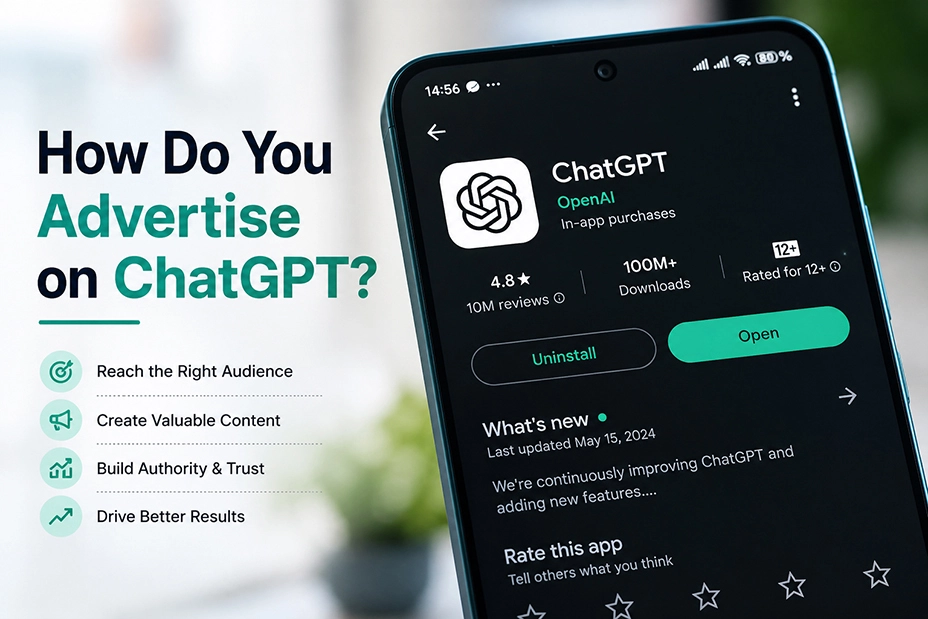
For years, digital advertising was built around search engines, social feeds, keywords and websites. A customer searched for a product, saw an advertisement and then decided whether to click. ChatGPT is creating a different kind of advertising environment—one where people are already having conversations, researching options, comparing products and asking for recommendations before they make a decision. This makes advertising on ChatGPT particularly interesting for brands that want to reach consumers at the consideration stage rather than simply compete for traditional search keywords.
OpenAI has introduced ChatGPT Ads, allowing eligible businesses to promote products and services within the ChatGPT experience. Advertisements are clearly identified as sponsored content and appear separately from ChatGPT’s answers. Importantly, advertisers cannot pay to influence or change the answers generated by ChatGPT. The advertising system and the conversational model operate separately.
What Exactly Is ChatGPT Advertising?
ChatGPT advertising is a paid advertising opportunity inside ChatGPT where eligible businesses can promote their products or services to users while they explore options, compare alternatives and make purchasing decisions. According to OpenAI, ads can appear below ChatGPT responses and include elements such as the advertiser name, logo or favicon, headline, description, landing page and creative image
The important distinction is that an advertisement is not the same thing as a ChatGPT recommendation. A sponsored placement is clearly labelled, and seeing an advertisement does not mean that ChatGPT has independently recommended or endorsed that company. OpenAI also states that advertisements do not influence the answers produced by ChatGPT.
This creates an interesting opportunity for brands. Imagine someone asking ChatGPT about home office furniture, travel destinations, productivity software, electronics or a particular type of consumer product. Instead of relying exclusively on traditional search advertising, a relevant brand can potentially appear within that decision-making environment. The opportunity is less about interrupting the consumer and more about being visible while the consumer is already researching.
Who Can Advertise on ChatGPT?
The first requirement is access to OpenAI’s advertising platform. Businesses can sign up through OpenAI Ads Manager, where they can create and manage advertising campaigns. OpenAI currently provides a self-service advertising environment, although availability varies by country and is still expanding. If Ads Manager is not yet available in a particular market, businesses can create an account and receive notification when access becomes available.
The easiest starting point is the official OpenAI Ads Manager. OpenAI’s current advertising platform also offers a promotional incentive for new advertisers: the Ads website currently advertises $500 in ad credit when you spend $500, subject to the applicable terms and eligibility.
Businesses should also understand that ChatGPT advertising is not an unrestricted advertising channel. OpenAI has advertising policies governing both where advertisements can appear and what businesses can advertise. The current program focuses primarily on consumer categories such as lifestyle and household products, local services, travel and experiences, and digital products or education. Some financial, healthcare and legal advertising may be approved under specific conditions, while several sensitive or regulated categories remain restricted or prohibited.
Step 1: Prepare Your Business Before Creating the Account
Before opening Ads Manager, it is worth getting the basic advertising assets ready. You will generally need a legitimate business or advertiser identity, a website or landing page, brand information, advertising creative, billing information and a payment method. OpenAI’s setup process also includes account verification.
Your website is particularly important because the landing page is part of the advertisement. It should clearly explain what you are offering, match the advertisement and provide a useful next step for the visitor. A strong ChatGPT advertisement should never promise one thing and send the user to a page offering something completely different. OpenAI’s policies require advertising assets and landing pages to be consistent with one another.
This is also the stage where a marketer should define the actual business objective. Are you trying to generate awareness? Do you want website traffic? Are you trying to generate purchases, registrations or another measurable action? Your answer will determine how you structure the campaign later.
Step 2: Create Your OpenAI Ads Manager Account
Once you are ready, visit Ads Manager and select Log in or Sign up. OpenAI says you can use an existing OpenAI account associated with your work email or create a new account. During setup, you can either begin by entering your website and creating a campaign or enter Ads Manager first and build the campaign afterward.
After entering the platform, you should complete the advertiser profile. This includes your business information and brand identity. OpenAI’s current quickstart guidance also instructs advertisers to add their brand logo, establish their billing profile and payment method, complete account verification and invite relevant team members where necessary.
For a company with multiple people working on marketing, it is better to have one primary administrator create the advertiser account and then invite other employees or agencies who need access. This keeps account ownership and permissions organized rather than creating multiple disconnected advertiser accounts.
Step 3: Choose Your Campaign Objective
After your account is ready, the next major decision is your campaign objective. This is where ChatGPT Ads starts to resemble other professional advertising platforms, but the available buying options are designed around different marketing goals.
OpenAI currently supports objectives including Views/Reach, Clicks and Conversions, with the exact interface and terminology potentially changing as the platform develops. A Views or Reach campaign is designed to maximize exposure and uses CPM-based buying, meaning you pay according to impressions. A Clicks campaign is designed to drive traffic and uses CPC-based buying, while conversion-focused campaigns are designed around downstream actions after the click.
For example, a newly launched luxury travel brand may initially want visibility and choose a reach-oriented campaign. An e-commerce company launching a new product may prefer a clicks objective to bring qualified visitors to its product page. A mature online retailer with proper conversion tracking may want to optimize toward purchases or another supported conversion event.
The important point is not to choose an objective simply because it sounds attractive. Your campaign objective should match the business outcome you actually want.
Step 4: Set Your Budget, Dates and Target Countries
Once the objective is selected, you can establish your campaign budget and schedule. Current campaign settings include the campaign title, objective, budget, start and end dates and countries you want to target. Depending on the campaign setup, additional targeting options such as platforms and custom audiences may also be available.
Budget planning deserves particular attention because ChatGPT advertising is still a developing channel. Rather than committing a large budget immediately, many advertisers would be better served by treating the first campaign as a structured learning phase. Start with an amount that allows you to collect meaningful performance data, identify which creative messages work and understand the quality of the traffic before scaling.
For CPC campaigns, OpenAI currently recommends starting with a maximum bid of approximately $3–$5 USD per click, although actual competitive requirements can vary. The system uses a relevance-weighted auction, meaning winning an auction is not simply about offering the highest possible bid.
Step 5: Build Your Ad Groups Around User Intent
This is where ChatGPT advertising becomes particularly different from traditional keyword advertising.
Instead of creating an enormous list of individual search keywords, advertisers can use context hints to describe the types of conversations, topics or situations in which their products may be relevant. These hints guide the system but do not function as exact-match keywords and do not guarantee that your advertisement will appear in a particular conversation.
For example, a travel company could structure an ad group around international vacation planning, while an electronics company could create an ad group focused on people comparing laptops for professional work. A home furniture brand could build another around people researching home-office setups.
The goal is to communicate the context in which your product is useful, rather than simply stuffing the account with disconnected keywords.
Step 6: Create the Actual ChatGPT Advertisement
Your advertisement is the creative unit that users see. Current ChatGPT Ads can include your brand name, logo, headline, description, landing page and image. OpenAI recommends creating clear, specific and benefit-focused messaging rather than relying on vague marketing slogans.
A useful advertisement should answer a simple question: Why should this product matter to this person right now? For example, instead of writing a generic headline such as “Discover Our Amazing Products,” a stronger message would explain the practical value of the product. The headline should communicate what the product is or why it is useful, while the description should provide additional information rather than simply repeating the headline.
OpenAI recommends multiple variations for an offering so the advertising system has more opportunities to identify relevant placements. The variations should not merely change a few words; each should present a genuinely different angle, benefit or use case.
Step 7: Prepare Your Landing Page and Tracking
Your advertisement is only the beginning of the customer journey. If someone clicks your ChatGPT advertisement, the landing page needs to continue the same story.
Make sure the landing page loads correctly, works on mobile devices, clearly explains the product and provides an obvious next action. The page should also match the language and offer presented in the advertisement.
For performance measurement, OpenAI currently supports conversion measurement and allows advertisers to add tracking parameters such as UTM parameters to landing-page URLs. These parameters can then be used with existing analytics systems to identify traffic originating from ChatGPT Ads.
For marketers, this is essential. Do not judge the campaign only by impressions or clicks. Look at what happens after the click. A campaign that generates fewer visitors but produces higher-quality leads or customers may be considerably more valuable than one that generates inexpensive traffic.
Step 8: Review Your Advertisement and Launch
Before launching, check the brand name, logo, headline, copy, landing page and image. Make sure every element accurately represents the same offer and complies with OpenAI’s advertising policies.
OpenAI’s launch process requires the advertiser account, billing profile and payment method to be established before campaigns can be launched. You then select or create your campaign, build the relevant ad groups and add the advertisements.
Once the campaign passes the relevant checks and is launched, the real work begins. Advertising should not be treated as a “set it and forget it” activity. Monitor performance, identify strong creative variations and adjust the campaign based on actual results.
How Much Does It Cost to Advertise on ChatGPT?
There is no single flat price for ChatGPT advertising. Current buying options include CPM, where advertisers pay for impressions, and CPC, where advertisers pay for valid clicks. Conversion-oriented buying options are also available in the current Ads Manager environment.
Your actual costs can depend on factors such as campaign objective, bid, competition, relevance and delivery. For CPC campaigns, OpenAI currently recommends a starting maximum bid of $3–$5 per click, but that should not be interpreted as a guaranteed market price.
This is why businesses should think about return on advertising spend rather than simply chasing the lowest click price. If a $5 click produces a qualified customer worth substantially more to the business, it may be more valuable than a $1 click that produces no meaningful action.
What Makes ChatGPT Advertising Different?
The biggest change is the environment in which the advertisement appears. Traditional advertising often tries to predict what a person might be interested in based on searches, browsing behavior or demographic information. ChatGPT advertising can operate in an environment where the user is explicitly explaining what they are trying to accomplish.
OpenAI says its ad system can consider conversation context and intent, along with factors such as the landing page, advertising copy, advertiser-provided context hints and, where personalization is enabled, selected signals from the user’s broader ChatGPT experience.
That makes relevance especially important. A brand should not simply ask, “What keywords should we target?” The more strategic question is, “What problems are our customers trying to solve, and in which conversations would our product genuinely be useful?”
That shift from keyword targeting to conversational intent—could become one of the defining characteristics of AI-native advertising.
The Future of Advertising on ChatGPT
ChatGPT advertising is still developing rapidly. OpenAI has recently expanded its advertising technology with new creative tools, measurement capabilities and integrations, including Shopify and HubSpot, while also testing new experiences such as sponsored agents.
OpenAI has also introduced a new visual advertising format designed to help people explore products and services more visually. This indicates that ChatGPT advertising is moving beyond a simple text-based sponsored placement toward a broader advertising ecosystem.
For businesses, the opportunity is therefore larger than simply adding another advertising channel to a media plan. ChatGPT could become an important part of the journey between discovery, research, comparison and purchase.
The brands most likely to benefit will not necessarily be the ones with the loudest advertisements. They will be the brands that understand their customers deeply enough to create useful, specific and contextually relevant messages.
Final Takeaway: How to Start Advertising on ChatGPT
The process is relatively straightforward: create an OpenAI Ads Manager account, complete your business and billing information, verify the account, choose a campaign objective, establish your budget and target markets, create intent-focused ad groups, upload multiple relevant advertisements, connect a strong landing page, configure tracking, review your campaign and launch.
But the real competitive advantage comes from what happens before you press the Launch button. Your campaign needs a clear audience, a meaningful business objective, strong creative, a useful landing page and a measurement strategy. ChatGPT advertising is not simply another version of Google or social media advertising; it is an emerging form of AI-native advertising built around conversations and decision-making.
For marketers looking to reach international consumers, e-commerce shoppers, travellers, technology buyers, lifestyle audiences or people researching products and services, this creates a new opportunity to appear at precisely the moment when someone is actively exploring a decision. As ChatGPT Ads continues to expand, understanding conversational intent, creating useful advertising messages and building strong first-party measurement could become increasingly important for modern digital marketing strategies.
Affiliate Disclosure: This article may contain affiliate links. If you purchase a product or sign up for a service through one of these links, we may earn a commission at no additional cost to you. Our reviews and opinions are based on our editorial assessment and are not influenced solely by affiliate compensation.