For more than five decades, the Nike Swoosh has represented movement, performance and ambition. It has appeared on running shoes, basketball sneakers, football jerseys, hoodies, caps, bags and countless pieces of streetwear, becoming one of the most recognisable symbols in modern fashion. Now, Nike is taking that familiar mark somewhere much more unexpected: jewellery. For Holiday 2026, the sportswear giant is stepping into the demi-fine jewellery category with a collection built around the Swoosh, transforming a logo traditionally associated with athletic performance into something designed to be worn as an everyday accessory.
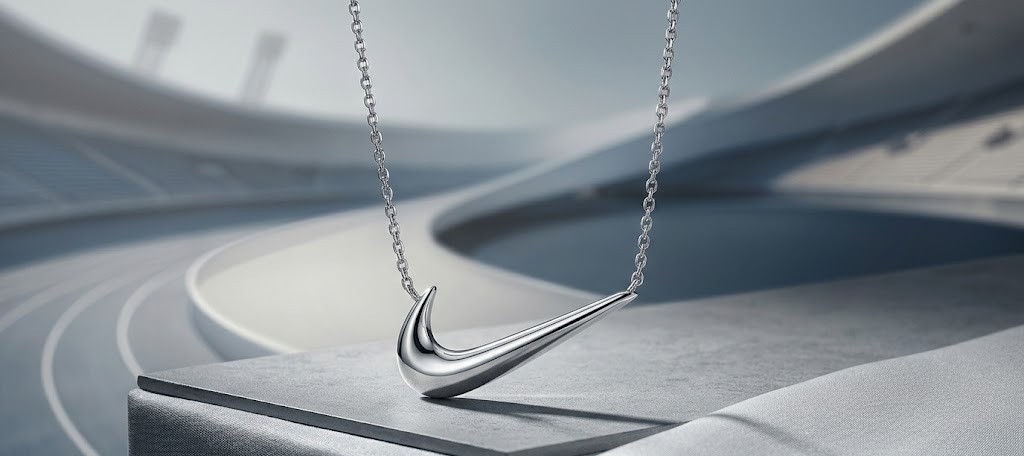
The move feels significant because Nike is not simply putting its logo on a conventional piece of merchandise. Instead, the Swoosh itself becomes the design. The debut collection introduces Swoosh hoop earrings and a Mini Swoosh necklace, crafted from S925 sterling silver and offered in white rhodium and 14-karat gold vermeil finishes. The result is noticeably more polished than the kind of novelty sports jewellery that often treats a logo as an afterthought. Nike is approaching the category with the same principle that has shaped its strongest products for decades: take a familiar symbol, simplify it and make it desirable in a completely different context.
From the Side of a Sneaker to the Centre of a Jewellery Collection
The Swoosh has always been more than a corporate logo. It has become a cultural shorthand. You do not necessarily need to see the word “Nike” to recognise the curved mark, and that level of visual recognition is precisely what gives the jewellery collection its potential. A small Swoosh on a necklace can communicate the same brand identity as a giant logo on a sweatshirt, but in a considerably more understated way. This is where Nike’s jewellery strategy becomes interesting: the brand is exploring what happens when an athletic emblem becomes a personal adornment rather than simply a branding device.
The first pieces are deliberately restrained. The Swoosh Hoop Earrings measure 29mm in diameter, with the logo integrated directly into the hoop rather than hanging from it as a separate charm. They are constructed from sterling silver and come in a white rhodium-plated version priced at $225, while the 14k gold vermeil version is priced at $295. The Mini Swoosh Necklace takes an even quieter approach, integrating a 22mm Swoosh into a thin curb chain that can be adjusted between approximately 42.5cm and 52.5cm. The silver version is listed at $165, with a gold vermeil version also reported.
That restraint is important. Nike could have gone in a much louder direction, covering the jewellery in oversized logos or creating miniature sneaker charms, but the collection appears to understand the current appetite for subtle branding. Luxury consumers increasingly recognise that a premium accessory does not always need to announce itself from across the room. The most effective pieces often work through proportion, material, finish and recognisability. Nike’s decision to reduce the Swoosh into a compact piece of metal allows the logo to function almost like a signature.
Nike’s Luxury Upgrade Is Really About Brand Perception
Calling the collection “luxury” requires a little nuance. These are not haute joaillerie pieces covered in diamonds or crafted from solid precious metals. Nike is positioning the collection closer to demi-fine jewellery, where sterling silver, gold vermeil and accessible premium pricing create a bridge between fashion accessories and traditional fine jewellery. That distinction matters because Nike is not trying to compete directly with heritage jewellery houses on craftsmanship or rarity. Instead, it is competing on something it already owns: cultural relevance.
The pricing reinforces that positioning. At $165 for the reported silver necklace and up to $295 for the gold vermeil hoops, the collection sits well above a basic fashion accessory while remaining far below the price territory of established luxury jewellery houses. It creates an interesting middle ground for consumers who may already spend hundreds of dollars on sneakers but have never considered buying a designer jewellery piece.
This could also be part of a larger shift in how sportswear brands approach lifestyle fashion. Nike has spent years moving beyond the idea that it is simply a performance company. Its cultural influence now extends across sneakers, streetwear, fashion collaborations, collectibles and accessories. Jewellery is another logical extension of that ecosystem. Once a brand’s symbol becomes culturally powerful enough, almost any category can become a canvas.
The Swoosh Was Already Becoming Jewellery Before Nike Made It Official
Interestingly, Nike’s move into jewellery does not come completely out of nowhere. The Swoosh has been moving toward jewellery-like territory for years through footwear details, limited-edition designs and special projects. Nike has experimented with metallic Swooshes, decorative finishes and custom pieces that blur the boundaries between sports equipment, fashion and adornment.
The brand’s 2026 After Dark Tour provides an especially clear example. Nike redesigned its race medal so that it could be worn as a necklace, bracelet, keychain loop or belt chain, while a related accessory collection included Swoosh hoop earrings, textured Swoosh studs and earbud cuffs. Nike itself described the medal as something intended to live beyond the finish line, turning a traditional athletic achievement into a wearable object of self-expression.
That evolution makes the new Swoosh jewellery collection feel less like a random experiment and more like the next stage of a broader design philosophy. Nike has gradually been teaching consumers to think of its symbols not only as identifiers of athletic performance, but also as objects that can be collected, styled and worn.
Why Jewellery Makes Sense for Nike in 2026
There is another reason this move feels particularly relevant now: the continuing convergence of streetwear, sportswear and luxury fashion. The old boundaries between sneakers, designer clothing and fine accessories have become increasingly fluid. A pair of performance sneakers can appear in a luxury fashion editorial, while jewellery can borrow visual language from sports culture.
Nike has enormous advantages in this environment. Its Swoosh already possesses the kind of instant recognition that emerging jewellery labels spend years trying to build. A new jewellery company might need an elaborate campaign to explain what its symbol represents. Nike does not. The logo arrives with decades of cultural history attached to it.
There is also a generational dimension to the move. Consumers who grew up with Nike sneakers, basketball culture, streetwear and Y2K fashion are now older and increasingly interested in premium accessories. The aesthetic of logo jewellery itself has also experienced a revival, with the early-2000s appetite for branded necklaces, hoops and statement accessories returning in updated forms. Nike’s new collection taps into that nostalgia while giving it a cleaner, more contemporary treatment.
Minimalism Could Be Nike’s Secret Weapon
The strongest element of the collection may ultimately be its simplicity. Instead of treating the Swoosh as a decorative graphic placed onto jewellery, Nike integrates it into the structure of the pieces. The hoop earrings use the logo as part of the form, while the necklace places the Swoosh directly within the chain. That difference may seem subtle, but it changes how the product is perceived.
A logo printed onto an accessory feels promotional. A logo engineered into the object feels designed.That distinction is at the heart of modern luxury branding. The best luxury accessories often transform brand identity into something tactile and functional. A recognisable monogram, clasp, pattern or silhouette can become part of the construction rather than an advertisement applied at the end. Nike’s jewellery follows a similar philosophy, even if it operates at a more accessible price point.
The necklace, in particular, has the potential to work beyond traditional Nike styling. Because the Swoosh is relatively small and the chain is understated, it can be worn alone or layered with other necklaces. The result is less “sports merchandise” and more “fashion accessory with a sports heritage.” That subtle shift could determine whether the collection becomes a one-season novelty or the foundation of a longer-term jewellery category.
But Can Nike Really Become a Jewellery Brand?
This is where the strategy becomes more complicated. Nike has an extraordinarily strong identity in footwear and athletic apparel, but jewellery is governed by a different set of expectations. Consumers who buy jewellery often evaluate materials, craftsmanship, durability, finishing and long-term value differently from consumers purchasing sneakers.
A $295 pair of Nike gold-vermeil hoops will inevitably be compared with jewellery from brands whose entire reputation has been built around precious metals and craftsmanship. Nike therefore cannot rely on the Swoosh forever. Brand recognition may create the initial desire, but product design will have to sustain it.
The first collection wisely avoids overcomplication. But future collections will need to evolve. The opportunity is enormous if Nike can build a distinctive jewellery language rather than simply producing more versions of the logo. Different silhouettes, sculptural pieces, chains, rings, cuffs and potentially more experimental interpretations could allow Nike to create an identifiable design universe around movement and sport.
The danger is that the Swoosh could become too literal. If every future jewellery release simply enlarges, shrinks or repeats the same logo, the category could quickly feel like expensive merchandise. Luxury is built not only on recognition, but also on restraint, innovation and scarcity.
The Bigger Story Is About the Future of Sports-Luxury
Nike’s jewellery experiment reflects something larger happening across fashion: performance brands are increasingly becoming lifestyle and luxury-adjacent brands. Consumers no longer divide their wardrobes into neat categories of sportswear, fashion and luxury. A sneaker can be a collector’s object. A running medal can become jewellery. A technical jacket can appear in a luxury wardrobe. And now, a sports logo can become an accessory worn for style rather than sport.
That is why the Swoosh necklace feels more important than it initially appears. It represents a change in the physical scale of Nike’s brand identity. The Swoosh is moving from products that cover the body to an object that sits directly on it. It is becoming intimate.
Nike is effectively asking consumers a different question. Instead of asking whether they want to wear Nike, it is asking how they want to wear Nike.
That distinction could open a new chapter for the brand. The company has already demonstrated that its logo can carry cultural meaning far beyond running shoes. Turning that logo into demi-fine jewellery is a natural extension of that influence, particularly at a time when consumers increasingly value pieces that connect fashion, identity and culture.
The Swoosh Gets Its Most Personal Form Yet
Nike’s entry into jewellery may not transform the luxury jewellery industry overnight, nor is it attempting to replicate the world of traditional fine jewellery. Its real ambition appears more strategic: to turn one of the world’s most powerful sports symbols into a premium lifestyle object.
The upcoming Swoosh jewellery collection does exactly that. Sterling silver, white rhodium and 14k gold vermeil give the familiar mark a more elevated physical presence, while the minimal silhouettes prevent the pieces from becoming overly promotional. The result sits somewhere between sneaker culture, contemporary fashion and accessible luxury.
And perhaps that is the most compelling part of Nike’s jewellery move. The Swoosh does not need to become something completely different to enter luxury territory. It simply needs to be treated differently. After years of representing speed, performance and athletic ambition, the logo is now being polished, reduced and transformed into something people can wear around their necks and ears.
The Swoosh has always been a symbol of movement. In 2026, Nike is moving it into a new category and potentially into a new definition of what sportswear luxury can look like.
Affiliate Disclosure: This article may contain affiliate links. If you purchase a product or sign up for a service through one of these links, we may earn a commission at no additional cost to you. Our reviews and opinions are based on our editorial assessment and are not influenced solely by affiliate compensation.