In the modern global economy, wealth is no longer tied to a single nation, city, or continent. The world’s wealthiest individuals are increasingly mobile, strategic, and globally connected. Over the past decade and especially after the pandemic a new phenomenon has reshaped luxury real estate, private banking, taxation strategies, and international business wealth migration.
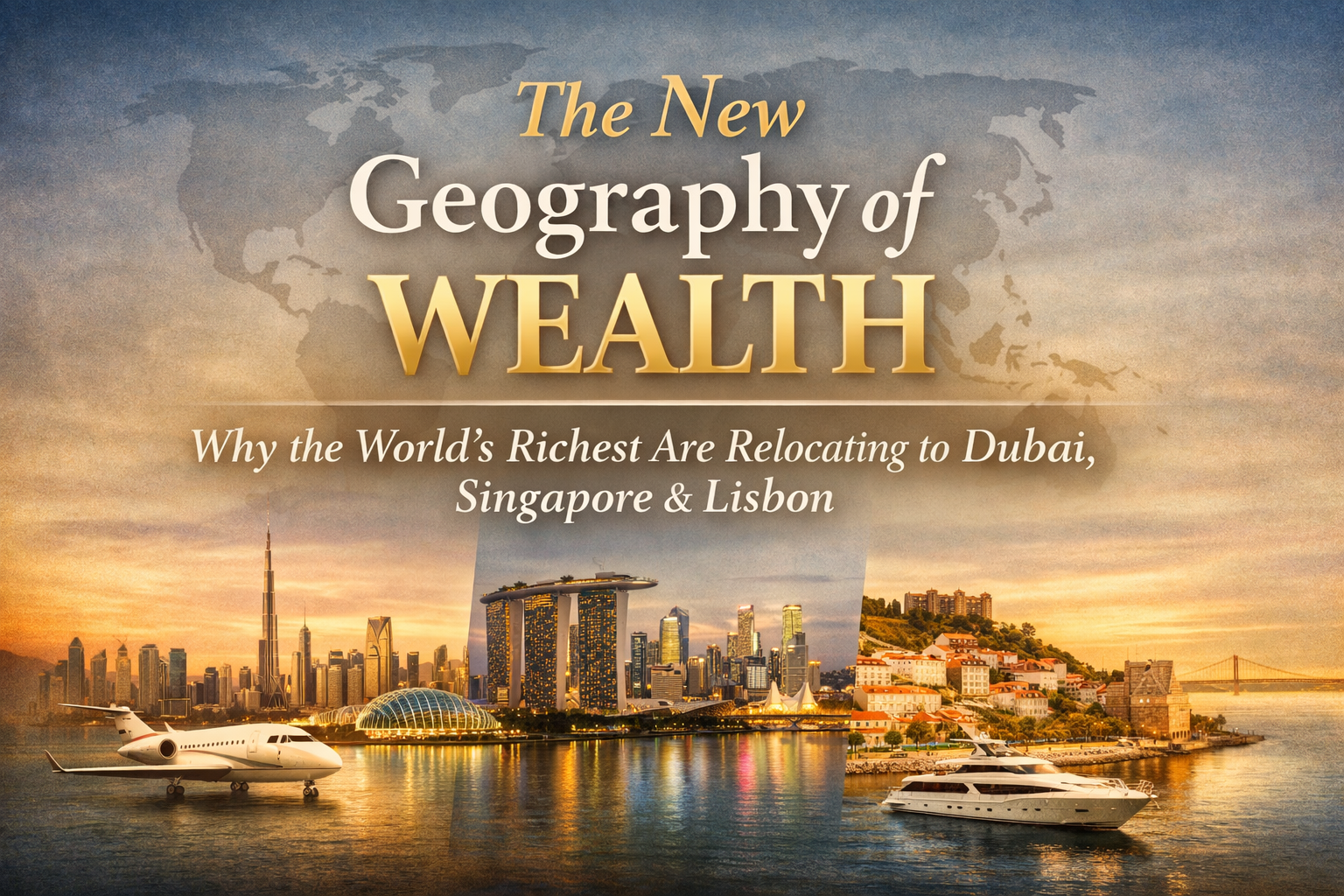
Today’s millionaires and billionaires are not simply choosing where to vacation they are carefully selecting where to live, invest, raise families, establish businesses, and protect long-term assets. As geopolitical uncertainty, rising taxes, inflation, and lifestyle priorities evolve, certain global cities have emerged as magnets for elite wealth. Among them, Dubai, Singapore, and Lisbon stand out as the new capitals of modern affluence.
These cities are not competing solely through luxury lifestyles. They are competing through tax efficiency, political stability, digital infrastructure, safety, international connectivity, and investment opportunities. Together, they represent a new geography of wealth one defined by mobility, flexibility, and global citizenship.
The Rise of Global Wealth Migration
Historically, wealthy individuals tended to remain tied to traditional financial centers such as London, New York, Paris, or Hong Kong. However, the modern wealthy class has become far more international. Technology has enabled businesses to operate globally, remote work has become normalized, and private wealth management has evolved into a borderless industry.
As a result, high-net-worth individuals (HNWIs) are increasingly relocating to countries that provide economic advantages alongside superior quality of life.
Several major factors are driving this trend:
- Rising taxation in Western economies
- Political and economic instability
- Demand for safer and cleaner cities
- Easier residency and investment programs
- Better business environments
- Luxury lifestyle opportunities
- International education and healthcare access
- Digital infrastructure and connectivity
The wealthy are no longer asking, “Where am I from?” Instead, they are asking, “Where does my wealth grow best?”
This shift has created fierce competition among cities and governments eager to attract affluent residents, investors, entrepreneurs, and global companies.
Dubai: The Luxury Capital of the New Economy
Few cities symbolize modern wealth migration more dramatically than Dubai. Once viewed primarily as a tourism and luxury shopping destination, Dubai has transformed into one of the world’s most influential wealth hubs.
Its appeal begins with taxation. The United Arab Emirates offers zero personal income tax, no capital gains tax for individuals, and highly favourable business conditions. For entrepreneurs, investors, and corporate executives, this creates enormous financial advantages compared to heavily taxed economies in Europe and North America.
But tax benefits alone do not explain Dubai’s rise. The city has aggressively positioned itself as a global lifestyle and business center. Luxury real estate developments, world-class infrastructure, elite hospitality, and international connectivity have elevated Dubai into a modern symbol of global ambition.
Ultra-luxury property demand has surged in recent years. Waterfront villas on Palm Jumeirah, penthouses overlooking Downtown Dubai, and branded residences connected to luxury hospitality groups have become highly desirable assets for international buyers.
The city also appeals to wealthy individuals seeking security and political neutrality. In an increasingly unstable world, Dubai markets itself as a safe haven economically, socially, and financially.
Beyond real estate, Dubai has become a center for:
- Private wealth management
- Cryptocurrency and fintech innovation
- Family offices
- Luxury retail
- Global entrepreneurship
- High-end tourism
- Aviation and logistics
Its location between Europe, Asia, and Africa further strengthens its global importance. Business leaders can easily operate across multiple markets while enjoying an unmatched luxury lifestyle.
Today, Dubai is no longer just a wealthy city. It is a strategic platform for international wealth itself.
Singapore: Asia’s Financial Fortress
While Dubai represents luxury-driven global ambition, Singapore represents precision, stability, and financial sophistication.
Singapore has become one of the world’s most trusted destinations for wealth preservation. For many ultra-high-net-worth individuals, especially from Asia, it functions as both a financial safe haven and a strategic business hub.
The city-state offers:
- Strong rule of law
- Political stability
- Highly secure banking systems
- Advanced digital infrastructure
- Competitive taxation
- Exceptional healthcare and education
Unlike many global cities struggling with rising crime or political polarization, Singapore maintains a reputation for efficiency, safety, and order. This reliability is incredibly valuable to wealthy families managing global assets.
Private banking has become one of Singapore’s strongest industries. Global banks, hedge funds, and family offices increasingly operate from the city, attracted by regulatory transparency and financial credibility.
Singapore has also become a major destination for technology founders, venture capital firms, and international investors. As Asia’s digital economy expands rapidly, Singapore sits at the center of innovation, finance, and regional business growth.
Luxury real estate demand has followed this economic success. High-end condominiums, waterfront residences, and exclusive districts continue attracting global elites despite strict regulations designed to manage property inflation.
Education is another major factor driving relocation. Wealthy families increasingly prioritize access to elite international schools and globally respected universities. Singapore’s educational ecosystem provides long-term advantages for globally mobile families.
Perhaps most importantly, Singapore offers predictability. In uncertain times, the wealthy value environments where systems function efficiently and long-term planning feels secure.
In many ways, Singapore represents the future of disciplined global wealth management.
Lisbon: Europe’s Lifestyle Wealth Magnet
Unlike Dubai’s futuristic luxury or Singapore’s financial precision, Lisbon attracts wealth through lifestyle, culture, and European accessibility.
Over the past decade, Lisbon has emerged as one of Europe’s most desirable destinations for affluent entrepreneurs, remote business owners, retirees, investors, and digital professionals.
Portugal’s residency and investment programs initially helped attract foreign capital, but lifestyle ultimately became Lisbon’s strongest asset.
The city offers:
- Mild climate and coastal living
- Historic architecture and culture
- Lower cost of luxury compared to Western Europe
- Access to the European Union
- Growing startup and tech ecosystem
- Strong tourism and hospitality industries
For many wealthy individuals, Lisbon represents balance combining European sophistication with slower, more relaxed living.
Luxury real estate has expanded rapidly, with historic mansions, coastal villas, and modern apartments attracting buyers from the United States, the United Kingdom, Brazil, and beyond.
The rise of remote work accelerated Lisbon’s global visibility. Entrepreneurs and investors discovered they could maintain international businesses while living in a city offering quality of life far superior to many overcrowded financial capitals.
Lisbon’s growing startup ecosystem has also strengthened its appeal. International founders increasingly view Portugal as a gateway into European markets, especially within technology, creative industries, and digital services.
At the same time, Portugal’s hospitality culture and lifestyle branding have transformed Lisbon into a premium global destination rather than merely a retirement city.
In a world where wealth increasingly prioritizes experience over status symbols, Lisbon offers something powerful: emotional luxury.
Luxury Real Estate: The New Asset Class
At the center of wealth migration lies luxury real estate.
For the wealthy, property is no longer only about housing. It functions as:
- Asset diversification
- Wealth preservation
- Residency access
- Lifestyle enhancement
- Global mobility
- Inflation protection
Prime real estate in Dubai, Singapore, and Lisbon has become deeply connected to international wealth flows.
Luxury buyers increasingly seek properties offering:
- Privacy and security
- Waterfront access
- Branded residences
- Smart-home technology
- Wellness-focused amenities
- Concierge services
- Investment potential
Developers are responding by creating ultra-premium living experiences that resemble five-star resorts more than traditional residences.
This trend has fuelled rapid growth in branded luxury real estate linked to hospitality groups and luxury brands. Wealthy buyers are not simply purchasing square footage they are buying identity, exclusivity, and global lifestyle access.
The Role of Private Banking and Family Offices
As global wealth becomes increasingly mobile, private banking institutions and family offices play a critical role in relocation decisions.
Wealthy individuals today require sophisticated financial ecosystems capable of managing:
- International taxation
- Cross-border investments
- Succession planning
- Philanthropy
- Asset protection
- Alternative investments
Dubai and Singapore, in particular, have aggressively expanded their capabilities in private wealth management.
Family offices private companies managing elite family wealth are growing rapidly across these cities. These organizations oversee investments, real estate portfolios, private equity, and generational wealth planning.
The rise of family offices reflects a broader transformation: the wealthy increasingly operate like multinational corporations.
The Future of Global Wealth
The relocation of the world’s richest individuals is not a temporary trend. It reflects a fundamental transformation in how wealth functions in the 21st century.
Modern wealth is:
- Mobile
- International
- Digitally connected
- Experience-driven
- Tax-conscious
- Lifestyle-oriented
Cities now compete not only for businesses but also for wealthy residents capable of driving investment, innovation, luxury spending, and global influence.
Dubai competes through ambition and opportunity.
Singapore competes through stability and financial excellence.
Lisbon competes through lifestyle and cultural sophistication.
Together, they represent the future of global affluence.
As technology continues reshaping business and remote work expands further, the geography of wealth will become even more fluid. Future wealth hubs may emerge across the Middle East, Southeast Asia, Southern Europe, and beyond.
What remains clear is this: the wealthy are no longer choosing cities based solely on geography. They are choosing ecosystems designed for global living.
And in that competition, the cities that combine opportunity, stability, luxury, and lifestyle will define the next era of international wealth.