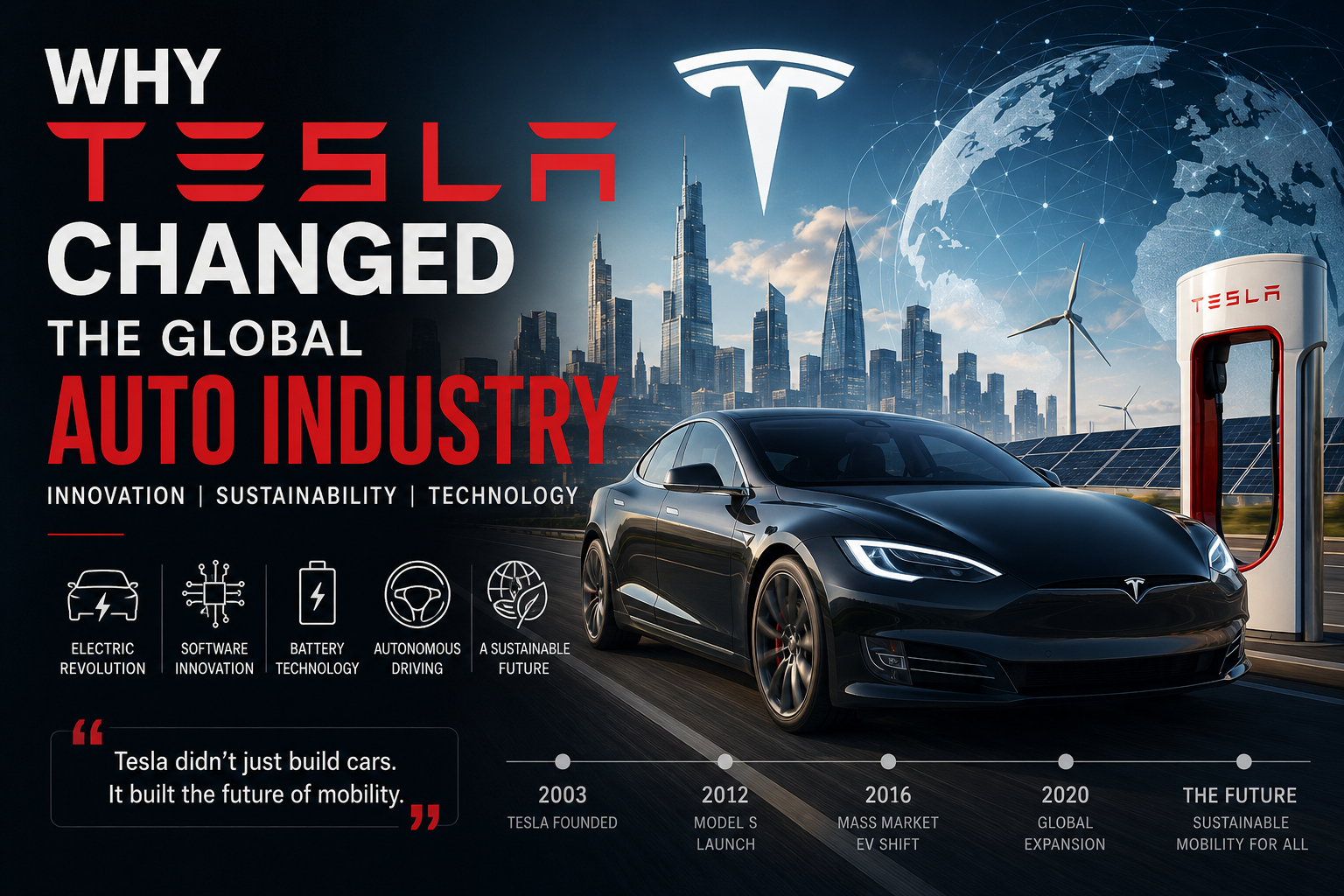
The global automobile industry has experienced multiple revolutions over the past century from the invention of mass production by Ford to the rise of Japanese efficiency models and German luxury engineering. However, the most disruptive transformation in recent decades has been driven by one company: Tesla.
Tesla did not just build electric cars; it redefined what a car company can be. It changed consumer expectations, forced legacy automakers to rethink their strategies, and accelerated the global shift toward sustainable transportation. Today, Tesla is not only a car manufacturer but also a technology and energy company that sits at the center of the electric vehicle (EV) revolution.
1. Making Electric Cars Desirable, Not Compromised
Before Tesla, electric vehicles were widely seen as slow, unattractive, and impractical. Early EVs had limited range, poor performance, and minimal design appeal. They were often treated as “eco-friendly compromises” rather than real alternatives to petrol or diesel cars.
Tesla changed this perception completely by launching high-performance electric vehicles that could compete with luxury sports cars. Models like the Tesla Roadster, Model S, Model 3, and Model Y demonstrated that electric cars could be fast, stylish, and technologically advanced.
Instead of sacrificing performance for sustainability, Tesla combined both. This shift changed consumer psychology worldwide: EVs were no longer a compromise they became aspirational products.
2. The Direct-to-Consumer Sales Model
Traditional automobile companies rely heavily on dealership networks. Tesla disrupted this system by adopting a direct-to-consumer sales model. Customers could order cars online, customize them digitally, and receive updates without visiting multiple dealerships.
This approach gave Tesla full control over pricing, customer experience, and brand identity. It also reduced inefficiencies and eliminated middlemen.
By treating cars like software products that can be sold and updated digitally, Tesla created a completely new automotive business model that many competitors are now trying to replicate.
3. Software-Driven Cars and Over-the-Air Updates
One of Tesla’s most revolutionary contributions is the idea that a car is a software platform. Unlike traditional vehicles, Tesla cars receive over-the-air (OTA) updates, similar to smartphones.
These updates can improve battery performance, add new features, enhance safety systems, and even unlock additional driving capabilities.
This software-first approach transformed the automobile industry in three major ways:
- Cars became upgradeable after purchase
- Continuous improvement replaced fixed design cycles
- User experience became dynamic rather than static
Companies like Ford, Toyota, and Volkswagen have since started investing heavily in software-defined vehicles to compete with Tesla’s model.
4. Building a Supercharger Network
One of the biggest barriers to EV adoption has always been charging infrastructure. Tesla solved this problem by building its own global fast-charging network known as Superchargers.
This network allows Tesla owners to travel long distances with minimal charging time, reducing “range anxiety,” one of the biggest concerns among EV buyers.
By controlling both the vehicle and the charging ecosystem, Tesla created a vertically integrated system that traditional automakers struggle to match.
5. Battery Innovation and Energy Efficiency
Battery technology is the heart of any electric vehicle. Tesla invested heavily in improving battery density, cost efficiency, and range performance.
Through partnerships and internal research, Tesla significantly reduced battery costs over time, making EVs more accessible to the mass market.
Its innovations in energy storage also extend beyond cars into renewable energy solutions, including large-scale battery systems for homes and industries.
This integration of mobility and energy positions Tesla as more than just a car manufacturer it is an energy technology company.
6. Autonomous Driving and AI Integration
Tesla has also been a pioneer in autonomous driving technology. Its Autopilot and Full Self-Driving (FSD) systems use advanced AI, cameras, and neural networks to assist drivers and improve road safety.
While fully autonomous driving is still evolving globally, Tesla has pushed the entire industry toward AI-based driving systems.
Companies such as Waymo and traditional automakers are now investing heavily in similar technologies due to Tesla’s early leadership in this space.
7. Brand Power and Global Influence
Tesla is not just a product company; it is a global brand phenomenon. It has successfully positioned itself as a symbol of innovation, sustainability, and futuristic living.
Unlike traditional car advertisements that focus on features, Tesla relies heavily on product performance, word-of-mouth marketing, and social media presence.
This unconventional branding strategy has created a cult-like following and significantly influenced consumer behaviour worldwide.
8. Forcing Legacy Automakers to Adapt
Perhaps Tesla’s biggest impact is how it forced traditional automakers to accelerate their EV strategies. Companies that once dominated the combustion engine era are now investing billions into electric mobility.
Brands such as BMW, Mercedes-Benz, and General Motors have all launched aggressive EV plans to compete in the changing market.
Without Tesla’s disruption, the global shift toward electric mobility would likely have taken much longer.
9. Challenges and Criticism
Despite its success, Tesla also faces challenges. These include production scalability, competition from emerging EV brands, regulatory scrutiny, and technological limitations in full autonomy.
However, even with these challenges, Tesla continues to set industry benchmarks that competitors strive to match.
Conclusion
Tesla has fundamentally changed the global automobile industry by redefining what a car can be. It transformed electric vehicles from niche eco-products into high-performance, technology-driven machines.
Through innovation in software, batteries, infrastructure, and autonomous systems, Tesla has forced the entire automotive world to evolve faster than ever before.
The result is a global industry now racing toward electrification, digitalization, and sustainability an evolution that would not have happened at this scale without Tesla’s disruptive influence.