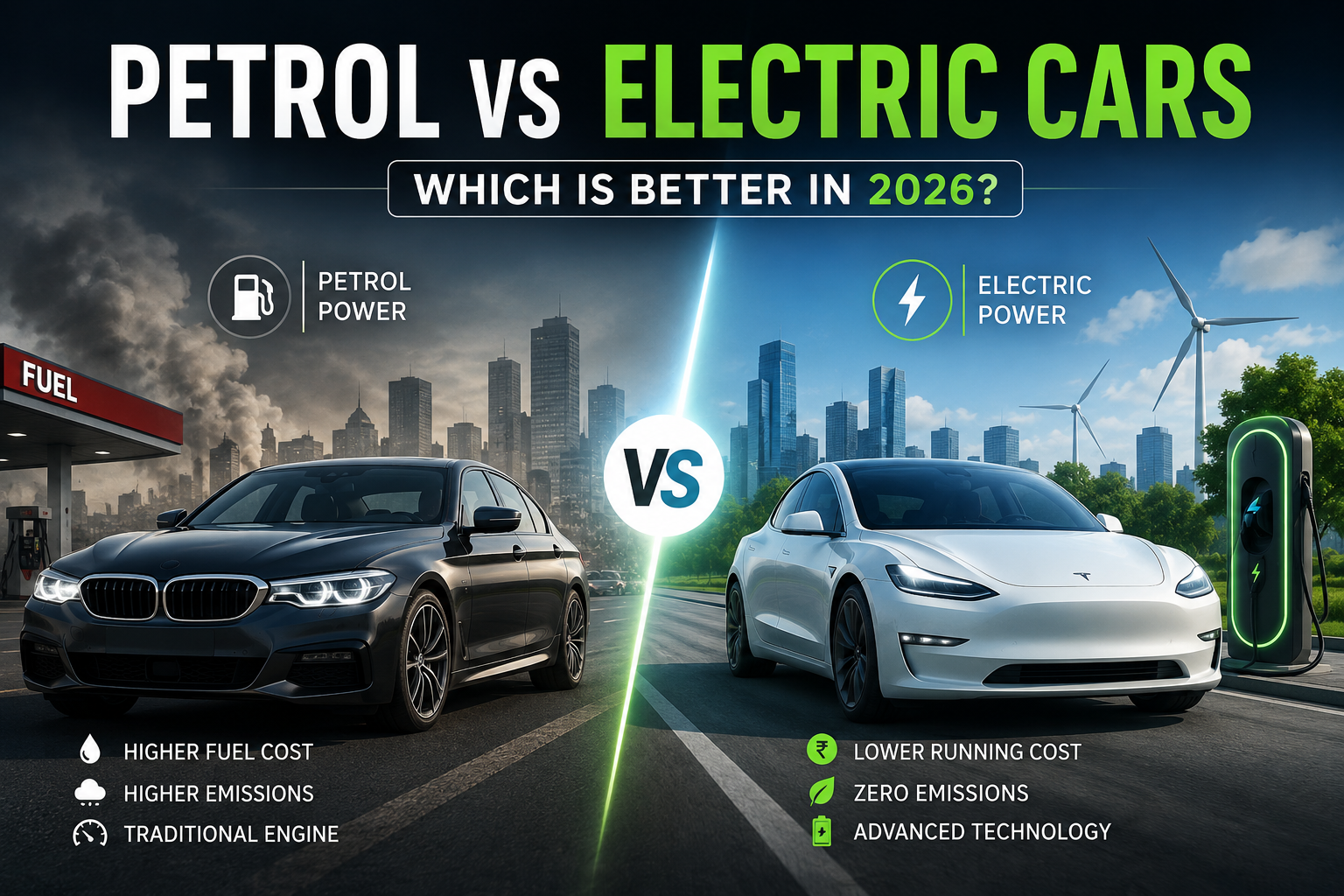
The global automobile industry in 2026 is at a major turning point. With rising fuel prices, stricter emission laws, and rapid advancements in battery technology, the debate between petrol cars and electric vehicles (EVs) has become more relevant than ever. Consumers worldwide are now asking a simple but important question: Which is better in 2026 petrol cars or electric cars?
The answer is not completely one-sided. Both petrol and electric cars have strengths and limitations depending on cost, infrastructure, usage, and region. This article provides a detailed international perspective to help understand which option is better in today’s world.
1. Global Shift in the Automobile Industry
Over the last decade, the automobile industry has moved toward sustainability. Governments in Europe, the United States, and parts of Asia are pushing for electric mobility through subsidies, tax benefits, and strict emission regulations.
Companies like Tesla, Toyota, BYD, and Volkswagen are heavily investing in electric and hybrid technologies. Meanwhile, traditional petrol car manufacturers are gradually transitioning to electric platforms to stay competitive.
This global shift has made EVs more visible, accessible, and practical than before.
2. Cost Comparison: Petrol vs Electric Cars
Petrol Cars
Petrol cars are usually cheaper to buy initially. They have a well-established supply chain, and maintenance costs are predictable. However, the long-term cost of ownership is increasing due to rising fuel prices worldwide.
Fuel expenses remain one of the biggest disadvantages of petrol vehicles, especially in countries with high fuel taxes.
Electric Cars
Electric vehicles are often more expensive upfront, but they are significantly cheaper to run. Electricity costs per kilometres are much lower than petrol or diesel.
EVs also require less maintenance because they have fewer moving parts no engine oil changes, fewer mechanical failures, and reduced wear and tear.
Conclusion: Petrol wins on initial cost, but EVs win on long-term savings.
3. Performance and Driving Experience
Petrol cars have been known for their strong engine performance, long driving range, and quick refuelling. They still dominate in areas where long-distance travel is frequent and charging infrastructure is limited.
Electric cars, however, offer instant torque, smooth acceleration, and a quieter driving experience. High-performance EVs can even outperform petrol sports cars in acceleration.
Brands like Porsche and Tesla have shown that electric cars can deliver both luxury and performance.
Conclusion: EVs are catching up fast and often outperform petrol cars in city driving.
4. Environmental Impact
One of the biggest differences between petrol and electric cars is their environmental footprint.
Petrol cars emit carbon dioxide and other harmful gases, contributing to air pollution and climate change. Despite improvements in fuel efficiency, they still rely on fossil fuels.
Electric cars produce zero tailpipe emissions, making them much cleaner. However, their environmental impact depends on how electricity is generated. In countries using renewable energy like solar or wind, EVs are significantly greener.
Governments across Europe and North America are promoting EV adoption to achieve net-zero carbon targets.
Conclusion: EVs are clearly more environmentally friendly.
5. Infrastructure and Charging Network
Petrol cars benefit from a fully developed global fuel infrastructure. Gas stations are available almost everywhere, making long-distance travel easy and convenient.
Electric cars depend on charging networks, which are expanding rapidly but still uneven globally. Countries like the United States, China, and Germany have strong EV charging infrastructure, while developing regions are still building capacity.
Fast-charging technology is improving, with some EVs now charging up to 80% in under 30 minutes.
Conclusion: Petrol still leads in convenience, but EV infrastructure is growing fast.
6. Maintenance and Reliability
Petrol engines are mechanically complex and require regular servicing, including oil changes, engine tuning, and exhaust maintenance.
Electric vehicles have simpler systems with fewer moving parts, leading to lower maintenance costs and higher reliability over time.
Companies like BYD and Tesla are improving battery durability and vehicle lifespan, making EVs more reliable each year.
Conclusion: EVs are cheaper and easier to maintain.
7. Market Trends in 2026
The global EV market is expanding rapidly. Governments in Europe have announced plans to ban new petrol car sales in the coming years. China continues to lead in EV production and adoption, while the U.S. is investing heavily in battery technology and charging infrastructure.
At the same time, hybrid vehicles are becoming a popular middle option, combining petrol engines with electric motors for better efficiency.
Traditional automakers like Ford and BMW are also transitioning toward electric platforms to stay competitive.
8. Challenges of Electric Cars
Despite their advantages, EVs still face some challenges:
- High upfront cost in many countries
- Limited charging infrastructure in rural areas
- Battery recycling and environmental concerns
- Charging time compared to quick refuelling of petrol cars
These challenges are being addressed, but they still affect adoption rates in some regions.
- If you want lower initial cost and long-distance convenience, petrol cars are still practical.
- If you want lower running costs, sustainability, and future-ready technology, electric cars are the better choice.
However, the global trend is clear: electric vehicles are the future of mobility. Petrol cars are gradually losing dominance, and within the next decade, EVs are expected to become the standard in most countries.
Conclusion
The automobile industry is evolving faster than ever. In 2026, petrol cars still hold relevance, but electric vehicles are rapidly becoming the preferred choice worldwide. With advancements in battery technology, charging infrastructure, and government support, EVs are not just an alternative they are the direction the world is heading toward.
The real question is no longer “Which is better?” but rather “How soon will electric vehicles completely replace petrol cars?”