
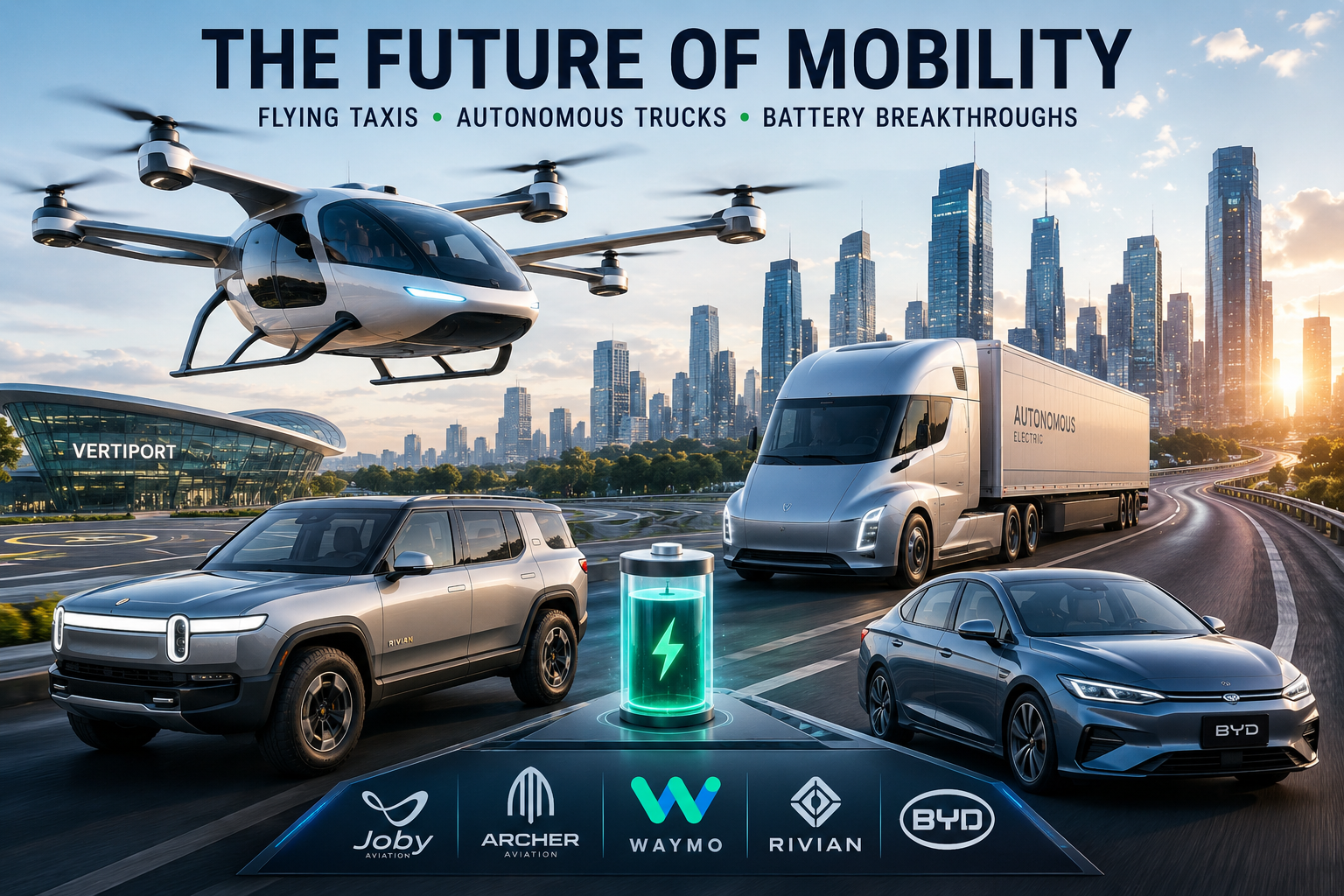
The transportation industry is undergoing one of the most significant transformations since the invention of the automobile. Advances in electric propulsion, artificial intelligence, automation, and energy storage are reshaping how people and goods move around the world. What once seemed like science fiction flying taxis carrying passengers above city traffic, self-driving trucks transporting cargo across highways, and batteries capable of charging in minutes is rapidly becoming reality.
The future of mobility is not simply about replacing gasoline vehicles with electric ones. It represents a complete rethinking of transportation systems, combining sustainability, automation, connectivity, and efficiency. Companies such as Joby Aviation, Archer Aviation, Waymo, Rivian, and BYD are among the organizations leading this revolution.
The Rise of Flying Taxis and eVTOL Aircraft
One of the most exciting developments in transportation is the emergence of electric Vertical Take-off and Landing (eVTOL) aircraft. These vehicles are often described as flying taxis because they are designed to transport passengers over short distances within and between urban areas.
Unlike traditional helicopters, eVTOL aircraft use multiple electric rotors, making them quieter, more efficient, and potentially safer. Their electric power systems also eliminate direct emissions during operation, aligning with global sustainability goals.
Why Flying Taxis Matter
Urban congestion is a growing challenge worldwide. According to various transportation studies, commuters in major cities lose dozens of hours annually sitting in traffic. As populations continue to grow, existing road infrastructure struggles to keep pace.
Flying taxis offer several potential advantages:
- Reduced travel times
- Lower traffic congestion
- Improved access to underserved areas
- Reduced environmental impact compared to helicopters
- New transportation options for business travelers
A journey that takes an hour by car could potentially be completed in 10 to 15 minutes using an eVTOL aircraft.
Joby Aviation
Joby Aviation has emerged as one of the leading players in the flying taxi industry. Founded in California, the company has spent years developing electric aircraft capable of carrying passengers over significant distances.
Joby’s aircraft is designed to transport a pilot and four passengers while producing significantly less noise than traditional helicopters. The company has secured partnerships with major organizations and continues to pursue regulatory approvals.
Joby’s long-term vision involves creating an aerial ridesharing network where passengers can book flights using mobile applications, much like current ride-hailing services.
Archer Aviation
Archer Aviation is another major competitor in the eVTOL market. The company aims to create urban air mobility solutions that can integrate seamlessly into existing transportation networks.
Archer’s aircraft, known as Midnight, is designed for rapid back-to-back flights with minimal charging downtime. The company believes that air taxi services could eventually become common in major metropolitan areas.
Archer has attracted attention through partnerships with airlines and transportation providers seeking to expand mobility options for travelers.
Challenges Facing eVTOL Adoption
Despite the excitement, several obstacles remain:
Regulatory Approval
Aviation authorities maintain strict safety standards. Aircraft manufacturers must demonstrate reliability before commercial operations can begin.
Infrastructure Requirements
Cities will need “vertiports” where eVTOL aircraft can take off, land, recharge, and undergo maintenance.
Public Acceptance
Many consumers remain unfamiliar with urban air mobility. Building trust will be essential for widespread adoption.
Cost Considerations
Initially, flying taxi services may target premium customers before becoming affordable for broader populations.
Nevertheless, industry analysts believe that urban air mobility could become a multi-billion-dollar market during the next decade.
Autonomous Trucking: Transforming Logistics
While flying taxis capture public imagination, autonomous trucking may deliver even greater economic impact.
The trucking industry serves as the backbone of global commerce. Every day, millions of trucks transport food, consumer products, industrial equipment, and raw materials. However, the industry faces challenges including driver shortages, rising operating costs, and increasing demand for faster deliveries.
Autonomous trucking technology aims to address these issues.
How Autonomous Trucks Work
Self-driving trucks rely on a combination of technologies:
- Artificial intelligence
- Cameras
- Radar systems
- LiDAR sensors
- GPS navigation
- Real-time mapping
These systems allow vehicles to perceive their environment, make driving decisions, and navigate roads with minimal human intervention.
Unlike passenger vehicles operating in complex city environments, many trucking routes involve long highway stretches, making automation more practical.
The Economic Benefits
Autonomous trucking offers several advantages:
Increased Efficiency
Self-driving trucks can operate for longer periods without mandatory rest breaks, potentially reducing delivery times.
Lower Operating Costs
Labor represents a major expense for logistics companies. Automation may reduce transportation costs while improving productivity.
Improved Safety
Human error contributes to most road accidents. Advanced autonomous systems can react faster and maintain consistent attention.
Addressing Driver Shortages
Many countries face significant shortages of qualified truck drivers. Automation could help meet growing freight demand.
Waymo’s Role in Autonomous Transportation
Waymo, a subsidiary of Alphabet, has become one of the world’s leading autonomous vehicle companies.
Although many people associate Waymo with self-driving passenger vehicles, the company has also invested heavily in autonomous trucking technology.
Waymo’s systems combine advanced AI software with extensive real-world driving data. Years of testing have enabled the company to develop sophisticated models capable of handling complex traffic situations.
The company’s experience demonstrates how artificial intelligence is becoming a critical component of future mobility systems.
Industry Impact
Autonomous trucking could reshape logistics in multiple ways:
- Faster freight movement
- More predictable delivery schedules
- Reduced fuel consumption through optimized driving
- Enhanced supply chain efficiency
- Lower transportation costs
However, the transition will likely occur gradually. Human drivers may continue to play important roles in local deliveries and specialized transportation tasks.
Battery Breakthroughs: The Foundation of Future Mobility
While flying taxis and autonomous vehicles receive significant attention, battery technology may be the most important innovation driving the mobility revolution.
Without major advances in energy storage, electric transportation cannot reach its full potential.
Modern batteries influence:
- Vehicle range
- Charging speed
- Performance
- Cost
- Safety
- Sustainability
Why Battery Innovation Matters
Consumers often cite range anxiety and charging times as barriers to electric vehicle adoption.
Battery breakthroughs aim to solve these challenges while reducing costs.
Future battery technologies could deliver:
- Longer driving ranges
- Faster charging
- Improved safety
- Lower prices
- Reduced environmental impact
Rivian and Electric Mobility
Rivian has established itself as a significant player in the electric vehicle market.
The company focuses on electric trucks and adventure-oriented vehicles designed for both everyday use and outdoor activities.
Rivian’s success depends heavily on battery innovation. By optimizing battery packs and energy management systems, the company seeks to deliver vehicles with strong performance and practical range.
The company’s approach highlights how advanced batteries are becoming central to vehicle design and customer experience.
BYD: A Global Battery Powerhouse
Chinese manufacturer BYD has emerged as one of the world’s most influential electric vehicle and battery companies.
Unlike many automakers that purchase batteries from suppliers, BYD develops much of its battery technology internally.
One of the company’s most notable innovations is the Blade Battery, designed to improve safety, durability, and efficiency.
BYD’s rapid growth demonstrates how battery expertise can create competitive advantages in the global mobility market.
Today, the company competes aggressively in markets across Asia, Europe, Latin America, and beyond.
Emerging Battery Technologies
Several promising innovations are attracting attention.
Solid-State Batteries
Solid-state batteries replace liquid electrolytes with solid materials.
Potential benefits include:
- Higher energy density
- Faster charging
- Improved safety
- Longer lifespan
Many experts consider solid-state technology a potential game changer for electric mobility.
Ultra-Fast Charging
Researchers are developing batteries capable of charging in minutes rather than hours.
Such advances could significantly reduce consumer concerns about charging convenience.
Sodium-Ion Batteries
Sodium-ion technology offers a lower-cost alternative to lithium-ion batteries.
Because sodium is abundant and widely available, these batteries could reduce supply chain risks and manufacturing costs.
Battery Recycling
As electric vehicle adoption grows, battery recycling becomes increasingly important.
Advanced recycling processes can recover valuable materials such as lithium, nickel, and cobalt, supporting a more sustainable circular economy.
Convergence of Technologies
The most transformative aspect of future mobility may be the convergence of multiple innovations.
Imagine a transportation ecosystem where:
- Autonomous electric vehicles communicate with smart infrastructure.
- Flying taxis connect airports to city centers.
- Electric trucks transport goods efficiently across continents.
- Renewable energy powers charging networks.
- Advanced batteries enable affordable, long-range transportation.
These technologies reinforce one another.
Battery improvements enhance electric vehicles and eVTOL aircraft. Artificial intelligence supports autonomous driving. Connectivity enables smarter transportation networks.
The result is a mobility system that is cleaner, safer, and more efficient than today’s infrastructure.
Looking Ahead
The future of mobility is arriving faster than many people expected. Flying taxis are moving closer to commercial deployment. Autonomous trucking continues to advance through extensive testing and real-world operations. Battery breakthroughs are steadily improving the performance and affordability of electric transportation.
Companies such as Joby Aviation and Archer Aviation are pioneering urban air mobility. Waymo is pushing the boundaries of autonomous transportation. Rivian is helping redefine electric adventure vehicles, while BYD is demonstrating how battery innovation can drive global expansion.
Challenges remain, including regulation, infrastructure development, public acceptance, and technological refinement. Yet the overall direction is clear. Transportation is becoming increasingly electric, intelligent, connected, and autonomous.
Over the next decade, mobility may look dramatically different from today’s systems. The roads, skies, and logistics networks of the future will likely be powered by technologies that are only beginning to emerge. For consumers, businesses, and governments alike, understanding these trends will be essential in navigating a rapidly evolving transportation landscape.
The future of mobility is not a distant possibility it is already taking shape, transforming how people and goods move across the world and creating new opportunities for innovation, sustainability, and economic growth.