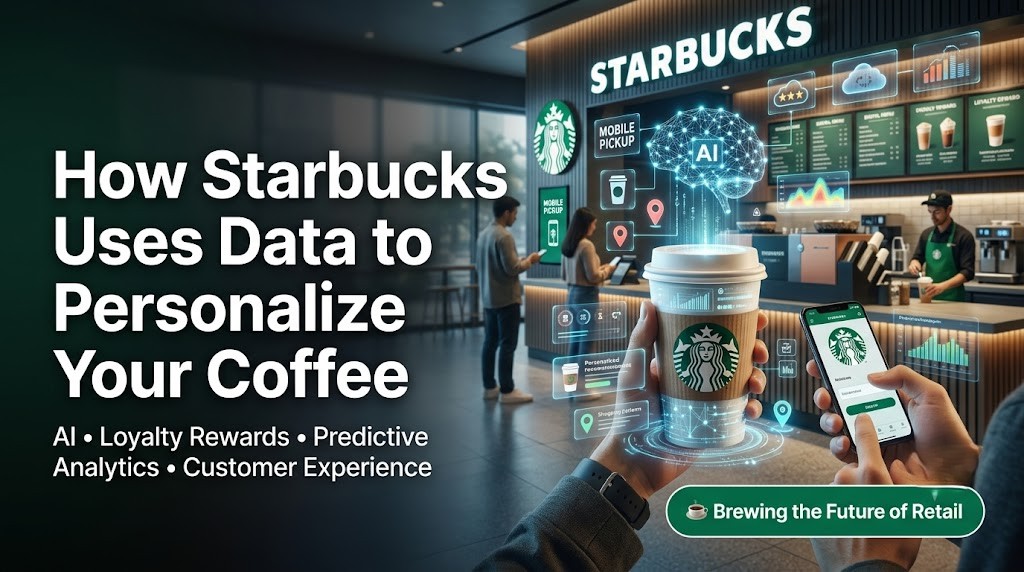
Every morning, millions of people around the world walk into a Starbucks expecting something familiar. Whether it’s a Caramel Macchiato with oat milk, a sugar-free Vanilla Latte, or a simple black coffee, many customers barely need to explain their order anymore. Open the Starbucks app, and your favourite drink is already waiting at the top of the screen, personalized offers appear at the right time, and nearby stores often seem to know exactly what you might want next.
This experience feels effortless, but behind every personalized recommendation lies one of the most sophisticated data ecosystems in the retail industry. Starbucks is no longer simply selling coffee. It has transformed itself into a technology-driven customer experience company where artificial intelligence, predictive analytics, location intelligence, and loyalty data work together to increase convenience while strengthening customer relationships.
The modern coffee shop has become a digital platform, and Starbucks is proving that personalization can be just as valuable as the product itself. But this raises an important question: are consumers paying for better coffee, or are they paying for an experience built entirely on data?
Starbucks Is More Than a Coffee Chain
When people think of Starbucks, they usually picture premium coffee, comfortable cafés, and green aprons. However, industry experts increasingly describe Starbucks as one of the world’s leading retail technology companies.
Over the last decade, Starbucks has invested billions of dollars in digital transformation. Its mobile application, rewards ecosystem, cloud infrastructure, artificial intelligence capabilities, and customer analytics platforms have become central to the company’s business strategy.
Today, Starbucks serves customers across thousands of stores in more than 80 countries. Managing such a vast operation requires far more than experienced baristas. Every purchase generates valuable information that helps the company understand customer behavior, predict demand, optimize inventory, and deliver highly personalized experiences.
Instead of relying only on instinct or traditional market research, Starbucks makes decisions based on real-time customer data.
Every Coffee Order Creates Valuable Data
Many customers don’t realize how much information is generated from a single coffee purchase.
Every interaction provides useful insights. The drink you order, the size you choose, your preferred milk option, how often you visit, your payment method, the time of day, seasonal preferences, and even the weather during your purchase contribute to Starbucks’ understanding of your habits.
Customers using the Starbucks Rewards program voluntarily provide even richer information. Purchase histories reveal long-term preferences, allowing Starbucks to identify patterns that would be impossible to detect manually.
For example, one customer may consistently order cold beverages regardless of season, while another only purchases premium handcrafted drinks during weekends. Someone else may visit multiple city locations because of frequent travel. These seemingly ordinary behaviours help Starbucks build detailed customer profiles that improve future recommendations.
Unlike traditional marketing campaigns that send identical offers to everyone, Starbucks creates increasingly individualized experiences based on actual purchasing behavior.
Artificial Intelligence Powers Personalized Recommendations
One of Starbucks’ biggest competitive advantages comes from its use of artificial intelligence to personalize customer interactions.
The Starbucks mobile app doesn’t simply display random promotions. Instead, machine learning algorithms analyse customer history to recommend products with the highest probability of purchase.
Imagine someone who regularly buys an Iced Brown Sugar Oat Milk Shaken Espresso every weekday morning. Instead of promoting hot chocolate or afternoon snacks, the app might recommend breakfast sandwiches that pair well with their routine or offer bonus reward points on similar beverages.
Another customer who frequently purchases seasonal drinks may receive early access to Pumpkin Spice Latte promotions before the general public.
This level of personalization increases customer satisfaction while also boosting sales.
AI allows Starbucks to move beyond demographic assumptions. Rather than assuming all young customers prefer cold coffee or all professionals’ order espresso, the company learns directly from individual behavior.
The result feels less like advertising and more like thoughtful recommendations.
Starbucks Rewards: The Heart of Its Data Strategy
If there is one technology that transformed Starbucks more than any other, it is the Starbucks Rewards program.
Loyalty programs are common across retail, but Starbucks elevated the concept into a powerful data engine.
Members earn Stars for purchases, unlock rewards, receive birthday treats, access exclusive promotions, and enjoy mobile ordering features. In exchange, Starbucks gains permission to understand purchasing patterns over months and years.
The longer customers participate, the smarter the recommendations become.
This creates a mutually beneficial relationship. Customers receive convenience and rewards, while Starbucks develops deeper customer insights.
Unlike anonymous cash transactions, loyalty programs connect purchases to individual customer profiles, allowing personalization at an unprecedented scale.
The loyalty ecosystem has become one of Starbucks’ strongest competitive advantages because it combines financial incentives with behavioral intelligence.
Mobile Ordering Has Changed Customer Expectations
The Starbucks mobile application has fundamentally reshaped how people buy coffee.
Instead of waiting in line, customers can customize drinks, place orders in advance, select pickup locations, and pay digitally before arriving.
From a customer perspective, this saves time.
From Starbucks’ perspective, mobile ordering creates structured, high-quality data.
Every tap inside the application helps Starbucks understand customer behavior. The company learns which menu items customers browse, which drinks they customize, which promotions receive attention, and which offers are ignored.
Even abandoned orders can provide valuable insights into customer preferences.
This digital ecosystem allows Starbucks to continuously improve both customer experience and operational efficiency.
Location Data Makes Recommendations Smarter
Location intelligence plays an increasingly important role in Starbucks’ personalization strategy.
When customers allow location permissions, Starbucks can recommend nearby stores, estimate pickup times, and notify users about convenient ordering opportunities.
Location data also helps Starbucks understand traffic patterns.
Business districts experience different demand compared to residential neighbourhoods. Airport locations serve travelers with different purchasing habits than suburban cafés.
This information supports staffing decisions, inventory planning, and localized promotions.
Weather also influences buying behavior.
Cold mornings typically increase demand for hot beverages, while unusually warm afternoons encourage cold drinks and refreshers.
Rather than applying identical promotions worldwide, Starbucks can tailor campaigns based on regional conditions.
Predictive Analytics Helps Before Customers Even Order
One of the most impressive aspects of Starbucks’ technology strategy is predictive analytics.
Instead of reacting after customers place orders, Starbucks increasingly predicts future demand.
Historical purchasing patterns, local events, holidays, weather forecasts, and seasonal trends help estimate what customers are likely to order before they arrive.
If demand for Pumpkin Spice Latte historically spikes during early autumn weekends, Starbucks can prepare ingredients accordingly.
If a city hosts a large sporting event, nearby stores may increase staffing and inventory to handle heavier traffic.
These predictions improve operational efficiency while reducing waste.
Accurate forecasting also ensures customers encounter fewer “out of stock” situations, improving overall satisfaction.
Technology Behind the Counter
Personalization doesn’t only benefit customers.
Employees also benefit from technology-driven operations.
Inventory systems help stores monitor ingredient availability, reducing shortages while minimizing unnecessary waste.
Digital scheduling tools align staffing levels with predicted customer traffic.
Supply chain systems use forecasting models to optimize deliveries across thousands of locations.
When stores receive the right inventory at the right time, customer experiences improve naturally.
Technology therefore enhances both front-end personalization and back-end efficiency.
Other Brands Following Starbucks’ Strategy
Starbucks is not alone in embracing data-driven personalization.
Amazon recommends products based on browsing and purchase history, making shopping increasingly individualized.
Netflix analyses viewing behavior to recommend movies and television shows tailored to each subscriber.
Spotify creates personalized playlists like Discover Weekly using listening habits collected over time.
McDonald’s has expanded digital personalization after acquiring AI technology companies that optimize drive-thru menus according to weather, traffic, and purchasing behavior.
Nike leverages its membership ecosystem to recommend products, exclusive launches, and personalized fitness experiences.
These companies share one common principle: customer data enables better experiences while increasing long-term loyalty.
Starbucks successfully applies the same philosophy within the food and beverage industry.
The Privacy Debate
As personalization becomes more advanced, privacy concerns naturally emerge.
Many consumers appreciate receiving relevant recommendations instead of generic advertising. They enjoy faster ordering, customized offers, and seamless payment experiences.
However, personalization requires data collection.
Customers must decide how much information they are comfortable sharing.
Questions surrounding data security, consent, transparency, and ethical AI continue shaping conversations across the technology industry.
Leading brands increasingly provide privacy settings, data controls, and clearer explanations about how customer information is collected and used.
The future of personalization depends not only on technological innovation but also on maintaining customer trust.
Without trust, even the most advanced recommendation systems lose their value.
The Future of AI-Powered Coffee
Starbucks continues investing in artificial intelligence, cloud computing, automation, and digital innovation.
Future developments may include even more accurate recommendation engines, smarter voice ordering, predictive inventory management, enhanced personalization through generative AI, and deeper integration between mobile experiences and physical stores.
Imagine walking toward your nearest Starbucks while your smartwatch detects your morning routine. By the time you open the app, your preferred drink is already suggested based on your schedule, weather conditions, previous purchases, and current reward status.
While this may sound futuristic, much of the technology already exists.
The next phase will simply make these experiences more seamless and increasingly invisible.
Consumers may interact less with technology directly while benefiting more from the intelligence operating behind the scenes.
Final Thoughts: Are We Buying Coffee or Convenience?
Starbucks demonstrates that the future of retail is no longer defined solely by product quality. Great coffee remains essential, but technology has become an equally important ingredient in the customer experience.
Data allows Starbucks to reduce waiting times, recommend relevant products, improve inventory management, strengthen customer loyalty, and deliver highly personalized interactions at a global scale. Every mobile order, every reward redemption, and every customized beverage help refine an ecosystem designed to make each visit feel more intuitive than the last.
The broader lesson extends far beyond coffee. Across retail, hospitality, entertainment, and e-commerce, businesses are increasingly competing on how well they understand individual customer needs rather than simply offering more products. Personalization has become a strategic advantage, and companies that use data responsibly are reshaping consumer expectations around convenience.
Yet the success of this model depends on maintaining a delicate balance between innovation and trust. Customers enjoy personalized recommendations because they save time and enhance convenience, but they also expect transparency about how their information is collected, protected, and used.
In the years ahead, brands will likely become even better at predicting preferences before consumers express them. The companies that succeed will be those that combine powerful technology with ethical data practices and meaningful customer value.
So, the next time your favourite Starbucks drink appears on your phone before you even think about ordering, consider what you’re really paying for. Is it simply another cup of coffee, or is it a personalized digital experience built from thousands of data points designed to make your day just a little easier?
The answer may define the future of retail itself.