
The Unexpected Resource Beneath America’s Largest Oil Field
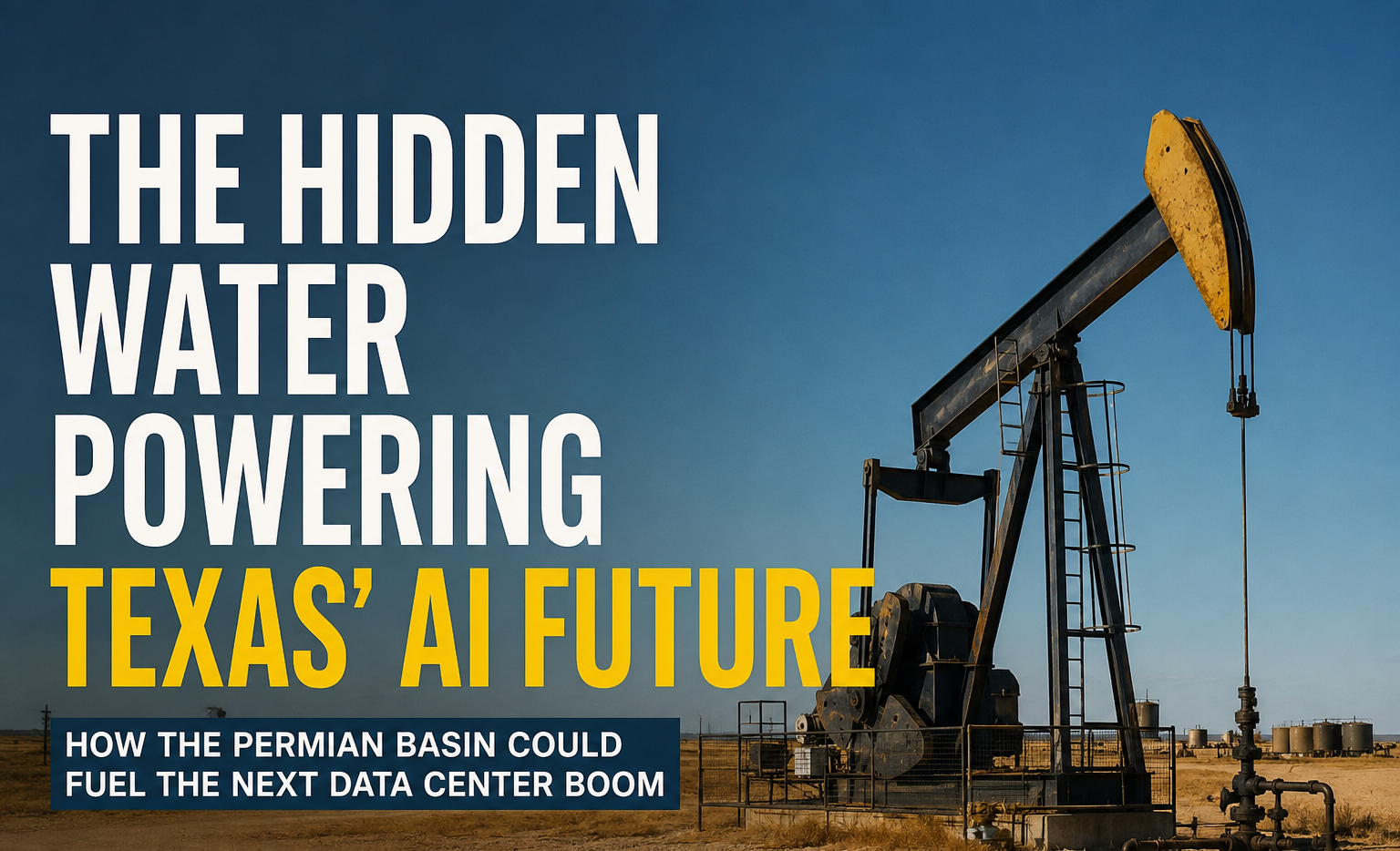
At first glance, the Permian Basin hardly seems like the ideal location for the next generation of artificial intelligence infrastructure. Stretching across the dry landscapes of West Texas and southeastern New Mexico, the region is known for its scorching temperatures, sparse vegetation, and endless rows of oil pumps rather than flowing rivers or freshwater lakes. Travelers crossing the basin are greeted by dusty highways, tumbleweeds, and drilling rigs that dominate the horizon. Water appears to be one of the last resources this arid landscape could possibly offer.
Yet beneath this seemingly water-starved region lies one of the most overlooked industrial water systems in the world. Every day, the Permian Basin generates an astonishing amount of produced water a byproduct of oil extraction that has traditionally been viewed as waste. Instead of being discarded as an environmental challenge, industry leaders now see this resource as the foundation for an entirely new economic opportunity. As artificial intelligence reshapes global industries and data centers demand unprecedented levels of electricity and cooling, the Permian Basin may soon become one of America’s most strategic technology hubs.
One of the strongest believers in this transformation is David Capobianco, co-founder of private equity firm Five-Point Energy. His vision extends far beyond oil production. Rather than treating produced water as a disposal problem, Capobianco sees it as the critical ingredient for attracting billions of dollars in AI infrastructure investment to America’s largest oil-producing region.
Understanding the Permian Basin’s Water Paradox
The Permian Basin presents one of the greatest paradoxes in modern energy production. While natural freshwater sources are scarce, oil extraction generates extraordinary quantities of water every single day. This water, known as produced water, comes from deep underground formations alongside crude oil and natural gas.
Current production figures illustrate the remarkable scale of this hidden resource. The basin now produces approximately seven million barrels of crude oil daily. Alongside that oil comes nearly twenty-five million barrels of produced water, equivalent to roughly one billion gallons every day. To put that into perspective, the volume rivals the daily water consumption of New York City.
For decades, this water represented an expensive operational burden. Oil companies invested billions in transporting, storing, recycling, or disposing of produced water through injection wells. Managing water became one of the industry’s largest operational expenses, yet few imagined it could eventually become a competitive advantage.
Today, technological advances in water treatment, recycling, desalination, and industrial cooling have fundamentally changed the conversation. Produced water is increasingly viewed as a valuable industrial resource capable of supporting energy-intensive industries far beyond oil and gas.
Why AI Data Centers Need Massive Quantities of Water
Artificial intelligence has dramatically changed the economics of data centers. Traditional cloud computing facilities already require significant cooling systems to prevent servers from overheating. AI workloads, however, push computing hardware to entirely new performance levels.
Modern AI processors consume enormous amounts of electricity while generating tremendous heat. Training large language models, running machine learning algorithms, and supporting AI applications demand thousands of specialized GPUs operating around the clock. Without effective cooling systems, these processors would quickly become unreliable.
Water remains one of the most efficient cooling mediums available. Many hyperscale data centers use sophisticated water-based cooling technologies to regulate temperatures while maximizing computing performance.
As global AI adoption accelerates, demand for water-intensive cooling systems continues to rise. Technology companies are now competing for locations where electricity, land, and reliable water supplies are all available simultaneously. Finding sites that satisfy all three requirements has become increasingly difficult, particularly as urban regions face growing environmental restrictions and resource limitations.
This challenge is creating opportunities in unexpected places including America’s largest oil-producing region.
David Capobianco’s Vision Beyond Oil
David Capobianco has spent decades investing in energy infrastructure through Five-Point Energy. Rather than focusing exclusively on traditional oil assets, he has identified water infrastructure as one of the industry’s most valuable long-term investments.
His strategy recognizes that the future of the Permian Basin extends well beyond hydrocarbons. Oil companies already possess extensive infrastructure for transporting and managing produced water, including pipelines, storage facilities, treatment systems, and disposal networks.
Instead of viewing this infrastructure solely as operational support for drilling activities, Capobianco believes it can become the backbone of an entirely new industrial ecosystem cantered around artificial intelligence.
His vision involves creating integrated campuses where AI data centers operate alongside existing energy infrastructure. These facilities would benefit from access to electricity generation, industrial water supplies, available land, and transportation networks—all within one of America’s most economically productive regions.
The concept transforms produced water from an unavoidable expense into a strategic economic asset capable of attracting major technology investments.
The Growing Energy Demands of Artificial Intelligence
Artificial intelligence is not only changing software—it is reshaping global electricity demand.
Major technology companies continue announcing billions of dollars in investments for AI infrastructure. Massive data centers housing tens of thousands of advanced GPUs require power levels comparable to small cities. Utilities across North America are struggling to keep pace with rising electricity requirements driven by AI expansion.
The Permian Basin offers a unique advantage because it already possesses significant energy infrastructure. Natural gas production remains exceptionally strong throughout the region, providing opportunities for dedicated power generation near future data center campuses.
Unlike densely populated metropolitan areas where expanding power grids can take years, West Texas offers relatively abundant land for new infrastructure development.
Combining energy production with industrial water availability creates an attractive proposition for companies seeking reliable long-term AI capacity.
Produced Water Could Become a Strategic Asset
Produced water has historically been treated as waste because of its high salinity and dissolved mineral content. However, industrial applications often do not require drinking-quality water.
Many cooling systems can operate using treated non-potable water, significantly reducing demand for freshwater resources. Advanced filtration, membrane technologies, and chemical treatment systems continue improving the feasibility of recycling produced water for industrial purposes.
This shift creates several economic advantages.
First, oil companies can reduce disposal costs by finding productive uses for water that previously generated only expenses.
Second, technology companies gain access to consistent industrial water supplies without competing directly with municipal drinking water systems.
Third, local communities may benefit from expanded infrastructure investments that diversify regional economic activity beyond oil extraction.
Rather than representing an environmental liability, produced water may become one of the Permian Basin’s most valuable competitive advantages.
Why West Texas Is Becoming Attractive for Technology Companies
Historically, most large data centers were built near major metropolitan regions to minimize network latency and simplify infrastructure development. However, modern cloud architectures and expanding fibre-optic networks have reduced the importance of proximity to urban centers.
Technology companies now prioritize locations offering affordable land, reliable electricity, favourable regulatory environments, and long-term scalability.
West Texas satisfies many of these requirements.
The region provides vast undeveloped land suitable for constructing hyperscale campuses. Existing industrial infrastructure supports large-scale construction projects, while energy production creates opportunities for dedicated electricity generation. Compared to crowded technology hubs, development costs remain significantly lower.
As AI infrastructure expands nationwide, regions like the Permian Basin are becoming increasingly competitive alternatives.
Environmental Challenges Cannot Be Ignored
Despite its enormous potential, using produced water presents significant environmental and technical challenges.
Produced water often contains high concentrations of salt, hydrocarbons, heavy metals, naturally occurring radioactive materials, and treatment chemicals accumulated during drilling operations. Extensive processing is necessary before the water becomes suitable for industrial reuse.
Environmental groups continue expressing concerns regarding groundwater contamination, wastewater disposal, and induced seismic activity associated with underground injection wells.
Large-scale recycling initiatives must therefore balance economic opportunity with environmental responsibility. Robust regulatory oversight, advanced treatment technologies, and transparent monitoring will be essential to maintaining public confidence.
Successfully transforming produced water into a reliable industrial resource depends on addressing these concerns through science, engineering, and responsible infrastructure investment.
The Economic Impact Could Extend Beyond Oil
The arrival of hyperscale AI data centers could fundamentally reshape the economy of West Texas.
Construction projects alone would generate thousands of jobs across engineering, electrical work, telecommunications, logistics, and industrial services. Long-term operations would create demand for skilled technicians, cybersecurity specialists, network engineers, mechanical operators, and facility managers.
Supporting industries including renewable energy, battery storage, equipment manufacturing, fibre connectivity, and advanced water treatment—could also experience substantial growth.
Economic diversification would reduce dependence on volatile oil prices while positioning the region at the center of two of the world’s fastest-growing industries: energy and artificial intelligence.
For communities that have historically relied almost exclusively on drilling activity, this transformation represents a significant opportunity for long-term economic stability.
AI Infrastructure Is Creating a New Industrial Geography
The rapid expansion of artificial intelligence is redefining where economic growth occurs.
Previous technology booms concentrated investment in coastal metropolitan regions like Silicon Valley, Seattle, Northern Virginia, and Austin. AI infrastructure, however, depends less on office towers and more on industrial-scale resources such as electricity, water, cooling capacity, and land.
This shift favors regions previously overlooked by technology investors.
Oil-producing states, manufacturing corridors, and energy-rich rural communities are increasingly competing to host AI facilities worth billions of dollars. Their existing industrial capabilities align surprisingly well with the physical demands of next-generation computing infrastructure.
The Permian Basin exemplifies this broader trend.
The Future of Produced Water Innovation
Researchers continue exploring new methods for maximizing the value of produced water.
Emerging technologies include advanced desalination systems, mineral extraction, lithium recovery, industrial chemical production, hydrogen generation, and closed-loop water recycling. These innovations could further improve the economics of produced water management while reducing environmental impacts.
Artificial intelligence itself may accelerate these advances by optimizing treatment processes, predicting equipment failures, and improving resource efficiency throughout water infrastructure networks.
Ironically, the very technology creating unprecedented demand for industrial water could also help solve many of the engineering challenges associated with water recycling.
Conclusion
The Permian Basin has long been recognized as the heart of America’s oil industry, but its future may depend just as much on water as it does on crude. Beneath its dry landscape lies an extraordinary industrial resource that has remained largely invisible outside the energy sector. As AI data centers search for locations capable of supporting massive computing operations, produced water is emerging as an unexpected competitive advantage.
David Capobianco’s vision reflects a broader transformation taking place across the global economy. Resources once considered waste are increasingly becoming strategic assets. The convergence of artificial intelligence, energy production, and water infrastructure could redefine the economic identity of West Texas for decades to come.
If technological innovation, environmental stewardship, and infrastructure investment continue advancing together, the Permian Basin may evolve from the world’s premier oil field into one of the most important AI infrastructure corridors on the planet. What once appeared to be a water-scarce desert may ultimately become one of the most resource-rich locations for powering the digital economy of the future.