
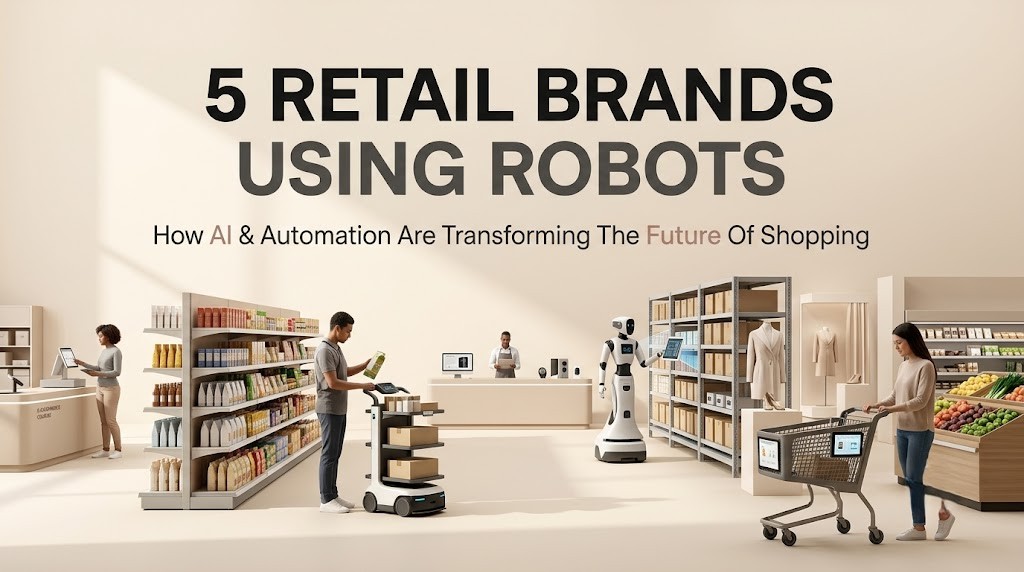
Retail has always been an industry driven by innovation. From self-checkout systems and mobile payments to artificial intelligence-powered recommendations, technology has continuously changed how consumers discover, purchase, and receive products. Today, one of the biggest transformations happening in retail is the integration of robots.
Robotics is no longer limited to factories and warehouses. Leading global retail brands are now using robots inside stores, fulfillment centers, and delivery networks to improve efficiency, reduce operational costs, and create better customer experiences. These intelligent machines are helping retailers manage inventory, automate repetitive tasks, improve order accuracy, and even interact directly with shoppers.
As labour challenges increase and consumer expectations for faster service continue to grow, robotics has become a key investment area for major retail companies. From grocery giants to e-commerce leaders, brands worldwide are exploring how robots can create a smarter and more connected retail ecosystem.
Here are five retail brands using robots to redefine the future of shopping.
1. Amazon: Leading Retail Robotics With AI-Powered Automation
When it comes to retail robotics, Amazon is one of the biggest pioneers in the industry. The company has invested heavily in robotic technology to improve its massive e-commerce fulfillment network. With millions of products moving through warehouses every day, automation helps Amazon process orders faster and more accurately.
Amazon uses robots in its fulfillment centers to transport products, organize inventory, and support warehouse employees. One of the company’s well-known robotic systems includes mobile robots that move shelves of products directly to workers, reducing the time employees spend walking through large warehouses.
The company has also developed advanced robotic systems that use artificial intelligence and computer vision to identify, pick, and handle different types of products. These technologies allow Amazon to improve warehouse productivity while maintaining faster delivery speeds.
Beyond warehouses, Amazon has also experimented with autonomous delivery robots and drone delivery technology. The company’s focus on robotics shows how automation can influence every stage of retail, from inventory management to last-mile delivery.
Amazon’s robotic innovations represent the future of e-commerce, where AI, automation, and human workers operate together to create faster and more efficient shopping experiences.
2. Walmart: Using Robots to Improve Inventory and Store Operations
Walmart, the world’s largest retailer, has been actively adopting robotics to enhance its stores and supply chain operations. With thousands of locations globally, managing inventory accuracy and product availability is one of the biggest challenges for the retail giant.
To solve these challenges, Walmart has introduced robots that scan store shelves and collect real-time inventory information. These robots use cameras and artificial intelligence to identify missing products, incorrect prices, and items that need restocking.
Inventory management robots help Walmart employees spend less time checking shelves manually and more time assisting customers. By improving stock visibility, the company can reduce out-of-stock situations and ensure shoppers find the products they need.
Walmart has also explored automation in its warehouses and distribution centers. Robotic systems help organize products, prepare online grocery orders, and improve supply chain efficiency.
The company’s approach focuses on using robots as support tools rather than replacements for employees. Walmart believes automation can create a better shopping environment by improving accuracy, speed, and customer service.
As online grocery shopping continues to grow, robotics will play an increasingly important role in helping Walmart deliver faster and more reliable services.
3. Ocado: Revolutionizing Grocery Retail with Robotic Warehouses
British online grocery retailer Ocado has become one of the most advanced examples of robotics in food retail. Unlike traditional supermarkets, Ocado operates highly automated fulfillment centers where thousands of robots work together to process customer orders.
Inside Ocado’s robotic warehouses, machines move across large grids to collect grocery products and deliver them to human workers who prepare customer orders. This automated system allows the company to process a huge number of online grocery orders with high speed and accuracy.
Artificial intelligence plays a major role in Ocado’s operations. The robots communicate with each other, optimize movement, and reduce unnecessary delays inside fulfillment centers. This creates a highly efficient supply chain designed specifically for online grocery shopping.
Ocado also provides robotic technology solutions to other grocery retailers around the world. Its technology platform helps supermarkets build automated warehouses and improve their digital retail operations.
The company demonstrates how robotics can completely transform grocery shopping by making online ordering faster, more scalable, and more efficient.
4. Alibaba: Combining Robotics and AI for Smart Retail Experiences
Chinese e-commerce giant Alibaba has been investing in robotics and artificial intelligence to create next-generation retail experiences. The company uses automation across warehouses, delivery networks, and physical stores.
Alibaba’s logistics division uses robots inside smart warehouses to sort packages, move products, and improve delivery efficiency. These automated systems help handle massive shopping events such as Singles’ Day, where millions of orders are processed within a short period.
The company has also experimented with robot-powered restaurants and smart stores. In some Alibaba retail environments, robots assist with food delivery, customer interaction, and automated checkout processes.
Alibaba’s vision of “new retail” combines online shopping, physical stores, data analytics, and artificial intelligence. Robotics is a major part of this strategy, helping connect digital and physical retail experiences.
By integrating robots with AI-powered systems, Alibaba is creating a retail ecosystem where technology improves convenience, personalization, and operational efficiency.
5. Carrefour: Bringing Robots into Supermarkets
French retail giant Carrefour has explored robotics as a way to improve supermarket operations and customer experiences. As traditional grocery stores face increasing competition from online shopping, retailers are looking for innovative ways to make physical stores smarter.
Carrefour has tested robots that help with inventory monitoring, customer assistance, and store management. These robots can support employees by collecting information about shelves, helping identify missing products, and improving store efficiency.
The company has also invested in digital transformation initiatives, including artificial intelligence, automated services, and data-driven retail solutions. Robotics is part of Carrefour’s broader strategy to modernize supermarkets and adapt to changing consumer expectations.
For customers, robotic technology can create smoother shopping experiences by ensuring products are available, reducing waiting times, and improving store navigation.
Carrefour’s adoption of robotics highlights how even traditional brick-and-mortar retailers are embracing automation to compete in the modern retail landscape.
How Robots Are Changing the Retail Industry
The rise of robotics in retail is not just about replacing manual tasks. Instead, it represents a shift toward smarter operations where humans and machines work together.
Robots are helping retailers solve some of the biggest challenges in the industry, including inventory accuracy, faster deliveries, rising operational costs, and increasing customer expectations. By automating repetitive processes, employees can focus more on customer service, problem-solving, and creative tasks.
Artificial intelligence is making robots even more powerful. Modern retail robots can analyze data, recognize products, navigate complex environments, and make real-time decisions. This combination of robotics and AI is creating a new generation of intelligent retail systems.
From automated warehouses to smart supermarkets, robotics is becoming a competitive advantage for global brands. Companies that successfully integrate automation will likely shape the future of retail.
The Future of Retail Robotics
The adoption of robots in retail is expected to grow rapidly in the coming years. Advances in artificial intelligence, machine learning, and computer vision will make robots more capable, flexible, and affordable.
Future retail stores may include robots that help customers find products, automated checkout systems, AI-powered inventory management, and fully automated fulfillment centers. Delivery robots and autonomous vehicles could also become more common as companies search for faster last-mile delivery solutions.
However, the future of retail robotics will likely depend on collaboration between technology and human expertise. While robots can improve efficiency, human creativity, empathy, and decision-making remain essential for delivering meaningful customer experiences.
The brands investing in robotics today are preparing for a future where shopping becomes faster, smarter, and more personalized.
Conclusion
Robotics is transforming the retail industry by changing how products are stored, managed, delivered, and purchased. Companies like Amazon, Walmart, Ocado, Alibaba, and Carrefour are showing how automation can improve efficiency while creating better experiences for customers.
As technology continues to evolve, robots will become an increasingly important part of global retail. The future of shopping will not simply be digital or physical it will be a combination of artificial intelligence, robotics, and human innovation working together.
For retailers, adopting robotics is no longer just an experiment. It is becoming a strategic investment that will define the next era of commerce.