
Introduction
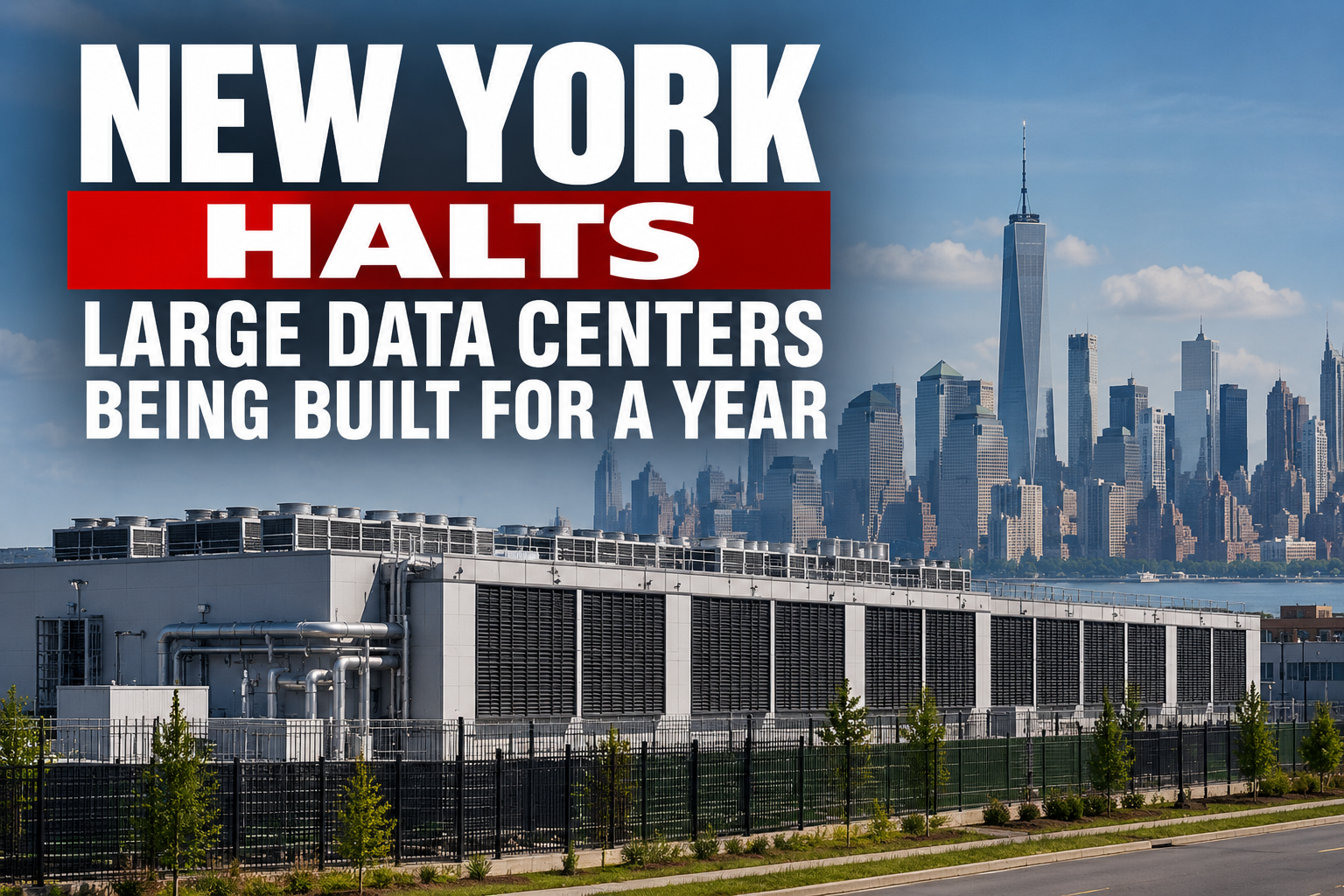
The rapid expansion of artificial intelligence, cloud computing, and digital services has sparked an unprecedented demand for data centers across the United States. As technology giants race to build larger facilities capable of supporting AI models and cloud platforms, local governments are beginning to question whether existing infrastructure can keep pace. New York has become the latest focal point in this debate after introducing a temporary halt on the construction of large-scale data centers in certain areas.
The one-year pause reflects a broader challenge facing governments worldwide: balancing technological innovation with environmental sustainability, power grid reliability, and community development. While supporters argue the moratorium will give officials time to evaluate long-term impacts, critics warn that delaying projects could push billions of dollars in investment—and thousands of potential jobs to neighbouring states.
This decision arrives at a time when AI-driven computing is transforming industries, making data centers one of the world’s fastest-growing infrastructure sectors. The outcome of New York’s temporary halt could influence how other states regulate future digital infrastructure projects.
Why New York Introduced the One-Year Pause
The temporary halt was introduced to allow state and local authorities to study the impact of hyperscale data centers before approving additional large developments. Over the past few years, proposals for massive AI-ready facilities have increased dramatically, with developers seeking locations that offer affordable land, reliable electricity, and fibre connectivity.
However, officials believe the pace of development has outgrown existing planning frameworks. Large data centers consume enormous amounts of electricity and water while requiring substantial transmission infrastructure. Communities have also raised concerns about land use, environmental effects, and whether local residents benefit proportionally from these billion-dollar investments.
Rather than permanently restricting development, the moratorium creates breathing room for policymakers to evaluate zoning regulations, energy planning, and environmental standards before approving additional projects.
The AI Boom Is Driving Unprecedented Demand
Artificial intelligence has fundamentally changed how data centers are designed and operated. Traditional cloud facilities mainly handled web hosting, storage, and enterprise applications. Today’s AI infrastructure requires thousands of high-performance GPUs running continuously to train and deploy increasingly sophisticated machine learning models.
Companies including OpenAI, Microsoft, Google, Amazon, Meta, and Oracle are investing billions in AI infrastructure worldwide. Hyperscale campuses now require significantly higher power capacity than conventional facilities, with many projects demanding hundreds of megawatts of electricity.
Industry experts estimate that AI workloads can consume several times more electricity than traditional cloud computing operations. As generative AI adoption accelerates across healthcare, finance, manufacturing, retail, education, and government, demand for advanced computing infrastructure continues to surge.
This rapid growth has transformed data centers from relatively low-profile industrial facilities into strategic national infrastructure.
Pressure on New York’s Power Grid
One of the primary reasons behind the temporary halt is concern about electricity demand.
Modern hyperscale data centers operate around the clock, consuming electricity equivalent to tens or even hundreds of thousands of homes. AI facilities equipped with GPU clusters require even greater power density than previous generations of data centers.
Energy planners are evaluating whether current infrastructure can support multiple large projects without affecting grid stability or increasing electricity costs for residential consumers and businesses.
As electrification expands through electric vehicles, heat pumps, and industrial modernization, governments must carefully balance competing energy demands. Adding several massive AI facilities simultaneously could require substantial upgrades to substations, transmission lines, and renewable generation capacity.
Supporters of the moratorium argue that taking time to evaluate grid readiness today can prevent larger infrastructure challenges in the future.
Environmental Concerns Continue to Grow
Beyond electricity consumption, environmental considerations have become central to discussions surrounding data center expansion.
Many facilities use significant quantities of water for cooling systems, particularly during warmer months. Although newer cooling technologies are becoming more efficient, large campuses can still place pressure on regional water resources depending on their design.
Environmental organizations have also highlighted concerns regarding carbon emissions associated with electricity generation, especially if growing demand increases reliance on fossil fuel power plants during peak usage periods.
New York has ambitious climate targets aimed at reducing greenhouse gas emissions while expanding renewable energy adoption. Policymakers are therefore examining how future data center growth aligns with these long-term sustainability goals.
Developers, meanwhile, argue that newer facilities are significantly more energy efficient than older infrastructure and increasingly rely on renewable energy agreements to reduce environmental impact.
Local Communities Want Greater Transparency
Residents living near proposed developments have expressed concerns extending beyond environmental issues.
Large data centers occupy extensive land areas while often employing fewer permanent workers than traditional manufacturing facilities. Although construction generates temporary employment and local spending, communities frequently question whether long-term economic benefits justify the infrastructure demands.
Traffic during construction, visual impacts, noise from cooling equipment, and future expansion plans have all become important topics during public hearings.
The temporary halt provides municipalities with an opportunity to establish clearer guidelines regarding zoning, environmental reviews, public consultation, and community benefit agreements before approving future projects.
Economic Opportunities Could Be Delayed
While environmental advocates have welcomed additional planning time, business groups have voiced concerns that the pause could discourage investment.
The United States is currently experiencing intense competition among states to attract AI infrastructure projects. Texas, Virginia, Ohio, Arizona, Georgia, and North Carolina continue expanding their data center industries by offering available land, energy infrastructure, and business-friendly policies.
If developers perceive regulatory uncertainty in New York, they may redirect investments toward states where approvals can proceed more quickly.
Large hyperscale projects often represent investments worth hundreds of millions—or even billions of dollars. Construction creates substantial demand for contractors, electricians, engineers, equipment suppliers, and local service providers.
Critics argue that delaying projects could reduce economic opportunities while slowing New York’s participation in the rapidly growing AI economy.
Big Tech’s Expanding Infrastructure Race
The timing of New York’s decision is particularly significant because technology companies are investing at record levels.
Major cloud providers continue announcing new campuses across North America to support AI model training, enterprise cloud services, and digital transformation initiatives.
Data centers are becoming as strategically important as transportation networks and energy infrastructure. Nations increasingly view computing capacity as essential for economic competitiveness, technological leadership, and national security.
Consequently, decisions affecting data center construction now carry implications extending far beyond local economic development.
Renewable Energy Could Become a Key Requirement
One likely outcome of the review period is stronger emphasis on renewable energy integration.
Many technology companies have publicly committed to carbon reduction goals and increasingly sign long-term renewable energy purchase agreements to power their operations.
Future regulatory frameworks could encourage developers to combine data center projects with solar farms, wind energy, battery storage, or advanced grid technologies to reduce environmental impacts.
Energy-efficient cooling systems, recycled water usage, and waste heat recovery may also become more common requirements as governments seek more sustainable digital infrastructure.
Rather than slowing innovation permanently, policymakers may ultimately encourage higher-quality development standards.
What This Means for the AI Industry
Although the one-year pause affects future approvals rather than existing facilities, it highlights an emerging challenge for the AI sector.
Computing demand is growing faster than electricity infrastructure in many regions. As AI models become larger and enterprise adoption accelerates, governments worldwide will increasingly face difficult decisions about balancing innovation with resource management.
The New York decision demonstrates that AI expansion is no longer solely a technology issue—it has become an energy, environmental, economic, and public policy issue.
Industry analysts expect similar debates to emerge in other states and countries where electricity demand is rapidly increasing.
Could Other States Follow?
New York may not remain an isolated example.
Across the United States, local governments are beginning to examine whether existing planning regulations adequately address hyperscale data centers.
Some communities are reviewing tax incentives, while others are considering stricter environmental assessments or new zoning requirements. As AI infrastructure becomes larger and more energy intensive, policymakers will likely introduce updated regulations focused on sustainability and grid resilience.
However, approaches are expected to vary considerably. States eager to attract investment may continue offering incentives, whereas others may prioritize environmental oversight.
This diversity of regulatory strategies could reshape where future AI infrastructure is built.
The Future of Data Center Development
The temporary halt should not be viewed as opposition to technology itself. Instead, it reflects growing recognition that digital infrastructure must develop alongside energy systems, environmental planning, and community interests.
Future data centers will likely become more efficient, relying on advanced cooling technologies, renewable electricity, modular construction, and intelligent energy management systems. Developers are already investing heavily in innovations designed to reduce environmental impact while supporting rapidly expanding AI workloads.
As governments and technology companies work together, the industry may emerge stronger through clearer regulations and more sustainable development practices.
Conclusion
New York’s decision to temporarily halt the construction of large data centers marks an important moment in the evolution of AI infrastructure policy. The one-year moratorium is intended to provide time for evaluating the effects of hyperscale facilities on electricity demand, environmental sustainability, land use, and local communities before additional projects move forward.
While supporters see the pause as an opportunity for responsible planning, critics worry it could divert investment to competing states that continue expanding digital infrastructure at a faster pace. Regardless of where opinions differ, the discussion underscores a broader reality: the future of artificial intelligence depends not only on better algorithms but also on reliable power grids, sustainable infrastructure, and thoughtful public policy.
As AI adoption accelerates across every major industry, governments around the world will increasingly face similar choices. The challenge will be finding the right balance between encouraging technological innovation and ensuring that growth remains environmentally responsible, economically beneficial, and resilient for decades to come. New York’s temporary halt may prove to be one of the earliest examples of how that balance will shape the next chapter of the global digital economy.