
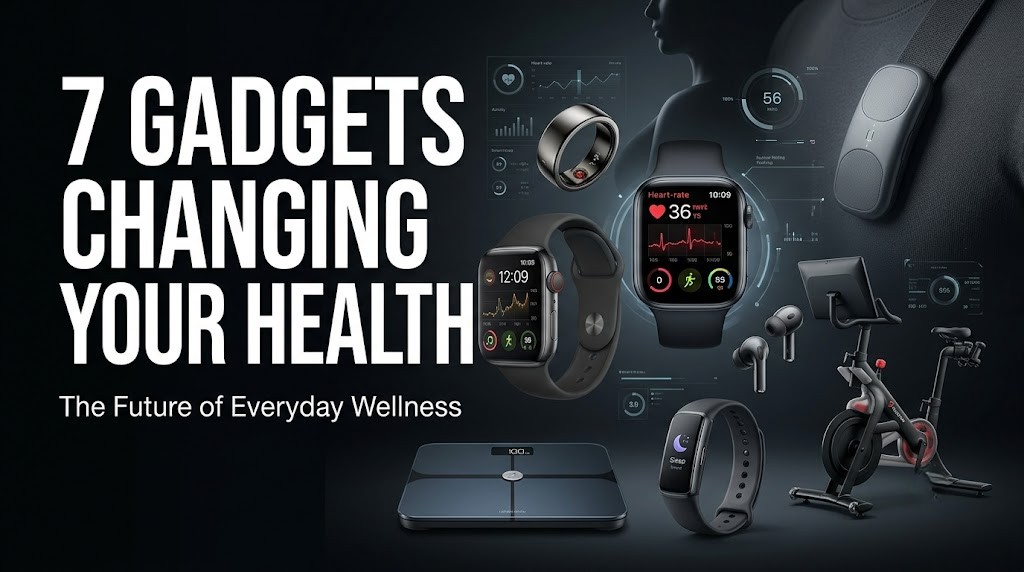
Health technology is no longer limited to hospitals, fitness centres, or complicated medical equipment. Some of the most interesting innovations are the small devices people use every day on their wrists, beside their beds, in their homes, and even in their pockets. They do not necessarily look like revolutionary medical technology, but they are gradually changing how people understand sleep, movement, stress, nutrition, and everyday wellbeing.
The biggest shift is not simply that these gadgets collect more information. It is that they make personal health data easier to notice and act on. Instead of waiting for an annual check-up to learn something about your lifestyle, connected devices can provide patterns and trends throughout the year. That can make health management feel less like an occasional task and more like an ongoing habit.
From smart rings and advanced fitness trackers to connected blood-pressure monitors and sleep technology, here are seven categories of gadgets quietly reshaping everyday health and wellness.
1. Smart Rings Are Turning Health Tracking Into Something Almost Invisible
Smartwatches have dominated wearable health technology for years, but smart rings are offering a much more discreet alternative. Devices such as the Oura Ring and Samsung Galaxy Ring are designed to collect health-related measurements without requiring a large screen on your wrist.
Depending on the device, smart rings can monitor information such as heart rate, sleep patterns, activity, skin temperature trends, and recovery-related metrics. Their appeal comes partly from their simplicity. There is no constant stream of notifications demanding attention, yet the device can continue collecting information throughout the day and night.
For people interested in understanding their sleep quality or daily recovery, this can be particularly useful. Instead of focusing only on how many steps they completed, users can begin looking at broader patterns—whether late nights affect their recovery, whether their activity levels change their sleep, or how consistent their daily routines actually are.
Smart rings are therefore contributing to a larger trend in wearable technology: health monitoring that fits naturally into everyday life rather than feeling like another task to complete.
2. Smartwatches Are Becoming Personal Health Dashboards
The modern smartwatch has evolved far beyond counting steps and displaying smartphone notifications. Products such as the Apple Watch and Garmin wearables increasingly function as compact health-monitoring platforms.
Depending on the model and region, smartwatches can provide features involving heart-rate monitoring, workout tracking, sleep tracking, activity levels, and other wellness measurements. Some models can also offer alerts or screening-oriented features that encourage users to pay attention to particular changes and seek professional advice when appropriate.
What makes smartwatches particularly influential is their accessibility. A person does not have to think about wearing a dedicated health device every morning—the watch can become part of their normal routine. Over time, that creates a stream of personal data that can reveal behavioural patterns.
The real value is often found in the long-term picture rather than a single reading. A smartwatch cannot replace a doctor, but it can help people become more aware of their habits and give them information they may want to discuss with a healthcare professional.
3. Smart Scales Are Looking Beyond Body Weight
For decades, stepping onto a bathroom scale meant seeing one number: body weight. Connected smart scales are changing that experience by attempting to provide a broader picture of body composition and health-related trends.
Brands such as Withings have developed connected scales that can record measurements and synchronise them with smartphone applications. Depending on the model, users may see information related to body composition, weight trends, heart rate, or other metrics.
The important development is not that one morning’s measurement suddenly tells you everything about your health. It is that repeated measurements can create a longer-term record. That makes it easier to see whether lifestyle changes are producing a sustained trend rather than reacting to a single day’s result.
This approach reflects a broader change in consumer wellness technology. People are increasingly interested in trends instead of isolated numbers. A connected scale can turn an otherwise forgettable daily routine into another source of longitudinal personal information.
At the same time, body-composition estimates from consumer scales should be treated as estimates rather than clinical measurements. The technology is most useful when viewed as a tool for tracking patterns, not as a definitive diagnosis.
4. Connected Blood-Pressure Monitors Are Bringing More Health Checks Home
Blood pressure is one of those health measurements that can change depending on circumstances, which is one reason regular monitoring can be valuable for people who have been advised to track it. Traditional blood-pressure machines have been available for years, but connected monitors are making home readings easier to record and review.
Companies such as Omron offer digital blood-pressure monitors, including connected models that can transfer readings to digital applications. Instead of writing numbers down in a notebook, users can build a chronological record that can potentially be shared with a healthcare professional.
This is a subtle but important change. The gadget itself is not replacing medical care; rather, it reduces friction around collecting information between appointments.
For someone who has been instructed by a clinician to monitor blood pressure at home, having an organised record may make conversations with healthcare professionals more informative. However, consumers should use validated devices correctly and follow professional guidance, particularly when readings are unexpectedly high or low.
5. Sleep Technology Is Making the Night Part of the Health Conversation
Sleep used to be one of the least visible parts of personal health. You went to bed, woke up, and largely relied on how you felt to judge the quality of your night. Today, wearable sensors and sleep-focused devices are making sleep a measurable part of the wellness conversation.
Smart rings, watches, mattresses, bedside sensors, and other connected products can attempt to estimate sleep duration and identify patterns in nighttime behaviour. Some systems also combine sleep information with activity and recovery data, creating a more complete picture of daily routines.
This has changed the way many people think about rest. Instead of treating sleep as the leftover hours between work and waking activities, technology increasingly presents it as a fundamental component of everyday wellbeing.
There is, however, an important distinction between sleep tracking and medical sleep diagnosis. Consumer devices can provide useful estimates and trends, but they do not necessarily provide the same level of assessment as a clinical sleep study.
The most constructive use of sleep technology may therefore be simple: helping people recognise habits. If consistently short nights appear alongside late screen use, irregular schedules, or excessive evening activity, the information can encourage someone to reconsider their routine.
6. Smart Hydration Gadgets Are Tackling an Ordinary Problem With Technology
Not every health gadget needs to measure something sophisticated. Sometimes technology is simply useful because it helps people remember an everyday habit.
Smart water bottles and hydration trackers are designed around that idea. Some connected bottles can track drinking behaviour, provide reminders, or connect with smartphone applications. Instead of relying entirely on memory, users receive prompts intended to keep hydration on their radar.
The concept may sound simple—and that is precisely why it is interesting. Much of consumer health technology is moving toward behavioural nudges rather than dramatic interventions. A reminder to drink water, stand up, walk, sleep, or take a break may seem insignificant on its own, but repeated prompts can support routines.
Of course, hydration needs vary considerably between individuals and circumstances, so generic targets should not automatically be treated as medical requirements. The broader value of these gadgets is their ability to make an easily forgotten daily behaviour more visible.
In an increasingly connected lifestyle, even a water bottle can become part of the personal wellness ecosystem.
7. Portable Health Monitors Are Making Personal Data More Accessible
Perhaps the most significant development is the growing number of compact devices designed to collect health-related information outside traditional medical environments. Portable ECG devices, connected thermometers, pulse oximeters, glucose-monitoring technologies, and other home-use products are expanding the amount of health information people can potentially access themselves.
Some devices can connect to smartphones, store historical readings, or help users share information with healthcare professionals. This can be particularly relevant for people who have been specifically advised to monitor a particular measurement at home.
The technology is also changing expectations around healthcare. Instead of imagining health monitoring as something that happens exclusively inside a clinic, consumers are increasingly surrounded by devices capable of collecting information throughout ordinary life.
But accessibility creates a responsibility: more data does not automatically mean better understanding. A single unusual reading can be caused by many factors, and consumer devices can have limitations. Health information needs context, and symptoms should not be dismissed simply because a gadget reports a reassuring number.
The most meaningful role of portable health technology may ultimately be to improve communication between individuals and healthcare professionals rather than replace professional judgement.
The Bigger Change Is Happening Quietly
The interesting thing about these gadgets is that none of them needs to completely transform healthcare on its own. Their impact comes from how they fit together.
A smartwatch can capture activity. A smart ring can provide sleep and recovery trends. A connected scale can record changes over time. A blood-pressure monitor can help someone maintain a home log. Sleep technology can reveal patterns that might otherwise go unnoticed. Together, these devices contribute to a world in which people have access to more information about their everyday health than previous generations did.
But there is a difference between health awareness and health diagnosis. Consumer gadgets are excellent at generating information, yet information still needs interpretation. Algorithms can identify patterns, but they cannot fully understand an individual’s medical history, symptoms, medications, or circumstances.
Privacy is another increasingly important part of the conversation. Health-related data is inherently sensitive, making it worth understanding what information a device collects, where it is stored, how it is used, and which third parties may have access to it.
Ultimately, the most useful health gadget may not be the one with the longest specification sheet. It may be the device that helps someone notice a meaningful pattern, maintain a healthier routine, or have a better-informed conversation with a healthcare professional.
A New Era of Everyday Health Technology
The future of personal wellness technology is unlikely to be defined by one spectacular gadget. Instead, it is being built through dozens of small innovations that quietly integrate health awareness into everyday routines.
Smart rings make monitoring discreet. Smartwatches make it continuous. Connected scales make trends easier to visualise. Home monitors make certain measurements more convenient. Sleep technology brings nighttime behaviour into the conversation, while hydration and portable wellness devices turn ordinary habits into trackable routines.
That is what makes this generation of health gadgets so interesting. They are not necessarily replacing traditional healthcare. They are changing what happens before, between, and around professional healthcare interactions.
And as sensors become smaller, software becomes smarter, and connected devices become more commonplace, the boundary between everyday technology and personal wellness will probably become even less noticeable.
Affiliate Disclosure: This article may contain affiliate links. If you purchase a product or sign up for a service through one of these links, we may earn a commission at no additional cost to you. Our reviews and opinions are based on our editorial assessment and are not influenced solely by affiliate compensation.