Introduction
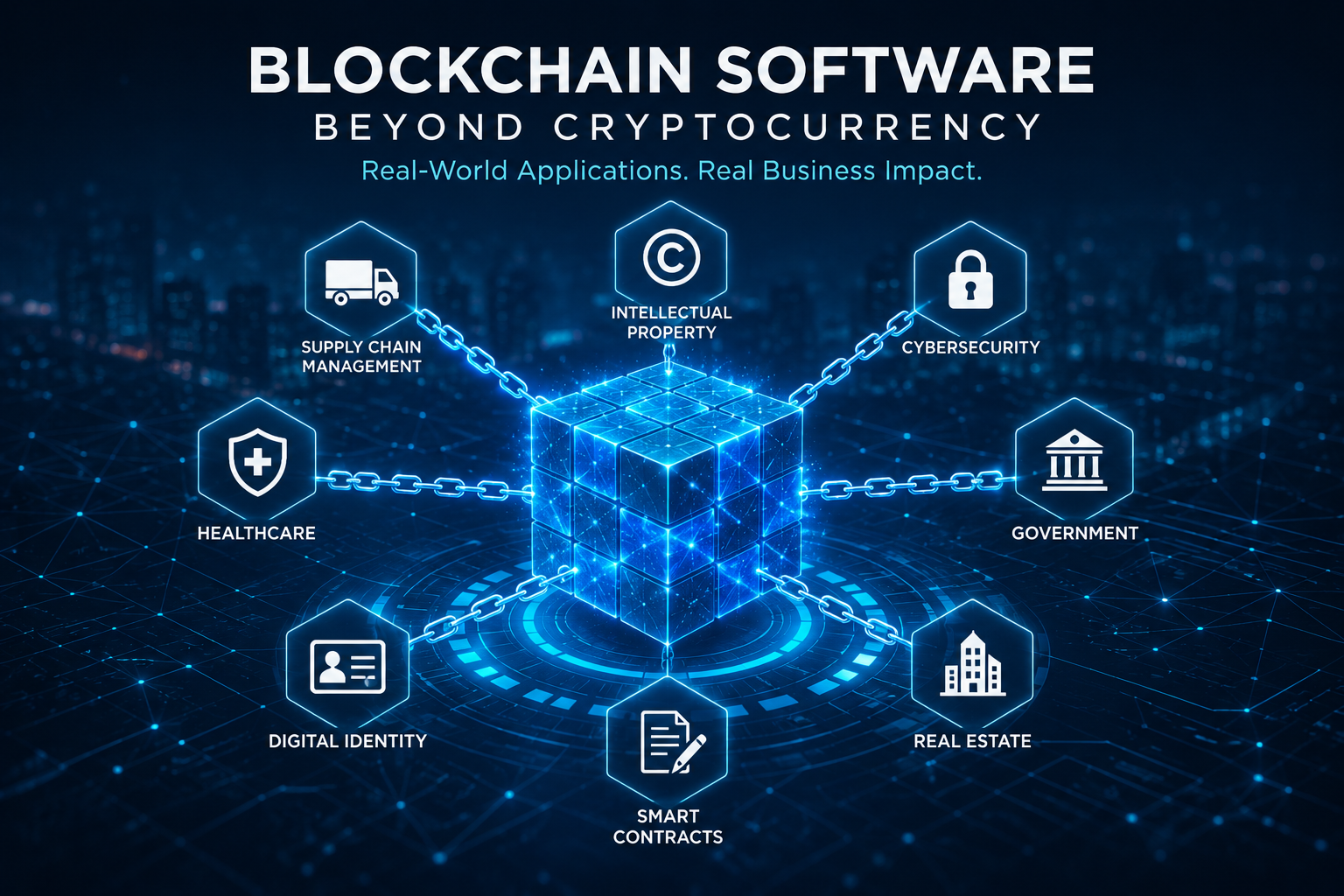
When most people hear the term blockchain, they immediately think of cryptocurrencies such as Bitcoin and Ethereum. While digital currencies remain the most well-known application of blockchain technology, the underlying software infrastructure has evolved far beyond financial transactions. Today, blockchain software is driving innovation across industries including healthcare, supply chain management, cybersecurity, government services, real estate, and digital identity management.
As organizations seek greater transparency, security, and efficiency, blockchain software is emerging as a powerful tool for solving complex business challenges. By providing a decentralized, tamper-resistant, and transparent method of recording and verifying data, blockchain is reshaping how information is stored, shared, and managed.
This article explores the growing role of blockchain software beyond cryptocurrency and examines how businesses and governments are leveraging this transformative technology to build more secure and efficient systems.
Understanding Blockchain Software
Blockchain software is a digital framework that records transactions and data across a distributed network of computers. Instead of relying on a central authority or database, blockchain uses a decentralized ledger that is shared among participants.
Each record, known as a block, contains information that is cryptographically linked to previous blocks, creating a secure chain of data. Once information is added to the blockchain, it becomes extremely difficult to alter, making the technology highly resistant to fraud and unauthorized modifications.
Key characteristics of blockchain software include:
- Decentralization
- Transparency
- Immutability
- Enhanced security
- Automated verification through smart contracts
These features make blockchain valuable for applications far beyond digital currencies.
Blockchain in Supply Chain Management
One of the most successful non-cryptocurrency applications of blockchain software is supply chain management.
Modern supply chains involve multiple stakeholders, including manufacturers, suppliers, logistics providers, distributors, and retailers. Managing information across these entities often creates inefficiencies and opportunities for fraud.
Blockchain software provides a shared and transparent record of every stage of the supply chain.
Benefits
Improved Traceability
Businesses can track products from raw material sourcing to final delivery. This visibility helps identify bottlenecks, verify authenticity, and improve quality control.
Reduced Fraud
Counterfeit goods cost businesses billions of dollars annually. Blockchain enables companies to verify product origins and maintain trusted records.
Faster Audits
Since all transactions are recorded in a transparent ledger, auditing becomes more efficient and less time-consuming.
Real-World Example
Major companies such as Walmart and IBM have implemented blockchain-powered supply chain solutions to track food products and improve food safety standards.
Healthcare and Medical Data Management
Healthcare organizations generate enormous volumes of sensitive patient information. Traditional systems often face challenges related to interoperability, security, and data sharing.
Blockchain software offers a secure platform for managing medical records while maintaining patient privacy.
Advantages
Secure Patient Records
Blockchain creates immutable records that reduce the risk of unauthorized modifications.
Better Data Sharing
Healthcare providers can securely share patient information across hospitals, clinics, and laboratories.
Enhanced Privacy
Patients can have greater control over who accesses their medical data.
Reduced Administrative Costs
Automated verification processes can simplify insurance claims and healthcare administration.
Future Potential
Blockchain could support global healthcare networks where patient records remain accessible and secure regardless of geographic location.
Digital Identity Management
Identity theft and data breaches continue to pose major challenges worldwide. Traditional identity systems rely on centralized databases that can become attractive targets for cybercriminals.
Blockchain software introduces decentralized digital identity solutions.
How It Works
Users control their own digital credentials and can share only the necessary information when verifying identity.
For example:
- Age verification
- Employment verification
- Educational qualifications
- Government-issued identification
Benefits
- Greater privacy
- Reduced risk of identity theft
- Simplified verification processes
- Lower costs for organizations
Governments and technology companies are increasingly exploring blockchain-based digital identity frameworks to improve security and accessibility.
Smart Contracts and Business Automation
One of blockchain’s most transformative features is the smart contract.
A smart contract is a self-executing program stored on a blockchain that automatically performs actions when predefined conditions are met.
Business Applications
Insurance
Claims can be automatically processed once verification criteria are satisfied.
Real Estate
Property ownership transfers can occur instantly after payment confirmation.
Financial Services
Loans, settlements, and compliance checks can be automated.
Procurement
Supplier agreements can trigger automatic payments upon delivery confirmation.
Benefits
- Reduced paperwork
- Faster transactions
- Lower operational costs
- Increased transparency
- Fewer intermediaries
Smart contracts represent a major step toward automating complex business processes.
Blockchain in Real Estate
Real estate transactions often involve extensive paperwork, legal procedures, and third-party verification.
Blockchain software can streamline property transactions by creating transparent and secure digital records.
Key Advantages
Faster Property Transfers
Ownership records can be verified instantly.
Reduced Fraud
Tamper-proof records help prevent title fraud and document manipulation.
Lower Transaction Costs
Fewer intermediaries mean reduced fees and administrative expenses.
Increased Transparency
Buyers and sellers can access verified ownership histories.
Some countries have already begun experimenting with blockchain-based land registries to improve efficiency and reduce corruption.
Government Applications of Blockchain
Governments worldwide are exploring blockchain software to improve transparency, accountability, and public trust.
Voting Systems
Blockchain-based voting platforms could provide secure and transparent election processes while reducing opportunities for fraud.
Public Records
Birth certificates, marriage records, licenses, and property registrations can be securely stored on blockchain networks.
Tax Administration
Blockchain can improve compliance and reduce administrative inefficiencies.
Public Procurement
Transparent procurement systems can help combat corruption and improve oversight.
While large-scale implementation remains a challenge, blockchain offers significant potential for modernizing public services.
Cybersecurity and Data Protection
Cybersecurity threats continue to grow in sophistication and frequency. Centralized databases remain vulnerable to hacking, ransomware attacks, and insider threats.
Blockchain software enhances cybersecurity through decentralization and cryptographic security mechanisms.
Security Benefits
Tamper Resistance
Data stored on blockchain networks is extremely difficult to modify without authorization.
Distributed Architecture
There is no single point of failure.
Improved Audit Trails
Every transaction is permanently recorded and traceable.
Secure Access Management
Blockchain can support advanced authentication and identity verification systems.
Organizations are increasingly exploring blockchain as part of comprehensive cybersecurity strategies.
Intellectual Property and Digital Rights Management
Creators and businesses often face challenges protecting intellectual property in the digital age.
Blockchain software provides verifiable proof of ownership and creation.
Applications
- Copyright management
- Patent registration
- Music royalties
- Digital art authentication
- Software licensing
Benefits
Transparent Ownership Records
Creators can establish clear ownership rights.
Automated Royalty Payments
Smart contracts can distribute payments automatically when content is used.
Reduced Piracy
Blockchain-based verification systems help authenticate legitimate digital assets.
The growth of digital content economies is increasing demand for blockchain-powered rights management solutions.
Blockchain in Education
Educational institutions can use blockchain software to issue and verify academic credentials.
Challenges with Traditional Systems
- Credential fraud
- Slow verification processes
- Administrative burdens
Blockchain Solutions
Universities can issue digital diplomas and certificates stored on blockchain networks.
Benefits
- Instant verification
- Reduced fraud
- Permanent records
- Easier international recognition
Employers can verify qualifications quickly without relying on manual checks.
Challenges Facing Blockchain Adoption
Despite its potential, blockchain software faces several obstacles.
Scalability
Many blockchain networks struggle to process large transaction volumes efficiently.
Regulatory Uncertainty
Governments continue to develop policies governing blockchain applications.
Integration Complexity
Organizations may face challenges integrating blockchain with existing systems.
Energy Consumption
Certain blockchain models require significant computational resources.
Skills Gap
Blockchain development remains a specialized field with limited talent availability.
Addressing these challenges will be essential for broader adoption across industries.
The Future of Blockchain Software
The future of blockchain software extends far beyond cryptocurrency. Emerging innovations are expected to drive widespread adoption across enterprise and public-sector environments.
Key trends include:
- Enterprise blockchain platforms
- AI-powered blockchain solutions
- Decentralized identity systems
- Tokenization of real-world assets
- Cross-border digital services
- Blockchain-enabled Internet of Things (IoT) networks
- Secure data-sharing ecosystems
As technology matures, blockchain is likely to become an invisible yet essential component of digital infrastructure, much like cloud computing today.
Conclusion
Blockchain software has evolved into a transformative technology with applications far beyond cryptocurrencies. From healthcare and supply chains to cybersecurity, education, real estate, and government services, blockchain is helping organizations improve transparency, security, efficiency, and trust.
While challenges related to scalability, regulation, and implementation remain, ongoing innovation continues to expand blockchain’s capabilities. As businesses seek more secure and decentralized solutions for managing information and transactions, blockchain software is positioned to play a critical role in the next generation of digital transformation.
The true value of blockchain lies not in digital currencies alone but in its ability to create trusted systems where data, processes, and transactions can be verified without relying on traditional intermediaries. This broader vision is what makes blockchain one of the most influential technologies shaping the future of the global digital economy.