Introduction
Artificial Intelligence (AI) has evolved from an emerging technology into a fundamental driver of business innovation. In 2026, organizations across industries are investing heavily in AI-powered software to improve efficiency, automate workflows, enhance customer experiences, and gain a competitive advantage. From multinational corporations to rapidly growing startups, businesses are leveraging AI solutions to transform operations and unlock new opportunities.
The global AI software market continues to expand at an unprecedented pace, fuelled by advancements in machine learning, generative AI, cloud computing, and data analytics. Major technology companies such as Microsoft, Google Cloud, AWS, Salesforce, Oracle, SAP, IBM, Adobe, and ServiceNow are integrating AI capabilities into their platforms, making sophisticated tools more accessible than ever before.
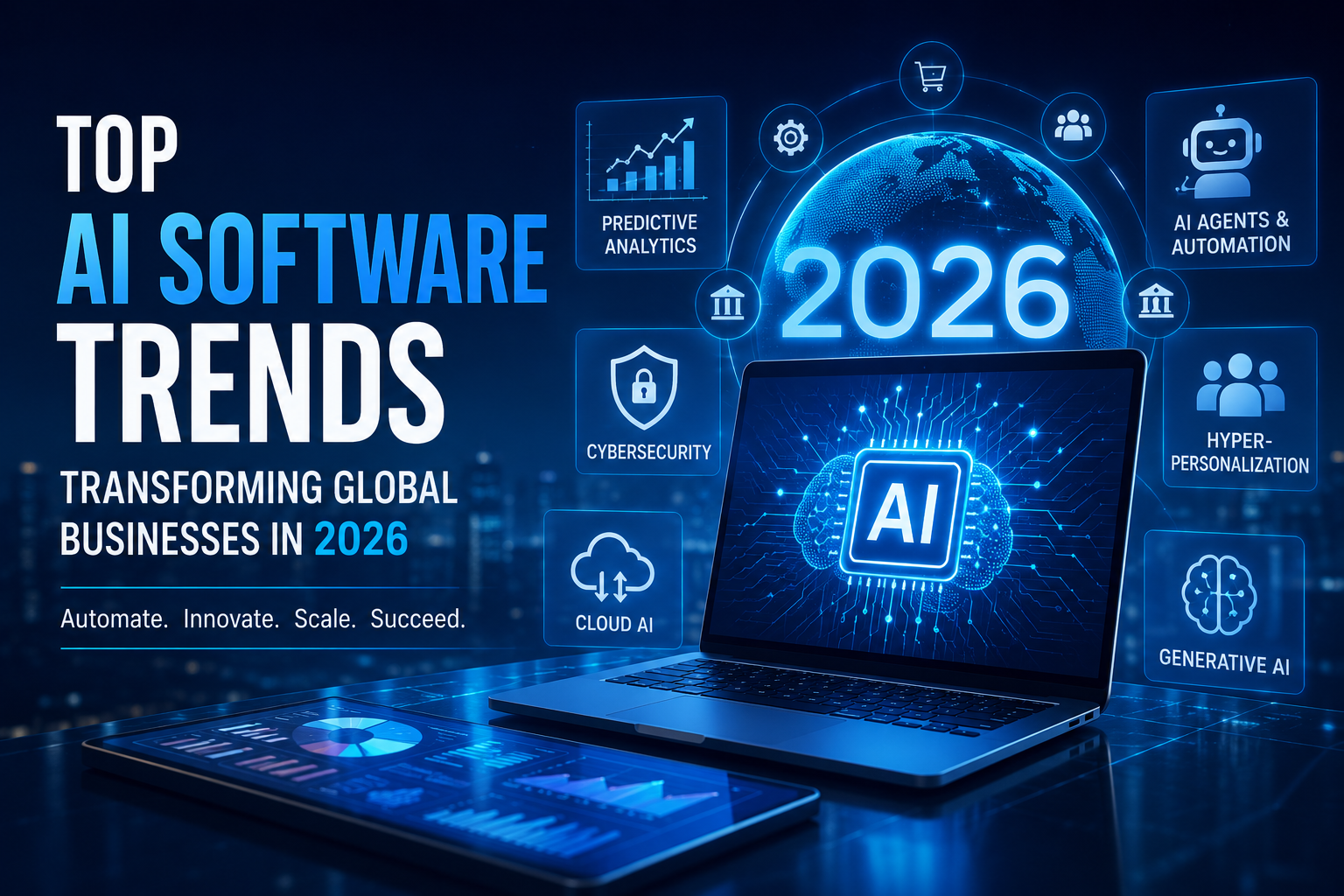
This article explores the most influential AI software trends shaping global businesses in 2026 and examines how these innovations are redefining the future of work.
1. AI Agents Become Enterprise Workforce Partners
One of the biggest developments in 2026 is the rise of AI agents. Unlike traditional chatbots that respond to simple queries, AI agents can perform complex tasks, make decisions, and execute multi-step workflows with minimal human intervention.
Businesses are deploying AI agents to:
- Manage customer support tickets
- Schedule meetings
- Analyse financial reports
- Generate marketing content
- Process invoices
- Conduct market research
Companies using AI agents report significant improvements in productivity and operational efficiency. These intelligent systems are becoming digital coworkers capable of collaborating with employees across departments.
Microsoft Copilot, Google Gemini for Workspace, Salesforce Agent force, and ServiceNow AI Agents are among the leading enterprise solutions driving this transformation.
2. Generative AI Moves Beyond Content Creation
Generative AI initially gained popularity for creating text, images, and videos. In 2026, its role has expanded dramatically.
Organizations now use generative AI to:
- Design products
- Develop software code
- Create business strategies
- Generate legal documents
- Build customer service workflows
- Produce personalized sales proposals
Modern AI platforms can understand business objectives and generate actionable solutions rather than simply producing content.
For example, marketing teams can create entire campaign strategies within minutes, while software developers use AI-assisted coding tools to accelerate application development and reduce errors.
This shift is making generative AI an essential business productivity tool rather than just a creative assistant.
3. AI-Powered Automation Redefines Operations
Automation has existed for years, but AI-powered automation is taking efficiency to a new level.
Traditional automation follows predefined rules. AI automation can learn, adapt, and improve over time.
Organizations are automating:
- Supply chain management
- Customer onboarding
- HR recruitment processes
- Financial auditing
- Procurement operations
- Inventory forecasting
AI software analyses large datasets, identifies patterns, and recommends actions automatically.
Businesses adopting intelligent automation experience:
- Reduced operational costs
- Faster decision-making
- Improved accuracy
- Enhanced customer satisfaction
According to industry analysts, AI-driven automation is expected to become one of the largest contributors to productivity growth worldwide.
4. Hyper-Personalization Becomes the New Customer Standard
Consumers increasingly expect personalized experiences across digital channels.
AI software helps businesses analyse customer behaviour, preferences, purchase history, and engagement patterns to deliver highly customized experiences.
Examples include:
- Personalized product recommendations
- Dynamic website content
- Customized email campaigns
- Individualized pricing strategies
- AI-powered customer support
Retailers, financial institutions, healthcare providers, and media companies are investing heavily in AI personalization platforms.
Brands that successfully implement hyper-personalization often achieve:
- Higher customer engagement
- Increased conversion rates
- Improved customer retention
- Greater lifetime customer value
In 2026, personalization powered by AI is no longer a competitive advantage—it is becoming a business necessity.
5. AI-Driven Cybersecurity Gains Strategic Importance
As cyber threats become more sophisticated, organizations are turning to AI-powered cybersecurity solutions for protection.
Modern AI security platforms can:
- Detect suspicious behaviour
- Identify malware
- Monitor network activity
- Predict potential attacks
- Automate incident response
Unlike traditional security tools, AI systems continuously learn from evolving threat patterns and adapt in real time.
Leading cybersecurity companies such as CrowdStrike, Palo Alto Networks, Microsoft Security, and IBM Security are integrating advanced AI capabilities into their products.
With global cybercrime costs continuing to rise, AI-driven cybersecurity is becoming a critical component of enterprise risk management strategies.
6. AI Software Accelerates Software Development
Software development is undergoing a major transformation due to AI-assisted coding tools.
Developers now use AI software to:
- Generate code automatically
- Detect bugs
- Suggest improvements
- Create documentation
- Conduct testing
- Optimize performance
Tools such as GitHub Copilot, Amazon Code Whisperer, and Google AI coding assistants significantly reduce development time.
Benefits include:
- Faster product releases
- Reduced development costs
- Improved code quality
- Increased developer productivity
Organizations can now bring digital products to market more quickly while maintaining high software quality standards.
7. AI and Data Analytics Converge
Data remains one of the most valuable business assets, but extracting meaningful insights can be challenging.
AI-powered analytics platforms are helping organizations transform raw data into actionable intelligence.
Key capabilities include:
- Predictive analytics
- Trend forecasting
- Real-time reporting
- Automated data visualization
- Business intelligence recommendations
Executives can now ask questions in natural language and receive sophisticated analytical insights instantly.
This democratization of analytics enables non-technical users to make data-driven decisions without requiring extensive expertise in data science.
Companies that effectively combine AI and analytics gain a significant advantage in strategic planning and market responsiveness.
8. Industry-Specific AI Solutions Gain Momentum
Rather than adopting generic AI tools, businesses increasingly prefer industry-specific solutions designed for their unique challenges.
Examples include:
Healthcare
- Medical diagnostics
- Patient management
- Drug discovery
Finance
- Fraud detection
- Risk assessment
- Investment analysis
Manufacturing
- Predictive maintenance
- Quality control
- Production optimization
Retail
- Demand forecasting
- Inventory management
- Customer insights
Logistics
- Route optimization
- Supply chain planning
- Fleet management
Industry-focused AI software delivers greater accuracy, faster implementation, and stronger business outcomes.
9. Responsible AI and Governance Become Priorities
As AI adoption accelerates, concerns regarding ethics, privacy, security, and compliance continue to grow.
Organizations are implementing AI governance frameworks to ensure responsible usage.
Key priorities include:
- Data privacy protection
- Bias mitigation
- Regulatory compliance
- Transparency
- Explainability
- Accountability
Governments worldwide are introducing regulations that require businesses to manage AI responsibly.
Software vendors are responding by incorporating governance features directly into AI platforms.
Responsible AI practices help organizations maintain customer trust while reducing legal and reputational risks.
10. Multimodal AI Expands Business Capabilities
Traditional AI systems typically process one type of data, such as text or images.
Multimodal AI can simultaneously understand and generate:
- Text
- Images
- Audio
- Video
- Structured data
This capability enables more advanced business applications.
For example:
- Customer service systems can analyse voice, text, and visual inputs together.
- Marketing teams can create complete multimedia campaigns using a single AI platform.
- Healthcare providers can combine medical images and patient records for improved diagnoses.
Multimodal AI is creating richer, more intelligent business experiences across industries.
11. AI-Powered Decision Intelligence Emerges
Decision intelligence represents the next stage of business analytics.
Instead of simply presenting information, AI systems now recommend optimal actions based on available data.
Applications include:
- Strategic planning
- Budget allocation
- Risk management
- Resource optimization
- Market expansion decisions
Executives increasingly rely on AI software to evaluate scenarios and forecast outcomes before making critical business choices.
This trend is transforming AI from a support tool into a strategic advisor within organizations.
12. Cloud-Based AI Adoption Continues to Rise
Cloud computing remains the foundation of enterprise AI deployment.
Cloud providers offer scalable infrastructure, advanced machine learning services, and integrated AI tools that reduce implementation complexity.
Leading platforms include:
- Microsoft Azure AI
- Google Cloud AI
- Amazon Web Services AI
- Oracle AI Services
- IBM Watson
Benefits of cloud-based AI include:
- Lower infrastructure costs
- Faster deployment
- Enhanced scalability
- Improved collaboration
- Continuous innovation
As businesses seek flexibility and efficiency, cloud AI solutions continue to dominate global adoption trends.
The Business Benefits of AI Software in 2026
Organizations investing in AI software are experiencing measurable advantages:
Increased Productivity
AI automates repetitive tasks, allowing employees to focus on higher-value activities.
Better Customer Experiences
Personalized interactions improve satisfaction and loyalty.
Reduced Costs
Automation lowers operational expenses and increases efficiency.
Faster Innovation
AI accelerates product development and business transformation initiatives.
Stronger Competitive Advantage
Organizations using AI effectively can respond more quickly to market changes.
Enhanced Decision-Making
Data-driven insights support smarter business strategies.
These benefits explain why AI investment remains a top priority for executives worldwide.
Conclusion
AI software is no longer an experimental technology it is a core business capability shaping the global economy in 2026. From intelligent agents and generative AI to cybersecurity, analytics, automation, and decision intelligence, organizations are leveraging advanced AI solutions to drive growth and innovation.
As leading technology providers continue to enhance their platforms, AI will become even more integrated into everyday business operations. Companies that embrace these trends strategically will be better positioned to improve efficiency, serve customers more effectively, and compete in an increasingly digital marketplace.
The future of business belongs to organizations that successfully combine human expertise with the power of artificial intelligence. In 2026 and beyond, AI software will remain one of the most transformative forces driving global business success.