Introduction
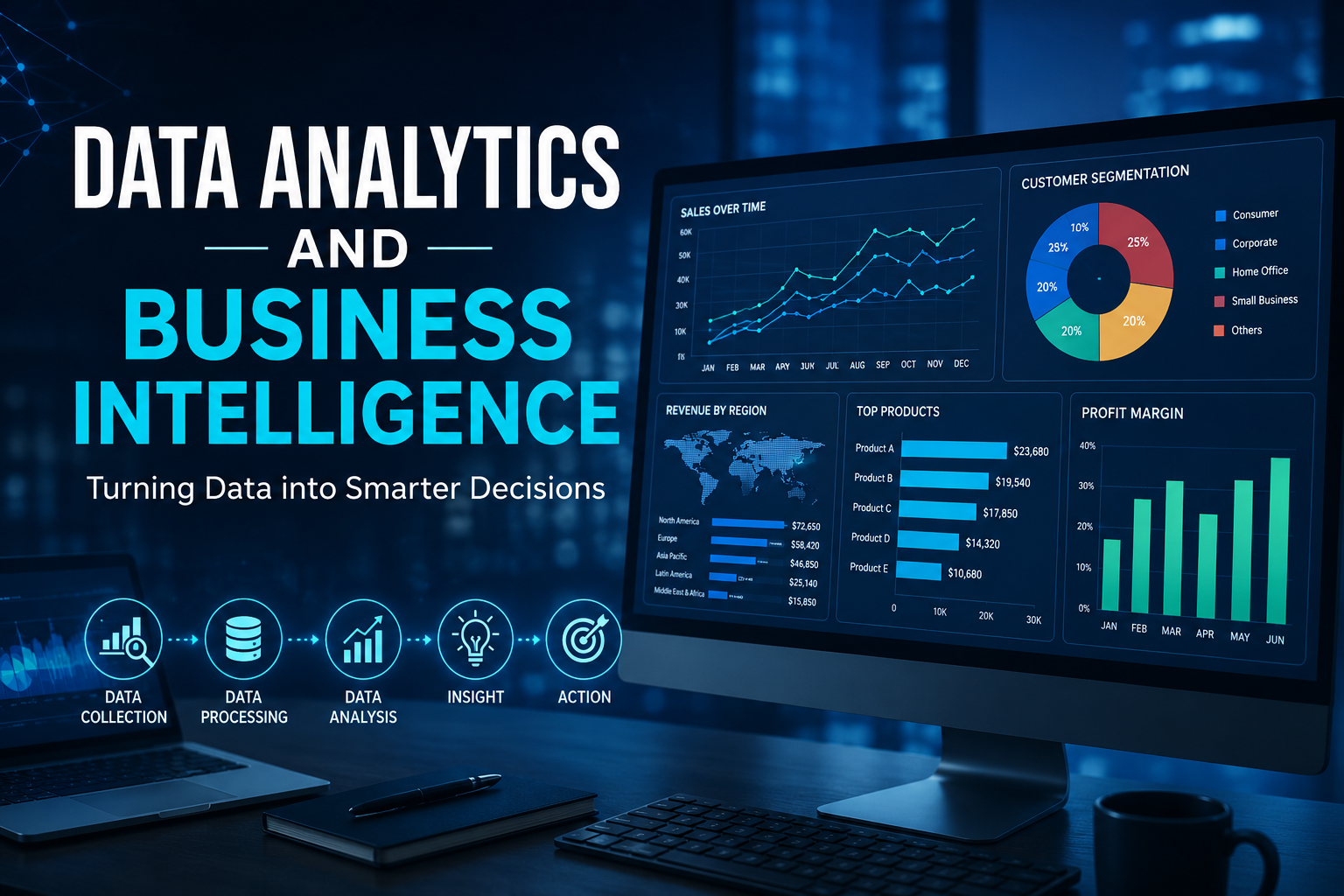
In today’s digital economy, data has become one of the most valuable assets for organizations across industries. Every day, businesses generate enormous volumes of information through customer interactions, online transactions, social media engagement, supply chain operations, and connected devices. However, raw data alone has little value unless it can be transformed into meaningful insights. This is where Data Analytics and Business Intelligence (BI) play a crucial role.
Data Analytics and Business Intelligence help organizations convert complex datasets into actionable information that supports strategic planning, operational efficiency, customer satisfaction, and revenue growth. As competition intensifies in global markets, businesses increasingly rely on advanced analytical tools and BI platforms to make informed decisions and gain a competitive advantage.
This article explores the importance of data analytics and business intelligence, their benefits, emerging trends, challenges, and their impact on modern enterprises.
Understanding Data Analytics
Data Analytics refers to the process of collecting, organizing, analyzing, and interpreting data to identify patterns, trends, and insights. It involves the use of statistical techniques, algorithms, machine learning, and visualization tools to extract valuable information from structured and unstructured datasets.
Data analytics can be categorized into four primary types:
1. Descriptive Analytics
Descriptive analytics examines historical data to understand what has happened in the past. It uses reports, dashboards, and data visualizations to summarize performance metrics.
Examples include:
- Monthly sales reports
- Website traffic statistics
- Customer satisfaction scores
2. Diagnostic Analytics
Diagnostic analytics helps organizations determine why a specific event occurred. It focuses on identifying the root causes behind trends and outcomes.
Examples include:
- Understanding why sales declined in a specific region
- Identifying reasons for increased customer churn
3. Predictive Analytics
Predictive analytics uses historical data, machine learning, and statistical models to forecast future outcomes.
Examples include:
- Demand forecasting
- Predicting customer behaviour
- Financial risk assessment
4. Prescriptive Analytics
Prescriptive analytics recommends actions that organizations should take to achieve desired outcomes.
Examples include:
- Inventory optimization
- Dynamic pricing strategies
- Supply chain improvements
What Is Business Intelligence?
Business Intelligence (BI) refers to technologies, processes, and tools used to collect, integrate, analyse, and present business information. BI systems provide decision-makers with real-time access to data through dashboards, reports, scorecards, and visual analytics.
The primary goal of BI is to support smarter and faster decision-making by transforming raw data into understandable insights.
Popular BI platforms include:
- Microsoft Power BI
- Tableau
- Qlik Sense
- SAP BusinessObjects
- Oracle Analytics Cloud
- IBM Cognos Analytics
- Looker
These tools allow organizations to monitor performance, identify opportunities, and respond quickly to market changes.
The Relationship Between Data Analytics and Business Intelligence
Although often used interchangeably, Data Analytics and Business Intelligence serve different but complementary purposes.
Business Intelligence primarily focuses on monitoring current and historical business performance using dashboards and reports. Data Analytics goes further by exploring patterns, predicting future trends, and generating recommendations.
For example:
- A BI dashboard may show that online sales increased by 15%.
- Data analytics can explain why sales increased and predict whether the trend will continue.
Together, they create a powerful framework for data-driven decision-making.
Why Data Analytics and Business Intelligence Matter
Organizations today operate in an environment characterized by rapid technological change, evolving customer expectations, and intense competition. Data Analytics and BI help businesses navigate these challenges effectively.
Improved Decision-Making
One of the most significant benefits is enhanced decision-making. Rather than relying on assumptions or intuition, leaders can use factual insights to make strategic choices.
Data-driven decisions often result in:
- Higher accuracy
- Reduced risks
- Better resource allocation
- Increased profitability
Enhanced Customer Understanding
Organizations can analyse customer behaviour, preferences, and purchasing patterns to improve products and services.
Benefits include:
- Personalized marketing campaigns
- Improved customer experiences
- Higher customer retention rates
- Better customer engagement
Increased Operational Efficiency
Analytics helps identify inefficiencies within business processes.
Examples include:
- Reducing production bottlenecks
- Optimizing logistics operations
- Improving workforce productivity
- Minimizing operational costs
Competitive Advantage
Businesses that leverage analytics effectively gain deeper insights into market trends and competitor activities.
This enables organizations to:
- Launch products faster
- Identify emerging opportunities
- Respond quickly to market changes
Applications Across Industries
Healthcare
Healthcare organizations use analytics to improve patient outcomes, reduce costs, and enhance operational efficiency.
Applications include:
- Disease prediction
- Patient monitoring
- Resource allocation
- Clinical decision support
Retail
Retailers leverage BI and analytics to understand consumer behavior and optimize sales strategies.
Applications include:
- Demand forecasting
- Inventory management
- Customer segmentation
- Personalized recommendations
Banking and Finance
Financial institutions use analytics to manage risk and detect fraud.
Applications include:
- Credit scoring
- Fraud detection
- Investment analysis
- Regulatory compliance
Manufacturing
Manufacturers utilize analytics to optimize production processes and improve product quality.
Applications include:
- Predictive maintenance
- Supply chain optimization
- Quality control
- Production forecasting
Education
Educational institutions analyse data to improve student performance and operational effectiveness.
Applications include:
- Student success prediction
- Curriculum optimization
- Enrolment forecasting
- Learning analytics
Emerging Trends in Data Analytics and Business Intelligence
Artificial Intelligence and Machine Learning
AI and machine learning are transforming analytics by automating data processing and generating deeper insights.
Benefits include:
- Faster analysis
- Improved forecasting accuracy
- Automated anomaly detection
- Intelligent recommendations
Many modern BI platforms now include AI-powered capabilities that simplify complex analytical tasks.
Real-Time Analytics
Organizations increasingly require immediate access to data.
Real-time analytics enables businesses to:
- Monitor operations continuously
- Detect issues instantly
- Respond to market changes quickly
Industries such as finance, e-commerce, and logistics heavily depend on real-time data processing.
Self-Service Business Intelligence
Traditional BI often required specialized technical expertise. Self-service BI tools allow non-technical users to create reports and dashboards independently.
Advantages include:
- Greater accessibility
- Faster decision-making
- Reduced dependency on IT departments
Cloud-Based Analytics
Cloud computing has revolutionized the analytics landscape.
Benefits include:
- Scalability
- Cost efficiency
- Remote accessibility
- Enhanced collaboration
Cloud-based platforms such as Microsoft Azure, AWS, and Google Cloud provide powerful analytics capabilities for organizations of all sizes.
Data Visualization
Modern BI tools emphasize intuitive visualizations that simplify complex information.
Popular visualization formats include:
- Interactive dashboards
- Heat maps
- Charts and graphs
- Geographic maps
Effective visualization improves communication and helps stakeholders understand insights quickly.
Challenges in Data Analytics and Business Intelligence
Despite their benefits, organizations face several challenges when implementing analytics and BI solutions.
Data Quality Issues
Poor-quality data can lead to inaccurate insights and flawed decisions.
Common issues include:
- Missing data
- Duplicate records
- Inconsistent formats
- Outdated information
Maintaining data quality is essential for successful analytics initiatives.
Data Security and Privacy
As organizations collect more information, protecting sensitive data becomes increasingly important.
Businesses must comply with regulations such as:
- GDPR (General Data Protection Regulation)
- CCPA (California Consumer Privacy Act)
- Industry-specific compliance requirements
Robust cybersecurity measures are necessary to safeguard data assets.
Skills Gap
There is a growing demand for professionals skilled in:
- Data science
- Business analytics
- Machine learning
- Data engineering
Many organizations struggle to recruit and retain qualified talent.
Data Integration Complexity
Businesses often store information across multiple systems and platforms.
Integrating these data sources can be challenging due to:
- Different formats
- Legacy systems
- Data silos
Successful integration is crucial for generating comprehensive insights.
Best Practices for Successful Analytics and BI Implementation
Organizations can maximize the value of analytics and BI by following several best practices.
Define Clear Objectives
Businesses should establish specific goals before launching analytics initiatives.
Examples include:
- Increasing revenue
- Reducing operational costs
- Improving customer satisfaction
Invest in Data Governance
Strong data governance ensures consistency, quality, and compliance.
Key components include:
- Data standards
- Access controls
- Security policies
- Data stewardship
Promote a Data-Driven Culture
Organizations should encourage employees at all levels to use data in decision-making.
This requires:
- Leadership support
- Training programs
- Accessible analytics tools
Choose the Right Technology
Selecting appropriate BI and analytics platforms is critical.
Factors to consider include:
- Scalability
- Ease of use
- Integration capabilities
- Security features
Continuously Monitor Performance
Analytics strategies should be reviewed regularly to ensure alignment with business goals and changing market conditions.
The Future of Data Analytics and Business Intelligence
The future of Data Analytics and Business Intelligence is closely tied to advances in artificial intelligence, automation, and cloud computing. Organizations will increasingly rely on predictive and prescriptive analytics to anticipate challenges and identify opportunities before they emerge.
Emerging technologies such as generative AI, natural language processing, and augmented analytics will make data analysis more accessible and efficient. Users will be able to ask complex business questions in natural language and receive instant insights without requiring advanced technical expertise.
As data volumes continue to grow, organizations that embrace analytics and BI will be better positioned to innovate, adapt, and compete in the global marketplace.
Conclusion
Data Analytics and Business Intelligence have become essential components of modern business strategy. By transforming raw data into actionable insights, these technologies empower organizations to make smarter decisions, improve operational efficiency, enhance customer experiences, and achieve sustainable growth.
As businesses navigate an increasingly complex digital environment, the ability to harness data effectively will be a defining factor in long-term success. Organizations that invest in advanced analytics capabilities, foster a data-driven culture, and embrace emerging technologies will gain a significant competitive advantage in the years ahead.
In an era where information drives innovation, Data Analytics and Business Intelligence are no longer optional they are fundamental to building resilient, agile, and future-ready enterprises.