Introduction
Artificial Intelligence (AI) has rapidly evolved from a futuristic concept into a transformative force across industries, and the global entertainment sector is no exception. From Hollywood film studios to streaming platforms and content creators worldwide, AI is changing how entertainment is produced, distributed, marketed, and consumed. As technology advances, AI is becoming a critical tool for filmmakers, producers, writers, and digital artists seeking to enhance creativity, reduce costs, and meet growing audience demands.
Hollywood, often regarded as the epicenter of global entertainment, is leading this technological revolution. Major studios, streaming services, and production companies are increasingly investing in AI-powered solutions to streamline operations and create innovative viewing experiences. While the integration of AI raises important ethical and professional concerns, its influence on the entertainment industry continues to expand at an unprecedented pace.
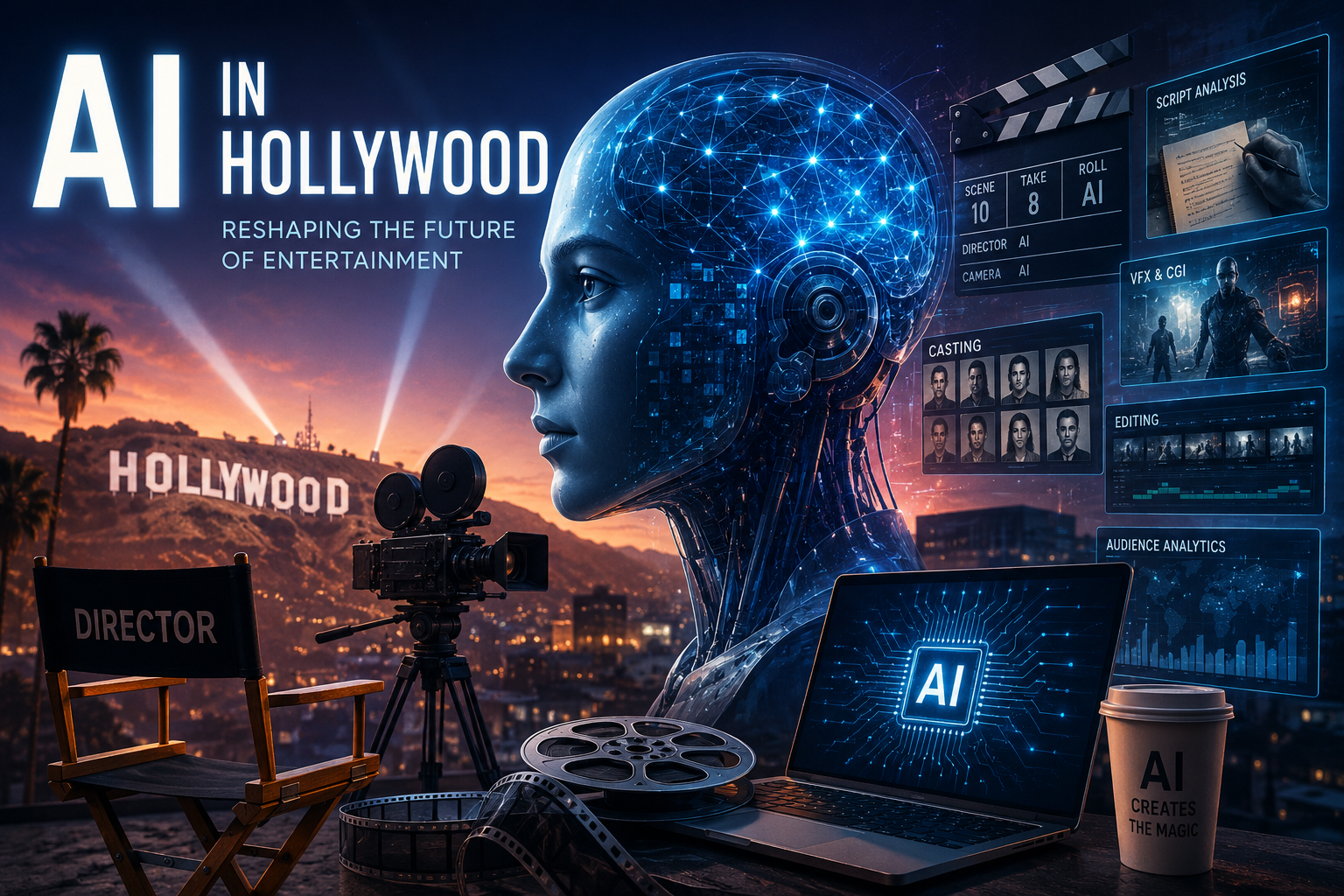
This article explores how AI is reshaping Hollywood and the broader global entertainment industry, examining its impact on content creation, visual effects, streaming services, marketing, audience engagement, and the future of storytelling.
The Rise of AI in Entertainment
The entertainment industry has always embraced technological innovation. From the introduction of sound in films to digital cameras and computer-generated imagery (CGI), technology has continually transformed how stories are told. AI represents the next major evolution.
Unlike traditional software, AI systems can analyse vast amounts of data, recognize patterns, generate content, and make predictions with minimal human intervention. This capability enables entertainment companies to improve efficiency and unlock new creative possibilities.
According to industry analysts, global investment in AI-driven entertainment technologies has increased significantly in recent years. Streaming platforms, film studios, gaming companies, and media organizations are leveraging AI to gain competitive advantages in an increasingly crowded marketplace.
AI-Powered Content Creation
One of the most significant developments in Hollywood is the use of AI during content creation.
Script Development
AI tools are now assisting writers and producers in script analysis and development. These systems can evaluate scripts based on factors such as:
- Story structure
- Character development
- Dialogue quality
- Audience appeal
- Commercial potential
By analysing successful films and television shows, AI can identify storytelling patterns and provide recommendations for improvement. While AI is unlikely to replace human creativity entirely, it serves as a valuable assistant during the writing process.
Major studios are increasingly exploring AI-driven script evaluation systems to identify projects with strong market potential before committing substantial production budgets.
Idea Generation
Generative AI technologies can help creators brainstorm concepts, develop plot outlines, and explore alternative storylines. This capability enables writers to experiment with ideas more efficiently and overcome creative challenges.
For independent creators and smaller production companies, AI tools offer access to resources that were once available only to large studios.
Revolutionizing Visual Effects and CGI
Visual effects (VFX) have become a cornerstone of modern filmmaking. AI is dramatically improving the speed, quality, and affordability of visual effects production.
Enhanced CGI Production
AI algorithms can automate many labour-intensive tasks involved in CGI creation, including:
- Object tracking
- Motion capture cleanup
- Background generation
- Character animation
- Scene rendering optimization
These advancements reduce production timelines while maintaining high visual quality.
De-Aging Technology
Hollywood has increasingly used AI-powered de-aging technologies to make actors appear younger on screen. Films featuring legendary actors have demonstrated how machine learning can digitally recreate younger versions of performers with remarkable realism.
This technology opens new storytelling opportunities while reducing reliance on traditional makeup and visual effects techniques.
Digital Humans
AI-generated digital humans are becoming increasingly realistic. Studios can create virtual characters capable of delivering performances that closely resemble those of real actors.
These innovations have applications in films, television shows, video games, advertising campaigns, and virtual experiences.
AI and Virtual Production
Virtual production represents one of the most exciting advancements in modern filmmaking.
Using AI combined with technologies such as LED walls and real-time rendering engines, filmmakers can create immersive digital environments without traveling to physical locations.
This approach offers several advantages:
- Reduced production costs
- Faster filming schedules
- Greater creative flexibility
- Lower environmental impact
Major Hollywood productions have successfully utilized virtual production techniques, demonstrating how AI can streamline complex filmmaking processes while enhancing visual storytelling.
Transforming Streaming Platforms
Streaming services are among the biggest beneficiaries of AI technology.
Companies such as Netflix, Disney+, Amazon Prime Video, and Apple TV+ rely heavily on AI to improve user experiences and maximize viewer engagement.
Personalized Recommendations
Recommendation engines analyse viewing behaviour, including:
- Watch history
- Viewing duration
- Search patterns
- Ratings
- User preferences
AI uses this data to suggest content tailored to individual viewers.
Personalization has become a critical competitive advantage in the streaming industry, helping platforms increase viewer retention and subscription growth.
Content Optimization
Streaming companies use AI to determine:
- Which content to produce
- What genres are trending
- Which actors attract audiences
- Optimal release schedules
These insights help platforms make data-driven investment decisions.
Predictive Analytics
AI enables streaming services to forecast audience demand and predict which projects are likely to succeed. This capability reduces financial risk and improves content planning.
AI in Entertainment Marketing
Marketing has become increasingly data-driven, and AI plays a central role in modern entertainment promotion.
Audience Targeting
AI analyses consumer behaviour across digital platforms to identify potential viewers. Marketers can then deliver highly personalized advertisements based on:
- Demographics
- Interests
- Online activity
- Viewing preferences
This precision increases campaign effectiveness and return on investment.
Automated Content Creation
AI tools can generate:
- Social media posts
- Promotional videos
- Advertising copy
- Email campaigns
These capabilities help studios and streaming platforms scale marketing efforts efficiently.
Sentiment Analysis
Entertainment companies use AI to monitor public reactions on social media and online platforms.
By analysing audience sentiment, studios can:
- Measure campaign effectiveness
- Identify emerging trends
- Respond to controversies
- Adjust marketing strategies
AI and Audience Engagement
The relationship between audiences and entertainment is becoming increasingly interactive.
Chatbots and Virtual Assistants
AI-powered chatbots assist users by providing:
- Content recommendations
- Customer support
- Subscription assistance
- Interactive experiences
These tools improve customer satisfaction while reducing operational costs.
Interactive Storytelling
AI enables dynamic storytelling experiences where narratives adapt to viewer choices.
This approach is particularly popular in:
- Interactive films
- Video games
- Virtual reality experiences
As AI capabilities improve, personalized storytelling may become a mainstream entertainment format.
The Impact on the Global Entertainment Industry
While Hollywood remains influential, AI’s impact extends across the global entertainment landscape.
International Content Expansion
AI-powered translation and localization tools make it easier for content to reach international audiences.
Technologies such as:
- Automated subtitling
- Voice cloning
- Real-time translation
help streaming platforms distribute content worldwide more efficiently.
This trend has contributed to the global success of Korean dramas, Indian films, Japanese anime, and other international productions.
Democratization of Creativity
AI tools are lowering barriers to entry for creators.
Independent filmmakers can now access capabilities previously available only to major studios, including:
- Video editing
- Visual effects
- Script analysis
- Audio enhancement
This democratization encourages innovation and increases diversity within the entertainment industry.
Ethical Challenges and Industry Concerns
Despite its benefits, AI introduces significant ethical and professional challenges.
Job Displacement Concerns
Many industry professionals worry that automation could reduce demand for certain roles.
Potentially affected occupations include:
- Editors
- Visual effects artists
- Voice actors
- Production assistants
While AI may create new opportunities, workforce adaptation remains a critical issue.
Copyright and Intellectual Property
AI-generated content raises complex legal questions regarding:
- Ownership rights
- Copyright protection
- Training data usage
- Creative attribution
Governments and industry organizations are actively developing regulations to address these challenges.
Deepfakes and Misuse
AI-generated deepfakes can create realistic but fabricated images and videos.
Without proper safeguards, this technology could be used to:
- Spread misinformation
- Manipulate public opinion
- Exploit celebrity likenesses
The entertainment industry must balance innovation with responsible implementation.
The Future of AI in Hollywood
The future of AI in entertainment appears increasingly collaborative rather than purely automated.
Most experts believe AI will function as a creative partner that enhances human capabilities rather than replacing artists entirely.
Future developments may include:
Fully AI-Assisted Film Production
AI could support every stage of production, including:
- Scriptwriting
- Casting
- Scheduling
- Editing
- Distribution
Hyper-Personalized Entertainment
Viewers may eventually receive customized versions of films and television shows tailored to their preferences.
Storylines, endings, and character arcs could adapt dynamically based on audience behavior.
Advanced Virtual Actors
Digital performers may become increasingly sophisticated, creating new opportunities for storytelling while raising important ethical considerations.
Real-Time Content Generation
Future AI systems could generate interactive entertainment experiences in real time, blurring the line between traditional media and personalized digital content.
Conclusion
Artificial Intelligence is fundamentally reshaping Hollywood and the global entertainment industry. From script development and visual effects to streaming recommendations and personalized marketing, AI is transforming every stage of the entertainment ecosystem.
The technology offers remarkable opportunities for innovation, efficiency, and creative expression. It enables filmmakers to produce more ambitious projects, helps streaming platforms deliver better user experiences, and empowers creators worldwide with powerful new tools.
At the same time, the rise of AI presents important challenges related to employment, ethics, intellectual property, and digital authenticity. The future of entertainment will depend on how industry leaders, policymakers, and creative professionals navigate these issues.
As AI continues to evolve, one thing is clear: the intersection of artificial intelligence and entertainment will play a defining role in shaping the future of global media. Hollywood’s next blockbuster innovation may not come solely from human imagination or technological advancement but from the powerful collaboration between the two.