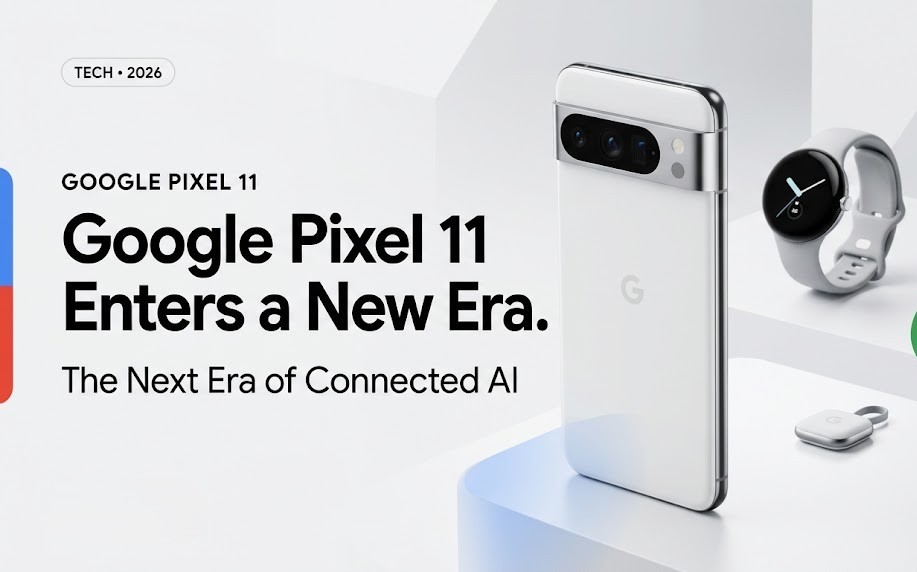
Google has officially entered another chapter in its hardware ambitions, and the Pixel 11 generation makes one thing clear: the company no longer wants Pixel to be seen simply as another Android smartphone. With a new smartphone lineup, the Pixel Watch 5, and the long-awaited Pixel Tag, Google is building a broader hardware ecosystem designed to keep users connected across more parts of their everyday lives.
The timing is significant. At its latest Made by Google event, Google introduced the Pixel 11, Pixel 11 Pro, Pixel 11 Pro XL and Pixel 11 Pro Fold, all built around its new Tensor G6 platform and deeper Gemini integration. The company also expanded its wearable portfolio with the Pixel Watch 5 and finally entered the smart-tracker category with Pixel Tag.
That combination matters more than any individual specification. The smartphone market is already crowded with premium devices from Apple, Samsung and other major manufacturers. Google’s opportunity is different: use its strength in artificial intelligence, Android, search and cloud services to make Pixel hardware feel increasingly connected and intelligent.
Pixel 11 Is About More Than a New Smartphone
On paper, the Pixel 11 series looks like a conventional annual smartphone upgrade. But Google’s strategy is becoming easier to understand when the devices are viewed as part of a larger ecosystem.
The standard Pixel 11 starts at $899 with 256GB of storage, while the premium range moves considerably higher. The Pixel 11 Pro and Pro XL target users looking for flagship cameras and displays, while the Pixel 11 Pro Fold pushes Google further into the ultra-premium foldable category, starting at $1,899.
That pricing signals a deliberate change in positioning. Google is not trying to win purely by being the affordable alternative to an iPhone or Galaxy. Instead, Pixel is being positioned as Google’s premium consumer hardware platform — a place where its software, artificial intelligence and hardware can work together more tightly.
This is particularly important because smartphone differentiation has become difficult. Displays are already excellent, cameras are highly capable and processors are increasingly powerful. For most consumers, another small performance improvement is unlikely to transform the experience.
Software intelligence, however, can.
Tensor G6 Puts AI at the Center
The Pixel 11 family is powered by Google’s new Tensor G6 processor, continuing the company’s strategy of designing silicon around the features it wants Pixel devices to deliver.
Google says the new platform improves efficiency and performance, while the Pixel 11 generation introduces a deeper layer of Gemini-powered experiences. According to Axios, Google claims improvements of up to 20% in power efficiency, 25% faster web browsing and 15% quicker app loading compared with the previous generation.
But raw benchmark numbers are not necessarily the most interesting part of Tensor G6.
The more important question is what Google’s custom chip allows the Pixel to do locally and how naturally AI can become part of everyday interactions. Google has increasingly treated Gemini as an operating-layer experience rather than simply a chatbot, and the Pixel 11 continues that direction.
Features such as proactive assistance, real-time translation and intelligent content creation suggest a future in which the phone does more than respond to commands. It begins anticipating what the user may need.
That distinction could become one of Google’s biggest competitive advantages.
The Camera Is Becoming a Creative System
Google has long used computational photography as one of the strongest selling points of Pixel phones, and Pixel 11 pushes that philosophy further.
The new generation introduces features such as Magic Capture, Camera Looks and Creator Suite. Magic Capture is designed to combine photos and video into a more polished collection, while Creator Suite brings additional creative tools directly into the camera experience. Pro models also receive advanced zoom capabilities and improved video features, including 8K Pro Stable Video.
This reflects a broader change in how consumers use smartphone cameras.
The camera is no longer just a tool for taking photographs. It is increasingly a production studio for social media, short-form video, travel content and personal storytelling. Google appears to understand that shift and is trying to make Pixel useful not only for capturing content but also for turning that content into something shareable.
That could make the Pixel 11 particularly attractive to creators who want sophisticated results without relying heavily on third-party editing applications.
Pixel 11 Pro Fold Takes Google Into the Luxury Smartphone Market
The Pixel 11 Pro Fold is arguably the most ambitious product in the lineup.
Google describes it as its most sophisticated foldable yet, with a thinner and lighter design, improved durability and a new main camera. The device starts at $1,899, placing it firmly in the premium and ultra-premium smartphone market.
Foldables remain a smaller category than traditional smartphones, but they are strategically important because they represent one of the clearest opportunities for manufacturers to create a new premium experience.
For Google, the Pro Fold also provides another canvas for Gemini and multitasking features. A larger internal display creates more space for productivity, content consumption and AI-assisted workflows.
The challenge, of course, is convincing consumers that the additional cost delivers enough practical value.
At nearly $2,000, a foldable cannot rely on novelty alone. It needs durability, software optimization, excellent cameras and a strong ecosystem around it. Google appears to be addressing all four areas, but the market will ultimately determine whether Pixel can justify that premium.
Pixel Watch 5 Expands the Ecosystem Beyond the Phone
Google’s hardware strategy does not stop at smartphones.
The Pixel Watch 5 arrives in two sizes and brings more advanced health, fitness and AI capabilities. The watch introduces features including AI-powered fitness coaching, Breathing Emergency Detection and Blood Pressure Trends, although some health features depend on regulatory approval.
The significance of Pixel Watch goes beyond fitness tracking.
For Google, the smartwatch creates another personal computing surface. Instead of asking users to take their phones out for every notification, interaction or piece of information, Google can bring more of the Pixel experience directly to the wrist.
That creates a natural relationship between the phone and watch. The smartphone becomes the primary computing device, while the watch becomes a lightweight companion for health, communication and quick interactions.
This is the same ecosystem philosophy that has made smartwatches strategically valuable for companies such as Apple and Samsung.
Pixel Tag Could Be Google’s Missing Ecosystem Piece
Perhaps the most interesting announcement is also the smallest.
Google has finally introduced Pixel Tag, a $29 tracking device designed to compete with products such as Apple’s AirTag. Pixel Tag connects with Google’s Find Hub network and supports ultra-wideband for more precise location tracking, with battery life of more than a year. It is expected to launch on November 11.
At first glance, a tracker may seem insignificant compared with a flagship smartphone.
Strategically, it is not.
Trackers make an ecosystem feel more complete because they connect physical objects to a user’s digital identity. Keys, luggage, bags and other everyday belongings can become searchable through the same platform used to locate a smartphone or other connected device.
For Android users, Google’s entry into this category fills an obvious gap.
It also demonstrates how Google is thinking beyond individual products. Pixel Tag does not need to become a billion-dollar product on its own. Its value comes from strengthening Google’s overall ecosystem and making Android hardware more interconnected.
Google Is Playing a Different Game Than Apple
The obvious comparison is Apple.
Apple’s competitive advantage has never been based solely on the iPhone. The strength comes from the relationship between the iPhone, Apple Watch, AirPods, Mac, iPad and services. Each product becomes more useful because it exists alongside the others.
Google is now moving toward a similar ecosystem model, although the underlying strategy is different.
Instead of building around a single proprietary operating system across every device, Google has Android, Gemini, Google services and its broader software infrastructure connecting its hardware portfolio.
The Pixel 11 generation shows that Google wants those pieces to feel increasingly unified.
A Pixel phone, Pixel Watch and Pixel Tag should not feel like three unrelated products. They should feel like different entry points into the same Google ecosystem.
That is the real significance of this launch.
The Biggest Challenge Is Not Technology — It Is Brand Loyalty
Google has the technology to compete at the highest level. The more difficult problem is consumer loyalty.
Apple has spent years building a powerful premium brand. Samsung has an enormous global smartphone presence and an extensive hardware portfolio. Google, despite its software dominance, still has considerably less hardware market share.
That means Pixel has to convince consumers to switch — not simply impress them during a product launch.
The Pixel 11’s combination of AI, cameras, foldable hardware, wearables and tracking technology gives Google more reasons to make that switch. But consumers will ultimately judge the experience rather than the specifications.
Reliability, software updates, customer support, accessories, resale value and availability all influence premium smartphone purchases.
Google has been working to strengthen its hardware presence, including its retail and after-sales strategy in markets such as India. The company has previously emphasized expanding Pixel’s retail and service foundation as part of its broader hardware ambitions.
That infrastructure could become just as important as Tensor or Gemini.
Why Pixel 11 Matters for the Future of Android
The bigger story behind Pixel 11 is Google’s attempt to define what an AI-native consumer ecosystem looks like.
The smartphone is becoming less about individual specifications and more about intelligence. Cameras are becoming computational systems. Watches are becoming health and AI assistants. Trackers are becoming part of location networks. And increasingly, the software connecting everything together matters more than any single device.
Google is uniquely positioned for that transition because it controls major pieces of the technology stack.
It develops Android. It owns Gemini. It operates massive cloud infrastructure. It develops custom silicon for Pixel. It has search, maps, photos, YouTube and other services used by billions of people.
Pixel becomes the physical layer connecting those services to consumers.
That is a much bigger ambition than simply selling smartphones.
Is Pixel 11 Ready to Challenge the Biggest Names in Tech?
The answer depends on what “challenge” means.
If the goal is to immediately overtake Apple or Samsung in global smartphone sales, Pixel 11 alone is unlikely to achieve that. The competition is too established, and consumer loyalty is too strong.
But if the goal is to establish Pixel as one of the world’s most sophisticated AI-powered hardware ecosystems, Google is making a serious move.
The Pixel 11 family gives Google a stronger flagship smartphone portfolio. Pixel Watch 5 expands its wearable ambitions. Pixel Tag closes an important ecosystem gap. Gemini provides the intelligence layer connecting these experiences.
Together, they create something more strategically interesting than another smartphone launch.
Google is betting that the next phase of consumer technology will not be defined by one device. It will be defined by how naturally multiple devices understand the user, communicate with one another and quietly handle tasks in the background.
That is where Pixel 11 could matter most.
The real competition is no longer simply Pixel vs. iPhone or Google vs. Samsung.
It is a race to build the ecosystem consumers will want to live inside.
And with Pixel 11, Google is making it clear that it intends to be part of that race.