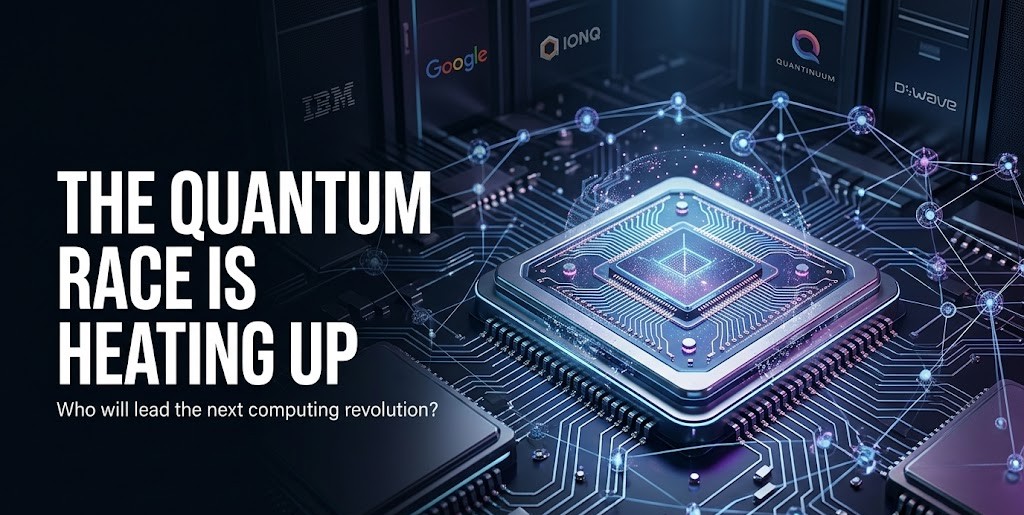
The quantum computing race is no longer a futuristic competition happening inside university laboratories. It has become one of the most closely watched technology battles in the world, with companies such as IBM, Google, IonQ, Quantinuum and D-Wave pursuing very different paths toward the same ambition: making quantum computing genuinely useful.
The industry is entering an important phase. For years, quantum computing was largely measured by qubit counts, experimental demonstrations and ambitious roadmaps. Today, the conversation is changing. The real challenge is no longer simply building a quantum computer with more qubits. It is building a system that can maintain those qubits, correct errors, execute meaningful workloads and work alongside classical computing infrastructure.
That shift could determine which company ultimately leads the quantum era.
Why Quantum Computing Matters
Traditional computers process information using bits represented as 0s and 1s. Quantum computers use quantum bits, or qubits, which can exploit phenomena such as superposition and entanglement to process certain classes of problems in fundamentally different ways.
That does not mean quantum computers will replace laptops, smartphones or conventional data centers. Instead, their potential lies in highly specialized problems that become extremely difficult for classical machines as complexity increases.
Drug discovery, molecular simulation, materials science, optimization, financial modelling, cryptography and some areas of artificial intelligence are among the fields frequently discussed as potential beneficiaries.
The opportunity is enormous, but so is the engineering challenge. Qubits are extremely sensitive to their environment, and errors can quickly destroy useful quantum information. This is why quantum error correction has become one of the defining battles in the industry.
In other words, the future of quantum computing may not belong to the company that simply produces the biggest number of qubits. It may belong to the company that produces the most useful logical qubits reliable qubits capable of supporting long and meaningful computations.
IBM: Building the Quantum Ecosystem
IBM is taking one of the most comprehensive approaches in the quantum computing industry. Rather than treating quantum hardware as a standalone product, the company is building an ecosystem that combines quantum processors, software, cloud access, developers, research institutions and classical high-performance computing.
Its current roadmap places significant emphasis on quantum-centric supercomputing, where quantum processors operate alongside CPUs and GPUs rather than functioning independently. IBM’s 2026 roadmap targets early examples of quantum advantage and outlines a path toward large-scale fault-tolerant quantum computing later in the decade.
The company’s Nighthawk processor is designed around a square lattice architecture with higher connectivity, while IBM’s broader roadmap focuses heavily on error correction, modularity and integrating quantum systems with classical infrastructure.
IBM also has something many competitors would love to have: an established enterprise ecosystem. Its quantum platform gives researchers and businesses access to quantum systems through the cloud, while Qiskit provides a widely used software environment for developing quantum applications.
In June 2026, IBM announced plans to invest more than $10 billion in quantum computing over five years, spanning research and development, manufacturing, acquisitions and ecosystem expansion. The company says it is targeting its Starling fault-tolerant system for 2029.
The IBM strategy is therefore less about winning a single benchmark and more about building an entire quantum computing stack.
That could become one of its biggest advantages.
Google: Betting on Breakthroughs in Error Correction
Google is approaching the quantum race from a slightly different angle. Its Quantum AI program has placed enormous emphasis on proving that quantum systems can overcome one of their biggest obstacles: errors.
Google’s Willow quantum chip became a major milestone for the industry after the company reported that increasing the number of qubits in its error-correcting architecture could actually reduce the error rate. Google described this as a major step toward scalable quantum error correction.
That matters because simply increasing the number of physical qubits is not enough.
Imagine building a larger computer where every additional component also introduces more opportunities for failure. Quantum computing faces a version of that problem. A useful machine needs methods for protecting quantum information while performing increasingly complex calculations.
Google’s approach therefore places enormous importance on the quality and reliability of quantum operations rather than focusing exclusively on raw qubit numbers.
The company has also demonstrated how dramatic the performance gap can become on specialized quantum benchmarks. But these demonstrations need to be interpreted carefully. A quantum computer outperforming a classical computer on a particular benchmark does not automatically mean it is commercially superior across everyday computing tasks.
The bigger question for Google is whether its advances in quantum error correction can eventually translate into practical systems capable of solving valuable real-world problems.
If they can, Google’s research-heavy strategy could become one of the industry’s strongest competitive advantages.
IonQ: A Different Bet on Trapped Ions
IonQ is taking a fundamentally different hardware approach from companies relying primarily on superconducting quantum circuits.
Its systems use trapped ions—individual atoms held in place using electromagnetic fields and manipulated with lasers. IonQ argues that naturally occurring atoms offer attractive characteristics for building high-quality quantum systems.
The trapped-ion approach has a major appeal: high-quality quantum operations and long coherence times can potentially make it easier to maintain quantum information.
But every architecture comes with trade-offs.
Scaling a quantum computer is not simply about making the current machine bigger. Engineers must solve problems involving control systems, optical components, connectivity, speed and physical architecture.
IonQ’s opportunity is to prove that trapped ions can scale efficiently enough to compete with alternative architectures while maintaining the quality that makes the technology attractive in the first place.
That makes IonQ particularly interesting in the quantum race. It does not need to copy IBM or Google. Its potential advantage comes from taking a different technological path altogether.
Quantinuum: Quality Over Raw Qubit Numbers
Quantinuum is another major player pursuing trapped-ion quantum computing, but its strategy places especially strong emphasis on fidelity, connectivity and the development of logical qubits.
Its Helios system currently offers 98 fully connected physical qubits and is designed around a trapped-ion architecture. Quantinuum also highlights its ability to combine quantum hardware with a broader software stack and real-time control capabilities.
This is important because the industry is gradually moving away from the idea that one simple number can determine which quantum computer is “best.”
A machine with thousands of noisy qubits may not necessarily be more useful than a machine with fewer but significantly higher-quality qubits.
Quantinuum’s strategy is therefore centered on creating systems where hardware quality, error correction, software and connectivity work together.
The company’s Helios platform has also attracted enterprise customers including BMW Group, JPMorgan Chase, SoftBank and Amgen, showing how quantum computing is increasingly being explored beyond pure academic research.
If the quantum industry enters an era where enterprises care less about impressive hardware specifications and more about measurable business outcomes, Quantinuum’s full-stack approach could become increasingly important.
D-Wave: The Specialist Taking a Different Route
D-Wave stands apart from many of the companies competing to build universal, fault-tolerant quantum computers.
Its primary focus has historically been quantum annealing; a specialized approach designed for optimization problems.
That difference matters.
While companies such as IBM, Google, IonQ and Quantinuum are largely pursuing general-purpose quantum computing architectures, D-Wave has concentrated on solving specific classes of optimization problems today.
Its Advantage2 system became generally available in 2025, featuring more than 4,400 qubits and more than 40,000 couplers, alongside improvements in energy scales, coherence and noise compared with the previous generation.
The D-Wave strategy presents an interesting question for the industry: does the winner have to be the company that eventually builds the most general quantum computer?
Not necessarily.
If quantum optimization can create measurable value in areas such as logistics, manufacturing, scheduling or resource allocation, a specialized quantum system could generate commercial value before fully fault-tolerant universal quantum computing arrives.
D-Wave’s approach is therefore a reminder that technological leadership can come from solving useful problems, not simply from building the most ambitious machine.
The Real Quantum Race Is About More Than Qubits
This is where the quantum industry becomes particularly interesting.
For years, qubit count was one of the easiest numbers to use when comparing quantum computers. But today’s landscape is far more complicated.
A useful comparison requires looking at several dimensions: qubit quality, error rates, gate fidelity, connectivity, coherence time, error correction, logical qubits, software, scalability, energy requirements and the ability to integrate quantum processors with classical infrastructure.
That changes the competitive landscape completely.
A company could have fewer physical qubits but dramatically better fidelity. Another could have more qubits but weaker connectivity. A third could have excellent hardware but a less mature software ecosystem.
The winner may ultimately be the company that can optimize the entire system rather than dominate one individual specification.
This is why IBM’s quantum-centric computing strategy, Google’s error-correction research, IonQ and Quantinuum’s trapped-ion approaches, and D-Wave’s optimization specialization all deserve attention.
They are not necessarily competing in exactly the same race.
They are competing to define what the quantum computer of the future should actually look like.
What Could Quantum Computing Change?
The most exciting applications are not necessarily the ones that make the biggest headlines.
One major opportunity is drug discovery. Quantum computers could eventually help researchers model molecular interactions with greater precision, potentially accelerating the search for new medicines.
Materials science is another major area. Designing better batteries, catalysts, superconductors or industrial materials requires understanding complex molecular and quantum interactions that can be difficult to model using classical methods.
Finance could benefit from quantum approaches to optimization, risk analysis and portfolio construction, although commercial usefulness will depend on whether quantum algorithms can demonstrate meaningful advantages over increasingly powerful classical systems.
Logistics and supply chains are another natural target. Companies constantly face optimization problems involving routes, warehouses, delivery schedules and resources. Specialized quantum systems could potentially help address some of these challenges.
Cybersecurity may be affected even before large-scale quantum computers become commercially useful. Cryptographically relevant quantum machines could threaten some existing encryption techniques, which is why organizations are increasingly discussing post-quantum cryptography and quantum-safe security.
The most realistic future is therefore not “quantum replaces classical.”
It is quantum + classical + AI.
Quantum processors are likely to become specialized accelerators inside larger computing systems, working alongside CPUs, GPUs, high-performance computing infrastructure and potentially AI systems.
IBM’s recent quantum-centric supercomputing strategy reflects exactly this direction.
So, Who Will Win the Quantum Race?
There may not be one winner.
That could be the most important point.
The quantum industry is still young enough that multiple architectures may survive. IBM could lead in enterprise adoption and quantum-classical integration. Google could lead in error correction and foundational research. IonQ and Quantinuum could demonstrate that trapped ions offer the best path toward high-quality scalable quantum computing. D-Wave could continue proving that specialized quantum systems can create commercial value before universal quantum computers mature.
The eventual leader may also be a company that has not yet emerged.
Technology history rarely follows a straight line. The company that invents an important technology is not always the company that ultimately commercializes it at scale.
The same could happen with quantum computing.
The decisive advantage may come from software, manufacturing, error correction, networking, cloud infrastructure, algorithms or an unexpected hardware breakthrough.
The Next Chapter of Computing
The quantum race is entering a more serious phase.
The industry is moving from impressive laboratory demonstrations toward a harder question: Can quantum computing deliver measurable value in the real world?
That is a much more difficult challenge than increasing qubit counts.
The next generation of breakthroughs will likely be judged by the quality of computations, the reliability of logical qubits, the ability to integrate quantum and classical systems, and the number of useful problems that quantum machines can solve better than conventional alternatives.
IBM, Google, IonQ, Quantinuum and D-Wave are all approaching that challenge differently. Their strategies may eventually converge—or one approach may prove dramatically more scalable than the others.
For now, the quantum race remains wide open.
And perhaps the most interesting part is that we are no longer asking whether quantum computing will matter.
We are beginning to ask who will make it matter first.