
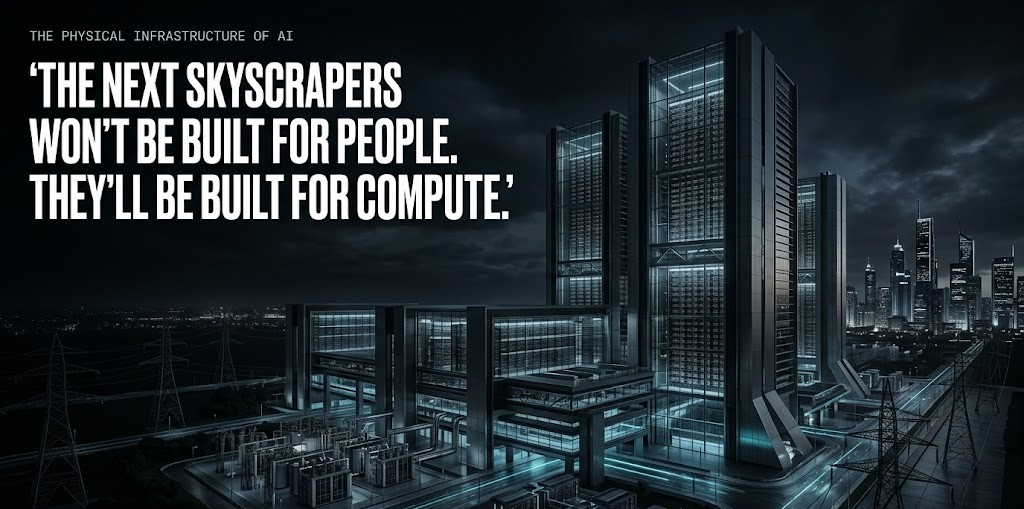
For more than a century, skyscrapers have represented human ambition. They became symbols of financial power, corporate influence, technological progress and the growth of modern cities. From Manhattan to Dubai, towering structures were designed to bring thousands of people, businesses and ideas together under one roof.
The next generation of monumental infrastructure may look very different.
Instead of offices filled with people, some of the most strategically important buildings of the coming decades will be filled with servers, GPUs, networking equipment, cooling systems and power infrastructure. They may not have impressive lobbies or panoramic observation decks. Their importance will be measured not by how many people work inside them, but by how much computing they can deliver.
These are AI data centers, and they are becoming the physical foundation of the artificial intelligence economy.
Behind every AI chatbot, recommendation engine, cloud application, autonomous system and increasingly sophisticated digital service is an enormous infrastructure layer. The interface might fit inside a smartphone screen, but the intelligence behind it depends on machines operating at industrial scale.
That is why the AI race is no longer simply a competition between algorithms and applications. It is increasingly a competition for computing capacity, energy, land, chips, cooling technology and the ability to build massive data center infrastructure.
AI Has a Physical Side
Artificial intelligence is often presented as something almost weightless. We interact with AI through a browser, an app or a voice assistant, creating the impression that intelligence exists somewhere in the cloud.
But the cloud is not actually a cloud.
It is a network of physical buildings containing millions of electronic components. Inside these facilities are processors that perform billions or trillions of calculations, storage systems that hold enormous quantities of data, networking equipment that moves information between machines and sophisticated cooling systems designed to keep the hardware operating safely.
Generative AI has made this physical infrastructure more important than ever.
Training advanced AI models requires enormous computing resources. Running those models for millions of users also requires substantial processing capacity. As AI becomes embedded into search, productivity software, customer service, healthcare, finance, entertainment, manufacturing and autonomous technologies, demand for computing continues to expand beyond traditional cloud workloads.
The result is a new infrastructure cycle.
Companies are not simply building better software. They are building the physical capacity required to make that software possible.
NVIDIA: The Engine Inside the AI Infrastructure
At the center of this transformation is advanced computing hardware.
NVIDIA has become one of the most important companies in the AI infrastructure ecosystem because its accelerated computing technology is widely used for training and running sophisticated AI systems.
The significance of NVIDIA extends beyond individual graphics processors. Modern AI infrastructure depends on interconnected systems of processors, high-speed networking and software designed to make thousands of computing units work together efficiently.
That changes the economics of data centers.
Traditional data centers were largely designed around general-purpose computing. AI workloads can demand dramatically different configurations, particularly when large numbers of accelerators need to operate simultaneously.
As AI models become larger and businesses deploy AI across more applications, data center architecture has to evolve with them.
The processor is no longer simply one component inside the building. It is increasingly influencing how the entire building is designed.
Microsoft, Amazon and Google Are Building the Infrastructure Layer
The world’s largest technology companies are also investing heavily in the infrastructure required for the AI era.
Microsoft has integrated AI deeply into its cloud ecosystem through Azure and its broader artificial intelligence strategy. Amazon is expanding AI capabilities through AWS, while Google is combining its cloud infrastructure with internally developed AI hardware and models.
Their competition illustrates an important shift.
The winners of the AI economy may not be determined solely by who develops the most impressive model. They will also depend on who can secure sufficient computing capacity and operate it efficiently.
That means access to electricity, data center sites, networking infrastructure and specialized chips can become strategic advantages.
The AI industry therefore has something in common with earlier industrial revolutions: technological progress depends on physical infrastructure.
The internet needed telecommunications networks. E-commerce needed warehouses and logistics. The automobile industry needed factories, roads and fuel infrastructure.
AI needs data centers.
The Data Center Is Becoming a New Kind of Factory
The modern data center can increasingly be understood as a factory for intelligence.
A traditional factory transforms raw materials into physical products. An AI data center transforms electricity, data and computing resources into digital outputs.
Those outputs can take many forms: generated text, images, software code, predictions, recommendations, simulations, search results and automated decisions.
The comparison becomes even more interesting when AI workloads are considered at scale.
A large language model may require enormous computing power during training. Once deployed, every user interaction consumes additional computational resources. As companies add AI features to products used by millions or billions of people, those small individual requests become a substantial aggregate workload.
This creates a powerful infrastructure demand cycle.
More users create more workloads. More workloads require more compute. More compute requires more chips, servers and data centers. More data centers require more electricity and cooling.
The AI economy is therefore creating a new industrial supply chain around computation.
Electricity Is Becoming a Strategic AI Resource
One of the biggest challenges facing the expansion of AI infrastructure is energy.
Computing equipment consumes electricity, and increasingly powerful AI systems can create significant power requirements. Data center operators therefore need reliable access to electricity alongside land, connectivity and cooling resources.
This could have consequences far beyond the technology sector.
Regions with abundant and reliable energy may become more attractive locations for AI infrastructure. Utilities may face increasing demand from large data center projects. Energy developers could find new opportunities in supplying power to digital infrastructure.
The relationship between technology and energy is becoming increasingly direct.
For years, discussions about the future of technology focused heavily on software, smartphones and online platforms. The AI era is bringing electricity back into the center of the technology conversation.
The question is no longer simply, “How intelligent can AI become?”
It is also, “How much infrastructure can we build to support it?”
Cooling May Be as Important as Computing
There is another physical constraint that is easy to overlook: heat.
High-performance computing generates substantial heat. As AI systems use increasingly dense computing equipment, managing that heat becomes an engineering challenge.
Traditional air cooling has limitations, particularly when enormous amounts of processing power are concentrated into relatively small spaces. This is accelerating interest in more advanced cooling approaches, including liquid cooling technologies.
That means the data center of the future may look increasingly different from the facilities that powered the early cloud computing era.
Power distribution, cooling systems, networking architecture and physical layouts will all have to evolve around AI workloads.
In other words, AI is not simply changing what happens inside the data center.
It is changing the data center itself.
The Geography of Compute Could Reshape the World
Data centers cannot be built anywhere.
They need suitable land, reliable electricity, high-speed network connections and increasingly sophisticated infrastructure. They also need access to cooling resources and, depending on the location, a regulatory environment capable of supporting large-scale development.
That makes geography an important part of the AI race.
The world’s future computing hubs may not always overlap with today’s technology capitals.
Silicon Valley became synonymous with software and venture capital. Seattle became a major center for cloud computing. Other regions could emerge as important centers of AI infrastructure because of their access to energy, land and connectivity.
This could create new economic clusters around data centers.
Construction companies, electrical contractors, energy providers, semiconductor manufacturers, cooling specialists, networking companies and real estate developers can all become part of the expanding AI infrastructure ecosystem.
The AI boom therefore has the potential to create an industrial ripple effect far beyond companies selling AI software.
Why AI Infrastructure Could Become the New Corporate Real Estate
There is also a fascinating architectural shift underway.
For decades, companies competed for prestigious office towers in major cities. Corporate headquarters were designed to communicate brand identity, power and influence.
But as digital businesses become more dependent on computing infrastructure, some of the most valuable physical assets may be far less visible.
A massive data center does not need a glamorous address.
It needs power.
It does not need an impressive skyline.
It needs reliable connectivity.
It does not need thousands of employees commuting every morning.
It needs highly engineered systems that can operate continuously.
That changes the definition of corporate infrastructure.
The most strategically important building for an AI company may be located far from the city center, surrounded by substations, fiber networks and industrial infrastructure rather than glass towers.
The future skyline of technology may therefore be less visible than its physical footprint suggests.
The Hidden Cost of Intelligence
The rapid expansion of AI infrastructure also raises difficult questions.
How much energy should be dedicated to computing? How should communities manage the environmental impact of large data centers? Who pays for new power infrastructure? How can companies make computing more efficient?
These questions will become increasingly important as AI adoption expands.
The future of AI cannot be measured only by model performance. Efficiency will matter.
A system that can deliver the same result with significantly less computing power could have enormous economic and environmental advantages. Improvements in chip architecture, model efficiency, cooling technology, networking and software optimization may therefore become just as important as building more capacity.
The next phase of AI may be about doing more with every unit of energy and every unit of computing power.
The AI Race Is Moving Into the Physical World
There is a temptation to think of AI as a purely digital revolution.
It is not.
AI is increasingly connecting software with factories, vehicles, robots, cameras, medical systems, financial infrastructure and physical machines. The intelligence may be digital, but the infrastructure supporting it is very real.
That makes the data center one of the defining buildings of the AI era.
The companies that control compute capacity, specialized chips, cloud infrastructure and energy access could have enormous influence over how quickly artificial intelligence develops.
And this is why the most important AI competition may not always be visible on a screen.
It could be happening inside buildings most people will never enter.
The Next Skyscrapers Won’t Necessarily Reach the Sky
The skyscraper was created to solve a problem: how to put more human activity into limited urban space.
The AI data center is solving a different problem: how to concentrate enormous amounts of computational power into an efficient, reliable physical environment.
Both represent a response to a changing economy.
But while skyscrapers transformed the visual identity of cities, data centers may transform something less visible: the infrastructure beneath the digital economy.
The next great technological landmarks may not be the tallest buildings in the world. They may be enormous computing facilities surrounded by power infrastructure and high-capacity networks.
Their windows may be limited. Their halls may be filled with machines rather than people. Their purpose may be invisible to anyone passing outside.
Yet inside, they will perform the calculations behind the services increasingly shaping modern life.
The AI revolution may look digital from the outside.
Underneath, it is becoming one of the world’s most significant industrial infrastructure projects.
The real AI race isn’t happening on your screen. It’s happening inside the data center.