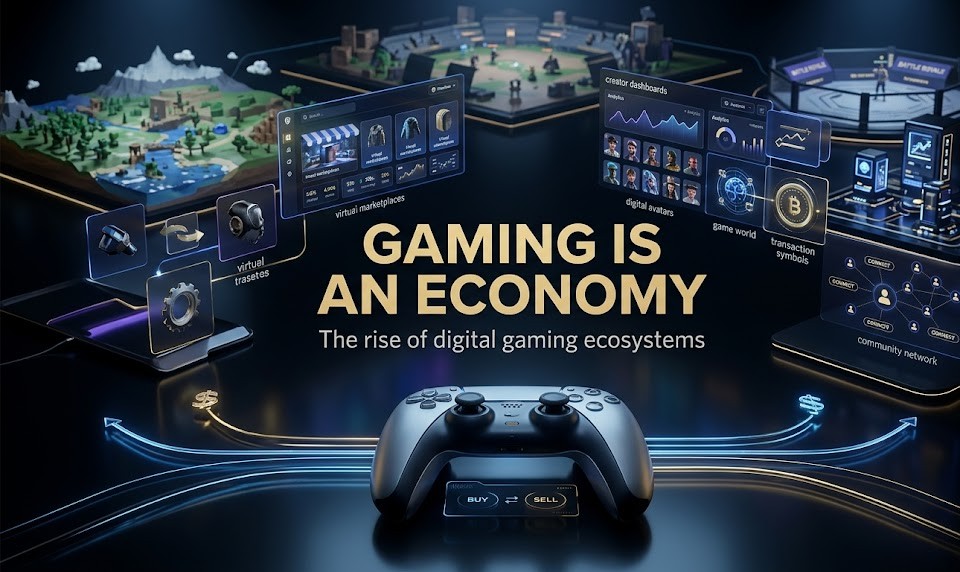
Gaming has evolved far beyond a screen, a controller, and a few hours of entertainment. Today, the gaming industry is becoming a powerful digital economy, where players can create content, purchase virtual goods, subscribe to services, compete professionally, build communities, and even generate income.
Platforms such as Roblox, Fortnite, Minecraft, PlayStation, and Steam are no longer simply places where people play games. They are becoming ecosystems that connect entertainment, commerce, technology, social interaction, digital identity, and creator economies.
The biggest opportunity may not be the game itself.
It may be the digital world built around the game.
From Games to Gaming Ecosystems
Traditional gaming followed a relatively simple model: consumers purchased a game and played it.
The modern gaming business model is much broader.
Players can now buy virtual clothing, character skins, accessories, downloadable content, battle passes, subscriptions, collectibles, and other digital experiences. At the same time, creators can develop maps, experiences, mods, assets, and virtual items for other players.
This shift has transformed gaming from a product-based business into an ecosystem-based business.
The game becomes the entry point. The ecosystem creates the long-term value.
That is why gaming platforms increasingly compete not only on graphics or gameplay, but also on community, creators, content, social features, digital commerce, and user engagement.
Roblox: Turning Players Into Creators
Roblox is one of the clearest examples of the gaming ecosystem model.
Rather than functioning as a single traditional game, Roblox provides a platform where users can discover and interact with millions of user-created experiences.
Its most important asset is arguably not any individual game.
It is the creator ecosystem.
Developers and creators can build experiences, attract audiences, and participate in Roblox’s digital economy. Players, meanwhile, spend time exploring different experiences and purchasing digital items.
This creates a cycle:
Creators build → players engage → players spend → creators earn → more content is created.
That model makes Roblox particularly interesting because its growth can be connected to the expansion of its creator community.
The future of gaming may increasingly belong to platforms that allow users to become both consumers and producers.
Fortnite: When a Game Becomes a Social Platform
Fortnite demonstrates another direction for gaming ecosystems.
What began primarily as a battle royale phenomenon has expanded into a broader entertainment environment featuring user-generated experiences, live events, collaborations, digital items, and social interactions.
Players aren’t necessarily entering Fortnite only to win a match.
They may enter to spend time with friends, attend an event, explore an experience, customize their digital identity, or participate in a cultural moment.
This is important because it changes the definition of a gaming customer.
The customer isn’t simply buying gameplay.
They are buying access to an evolving digital environment.
That creates opportunities for brands as well. Fashion, entertainment, sports, music, and consumer brands can use gaming environments to reach audiences through experiences rather than conventional advertising.
Minecraft: A Digital Sandbox With Endless Possibilities
Minecraft represents another powerful gaming ecosystem: the digital sandbox.
Instead of giving players one fixed experience, Minecraft gives them tools to create their own.
Players can build cities, recreate real-world locations, design games, collaborate with friends, create educational environments, and develop enormous community projects.
Its long-term appeal demonstrates a crucial principle of digital economies:
User creativity can extend the life of a platform far beyond what the original developer could create alone.
When users become creators, every new creation can become another reason for someone else to return.
That creates a network effect where the value of the ecosystem increases as participation increases.
PlayStation: Building an Ecosystem Around the Console
Console gaming is also becoming increasingly ecosystem-driven.
Sony Interactive Entertainment’s PlayStation ecosystem extends beyond hardware.
The modern PlayStation experience can include digital game purchases, subscriptions, online multiplayer, downloadable content, accessories, entertainment, communities, and recurring digital spending.
This creates an important shift in the economics of gaming hardware.
A console can act as the gateway to a much larger digital ecosystem.
The initial hardware purchase may bring a customer into the platform, but ongoing engagement can come from games, subscriptions, digital purchases, and services.
For platform companies, the long-term relationship with the player can therefore become more valuable than a single hardware transaction.
Steam: The Digital Marketplace Behind PC Gaming
On PC, Valve Corporation’s Steam demonstrates the power of a digital distribution ecosystem.
Steam is more than a place to download games. It combines game discovery, digital purchases, user reviews, communities, libraries, sales, developer distribution, and other digital features.
This creates a marketplace connecting developers and consumers at enormous scale.
For developers, platforms such as Steam can reduce the traditional barriers associated with distributing physical games.
For players, the value comes from convenience, choice, discovery, and a persistent digital library.
The marketplace itself becomes an important part of the gaming experience.
The Rise of the Gaming Creator Economy
One of the most important developments in gaming is the emergence of the gaming creator economy.
Players can increasingly move between different roles:
Player → Creator → Community Builder → Influencer → Entrepreneur
A gamer might begin by playing a title, then start streaming gameplay, create videos, develop virtual experiences, build a community, sell digital assets, or collaborate with brands.
This is changing the economics of gaming.
The creator is no longer simply marketing the game.
In many cases, the creator becomes part of the product ecosystem itself.
Platforms that make creation easier can therefore attract more creators, more content, and more users.
Virtual Goods Are Becoming Digital Commerce
Digital commerce inside gaming is another major opportunity.
A player may purchase a character skin, avatar accessory, emote, virtual environment, expansion, or other digital item.
Unlike physical retail, digital goods can be created and distributed at enormous scale without traditional inventory, shipping, or physical storefronts.
The economics are therefore fundamentally different.
A digital item can potentially be sold repeatedly across a global audience with minimal marginal distribution costs.
This makes virtual goods an increasingly important part of the broader digital commerce landscape.
Gaming Is Becoming Social
The social aspect of gaming is becoming just as important as gameplay.
Friends can meet inside virtual environments, communicate through voice and text, attend events, compete, collaborate, and build communities.
For younger digital audiences especially, the boundary between gaming, social media, entertainment, and online identity is becoming increasingly blurred.
A gaming platform can therefore compete for the same attention that social networks, streaming services, and entertainment platforms compete for.
The real commodity is increasingly time and attention.
Brands Are Entering Gaming Ecosystems
Gaming is also becoming a powerful channel for brand marketing.
Instead of simply displaying advertisements around games, brands can participate directly inside gaming environments.
They can create virtual experiences, launch digital products, collaborate with creators, sponsor events, or build interactive campaigns.
This approach is particularly attractive because gaming can provide something traditional advertising often struggles to deliver:
participation instead of passive exposure.
A player who interacts with a branded experience is doing more than viewing an advertisement.
They are experiencing it.
That distinction could become increasingly important as digital consumers become more resistant to traditional advertising formats.
Why the Ecosystem Matters More Than the Game
The biggest strategic lesson from modern gaming is simple:
A successful game can attract players. A successful ecosystem can keep them.
Games can become outdated.
Platforms can continue evolving.
When an ecosystem has creators, communities, marketplaces, subscriptions, social features, and constantly refreshed content, users have multiple reasons to return.
This creates stronger network effects.
More players attract more creators.
More creators produce more content.
More content attracts more players.
More engagement creates more commercial opportunities.
That creates a powerful feedback loop.
What Could Gaming Look Like in the Future?
The next phase of gaming may look less like traditional gaming and more like a combination of entertainment platform + social network + digital marketplace + creator economy.
Artificial intelligence could make content creation faster and more accessible. Virtual and augmented reality could make digital environments more immersive. Digital identity could become more important as people spend more time inside virtual spaces.
Meanwhile, brands may increasingly treat gaming platforms as major destinations for commerce and marketing.
The winning companies may not necessarily be the ones creating the most technically impressive games.
They could be the companies creating the most valuable ecosystems around player participation.
Which Gaming Ecosystem Has the Biggest Future?
There may not be one universal winner.
Roblox has enormous potential through its creator-driven model.
Fortnite demonstrates how gaming can merge with entertainment and social experiences.
Minecraft proves the long-term power of user creativity.
PlayStation shows how hardware can anchor a broader subscription and digital ecosystem.
Steam demonstrates the power of digital distribution and marketplace infrastructure.
Each represents a different vision of what gaming can become.