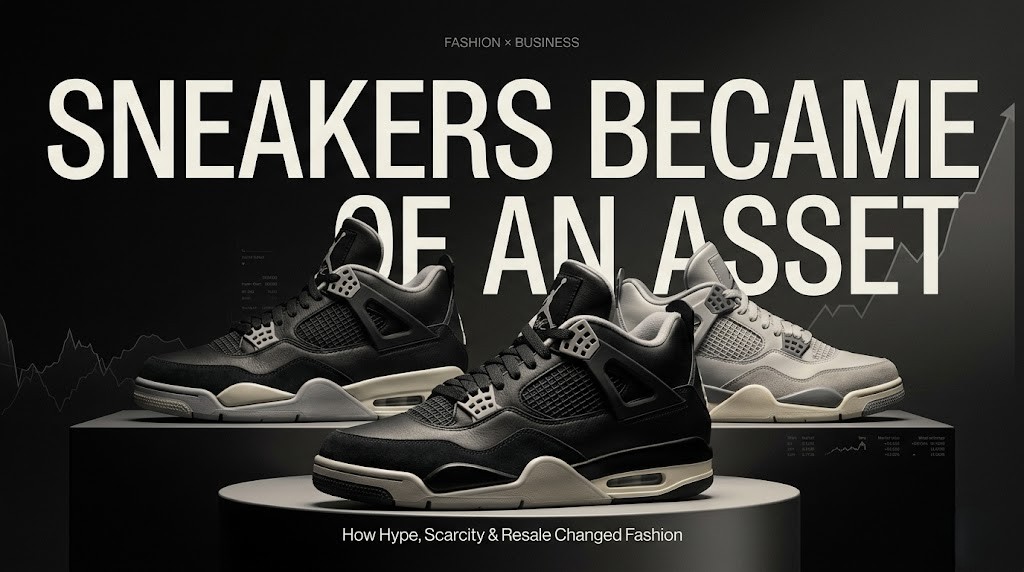
Sneakers were made to be worn. That was the simple idea behind them for decades: buy a pair, lace them up, and take them wherever the day takes you. But somewhere between limited releases, celebrity collaborations, social media hype, and the rise of resale platforms, sneakers became something else. They became collectibles, cultural symbols, status markers, and, for some buyers, alternative assets.
The transformation is fascinating because sneaker resale did not begin with a sophisticated financial model. It began with people wanting pairs they could not easily get. A shoe would sell out within minutes, disappear from retail stores, and suddenly appear online for two or three times its original price. What started as frustration for ordinary shoppers eventually became an entire marketplace built around scarcity.
The Economics of “Limited”
Scarcity has always influenced how people value products. Luxury watches, rare handbags, collectible cards, and limited-edition art all benefit from the perception that there are not many available. Sneakers simply brought that psychology to a much younger and more digitally connected audience.
Nike’s Air Jordan line is one of the clearest examples. When the original Air Jordan launched in 1985, it was not introduced as an investment product. It was a basketball shoe associated with Michael Jordan, one of the most recognizable athletes in the world. Its cultural importance grew alongside Jordan’s career, and the sneaker gradually became much bigger than its original purpose.
Decades later, an original or particularly rare Jordan can carry a value that has little to do with the cost of manufacturing a shoe. The price reflects history, rarity, condition, cultural relevance, and demand. That is the fundamental difference between buying an ordinary pair of sneakers and buying a collectible.
The same logic appears repeatedly across sneaker culture. A general-release sneaker might remain close to its retail price because thousands of pairs are available. A collaboration released in limited quantities can behave very differently. If thousands of people want something that only a small number of people can obtain, the resale market creates its own price.
Nike Helped Turn Sneakers into Culture
Nike did more than sell basketball shoes. Through athletes, designers, musicians, and cultural partnerships, it helped turn footwear into a form of self-expression.
Consider collaborations such as Nike and Off-White. Virgil Abloh’s approach to sneakers challenged the conventional idea of what a sports shoe should look like. His deconstructed designs became cultural objects as much as fashion products. People were not simply buying footwear; they were buying a connection to a particular moment in streetwear and contemporary fashion.
The interesting part was that demand existed beyond people who actually wanted to wear the shoes.
A sneaker could sit inside a collector’s closet for years, displayed almost like an artwork. Another buyer might purchase it specifically because they believed somebody else would eventually pay more. A third person might simply want the experience of owning a pair that had become culturally important.
That difference in motivation is what makes sneaker resale so interesting. The same product can simultaneously be a fashion item, a collectible, a status symbol, and a speculative purchase.
StockX Changed the Conversation
Before modern resale platforms became mainstream, sneaker resale was much less transparent. Buyers and sellers often relied on local networks, sneaker forums, physical stores, or informal marketplaces. Prices could vary dramatically depending on who was selling and who was buying.
StockX helped change that by creating a marketplace that looked and felt more like financial trading.
The platform introduced a bid-and-ask model that made sneaker prices visible. Instead of simply seeing a seller’s asking price, users could observe market activity and compare what buyers were willing to pay with what sellers wanted.
That seemingly simple change was powerful.
Suddenly, a sneaker could have something resembling a “market price.” People could watch prices move after a release. They could compare different sizes. They could see whether demand was rising or falling. Sneakers began to feel less like products sitting on shelves and more like assets being traded.
GOAT and other resale marketplaces helped expand this ecosystem further. Authentication services also became increasingly important because a resale market becomes difficult to trust when buyers cannot be confident that the product is genuine.
The result was an infrastructure around sneaker ownership that barely existed at the beginning of sneaker culture.
The Reseller Changed the Game
The rise of sneaker resellers created an entirely new character in the retail ecosystem.
Imagine a limited sneaker releasing at $180. A buyer manages to secure two pairs. They keep one and sell the other for $350. The profit encourages them to try again on the next release. Eventually, some resellers become highly organized, using multiple accounts, release calendars, automated tools, and networks of buyers.
This created tension within sneaker communities.
For an enthusiast who genuinely wanted to wear the shoe, seeing a release disappear immediately because resellers had purchased large quantities could be frustrating. The sneaker was no longer simply competing against other fans. It was competing against people treating the release as inventory.
Yet from another perspective, resellers were responding to an economic opportunity. If there was a gap between retail price and what consumers were willing to pay, someone was going to attempt to capture that difference.
This is where sneaker culture began to resemble other markets.
The Size of the Shoe Matters
One of the most interesting aspects of sneaker resale is that value is not always consistent across sizes.
A highly desirable sneaker may have different resale prices depending on the size. Certain sizes can be more difficult to find because brands do not produce identical quantities of every size. Demand also varies depending on the consumer base.
This creates a strange situation where two identical sneakers can have different market values simply because they are different sizes.
For collectors, this matters enormously. Someone looking at the resale price of a sneaker cannot always assume that one listed price represents the entire market. Condition, size, box condition, release version, and even regional availability can affect what a buyer is willing to pay.
That is one reason experienced sneaker buyers tend to look beyond headlines such as “This sneaker is worth $1,000.”
The real question is: Which version, which size, in what condition, and in which market?
Hype Is Powerful — But It Is Not Permanent
One of the biggest mistakes people make when looking at sneaker resale is assuming that every limited sneaker will increase in value.
It will not.
Hype can disappear surprisingly quickly.
A celebrity collaboration may receive enormous attention when it launches, only for interest to decline months later. A sneaker that once seemed impossible to obtain can become less desirable when the brand releases similar designs repeatedly. Consumer tastes change, trends move, and social media can create new obsessions almost overnight.
The Yeezy market is a particularly useful example of how closely sneaker value can be connected to culture and circumstances. Kanye West’s Yeezy partnership with Adidas created one of the most commercially successful sneaker ecosystems of the modern era. Certain releases developed significant demand and resale premiums.
But when Adidas ended the partnership in 2022, the broader context around Yeezy changed dramatically. The story demonstrated an important lesson: collectible value does not exist in isolation. It is connected to the people, brands, communities, and cultural narratives surrounding the product.
A sneaker can be rare and still lose relevance.
The Most Valuable Sneaker Is Not Always the Rarest
Rarity helps, but rarity alone does not guarantee value.
A completely unknown sneaker produced in only a few hundred pairs might attract little attention. Meanwhile, a historically significant sneaker produced in larger numbers can remain highly desirable because millions of people recognize its cultural importance.
This is why certain Jordan models continue to command attention. Their value is connected to a much larger story involving basketball, Michael Jordan, Nike, streetwear, music, fashion, and decades of cultural history.
The sneaker becomes a piece of that story.
Collectors are often paying for the narrative as much as the object itself.
The same principle exists in watches. A Rolex is not valuable simply because it tells time. Paintings are not valuable because they cover walls. Vintage cars are not valuable simply because they can transport people.
Collectibles derive value from meaning.
Sneakers eventually entered that same territory.
Social Media Made the Market Faster
Instagram, TikTok, YouTube, and sneaker-focused communities accelerated everything.
A sneaker release that once might have been discussed within a small group could now become globally visible within hours. A celebrity wearing an unexpected pair could send thousands of people searching for the model. A viral video could turn an obscure sneaker into a trend.
This created a feedback loop.
People saw a sneaker gaining attention. They searched for it. More searches increased visibility. Resellers began listing it. Social media creators discussed the price. More consumers became aware of the product. Demand increased again.
In this environment, attention itself became an economic force.
Brands understood this quickly. A product did not necessarily need to be available everywhere. Sometimes making people talk about it was enough.
That is one of the great lessons of modern sneaker marketing: desirability can be created before availability.
When the Sneaker Becomes an Asset
Calling sneakers an “investment” requires some caution.
Unlike a stock, a sneaker does not generate earnings or dividends. Unlike a bond, it does not provide contractual interest. Its resale value depends largely on what another person is willing to pay.
That makes sneaker resale closer to collecting than traditional investing.
There are also practical costs. Storage matters. Condition matters. Authentication matters. Platform fees reduce profits. Shipping introduces risk. Market prices can fall. And a pair that looks valuable on paper may not sell quickly at the advertised price.
Liquidity is particularly important.
If a sneaker is listed online for $2,000, that does not necessarily mean the owner can immediately walk away with $2,000. The actual selling price depends on current demand and the platform’s fees and conditions.
In other words, the listed price is not always the same thing as realized value.
The Emotional Side of Sneaker Ownership
Numbers only explain part of sneaker culture.
Ask someone why they bought their first pair of Jordans, and the answer may have nothing to do with resale value.
Maybe they watched Michael Jordan as a child. Maybe their first expensive sneaker was a birthday gift. Maybe a particular model reminds them of high school, a favorite athlete, or a moment when they finally had enough money to buy something they had wanted for years.
That emotional connection is one reason sneaker culture has survived multiple trends.
For many collectors, the value of a sneaker is personal before it is financial.
Someone might refuse to sell a pair worth $500 because it represents a memory. Another person might sell the same pair immediately because they see an opportunity to fund their next purchase.
Neither approach is necessarily wrong.
The meaning of the sneaker depends on the owner.
So, Which Sneakers Are Worth Owning?
That depends on what “worth” means.
If the goal is financial potential, buyers should look at historical demand, scarcity, collaboration strength, cultural relevance, condition, and the long-term reputation of the model rather than simply chasing whatever is trending on social media.
If the goal is collecting, the answer can be completely different.
A sneaker worth owning might be the one connected to an important moment in fashion or sport. It might be a pair that defined an era. Or it might simply be the sneaker you have wanted since you were sixteen.
The most intelligent approach is perhaps to separate collecting from speculation.
Buy a sneaker because you genuinely like it first. If it becomes more valuable later, that is a bonus.
Because sneaker culture ultimately tells us something bigger about modern consumer behavior. We no longer buy products only for what they do. We buy stories, identity, belonging, scarcity, memories, and sometimes the possibility that someone else will value the object more than we did.
The sneaker started as something you wore.
Then brands made it desirable. Culture made it meaningful. Scarcity made it difficult to obtain. Resale platforms gave it a price.
And somewhere along the way, the sneaker stopped being just a shoe.
It became a market.