For years, the promise of wireless earbuds was simple: put them in, press play, and disappear into your own private soundtrack. Noise cancellation became one of the biggest selling points in personal audio, turning busy streets, crowded trains, offices and airports into quieter, more controlled environments.
But a different idea is beginning to challenge that definition of a great listening experience.
What if the future of earbuds isn’t about shutting the world out at all?
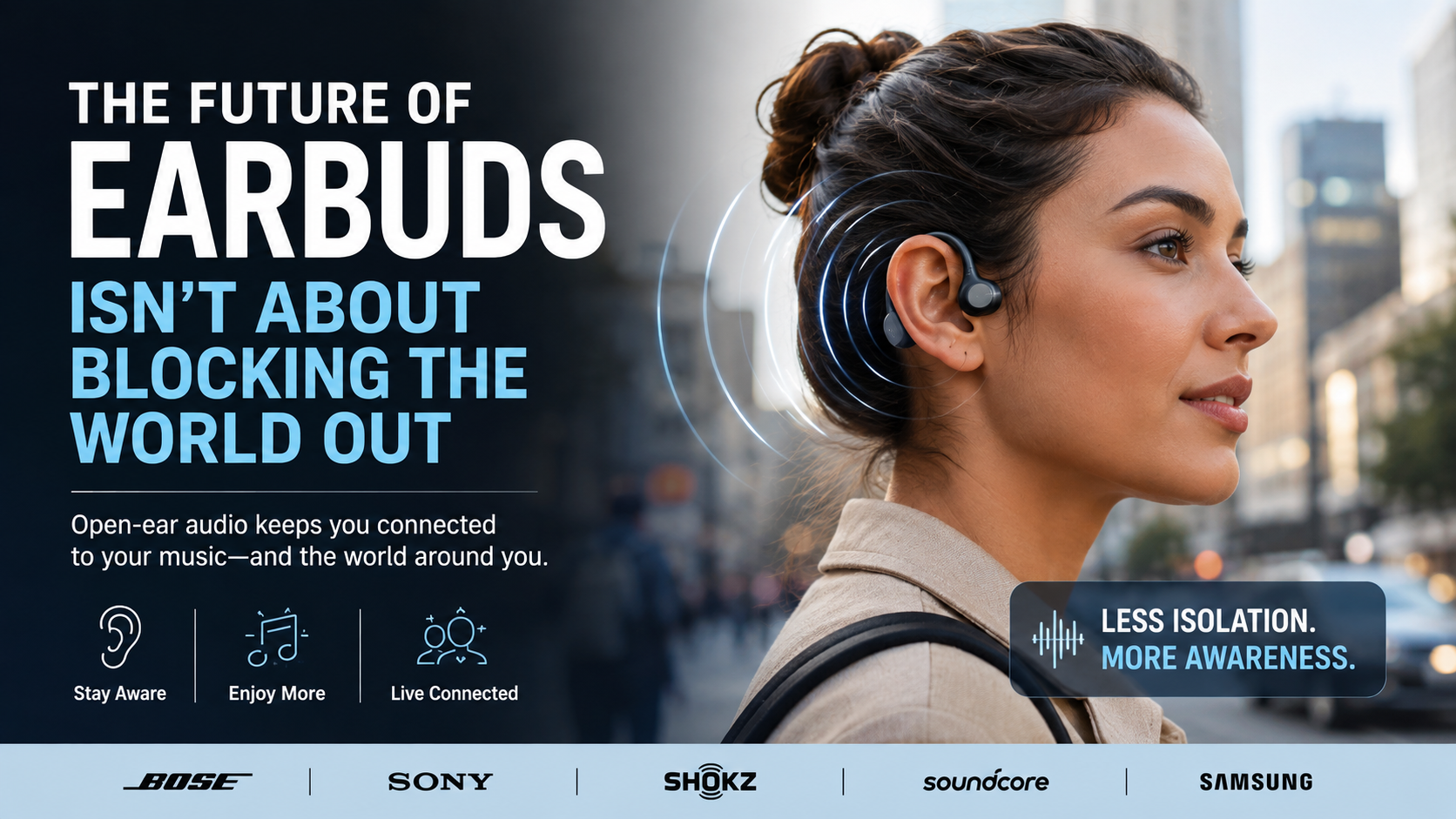
Open-ear audio is building an alternative vision of personal listening — one where music, podcasts and calls stay close while the surrounding environment remains part of the experience. Instead of sealing the ear canal, open-ear headphones sit outside or around the ear, allowing listeners to hear what is happening around them while continuing to enjoy their audio.
The concept is not entirely new. Bone-conduction headphones helped establish the idea that people could listen without covering their ears, particularly among runners and outdoor athletes. But the category has evolved significantly. Today’s open-ear audio market includes air-conduction earbuds, clip-on designs and ear-hook models, with brands such as Bose, Sony, Shokz and Soundcore pushing the technology into mainstream consumer electronics. According to Omdia, open-ear products accounted for more than 10% of the global personal audio market, with annual shipments exceeding 30 million units by 2025.
That makes this more than another niche headphone trend. It may represent a broader change in how people think about personal technology.
From Isolation to Awareness
The traditional earbud was designed around isolation. The better the seal, the easier it was to create powerful bass, reduce outside noise and deliver an immersive soundstage.
That philosophy works beautifully in certain situations. A long flight, noisy commute or focused work session can be much more comfortable when the outside world fades away.
But constant isolation isn’t always desirable.
Imagine walking through a city while listening to a podcast. You may still want to hear a bicycle approaching, a colleague calling your name or an announcement at a train station. During a morning run, you might want your playlist without completely disconnecting from traffic and other people around you.
This is where open-ear audio changes the equation.
Instead of asking, “How effectively can these earbuds block the outside world?”, the technology asks a different question: “How can we deliver personal audio without requiring users to disconnect from their surroundings?”
That distinction is important.
Open-ear listening turns awareness from a compromise into a feature.
The Technology Is Moving Beyond Sports
For a long time, open-ear headphones were closely associated with running, cycling and outdoor fitness. The reason was obvious: athletes wanted music without completely losing awareness of their surroundings.
Shokz became particularly associated with this approach through its bone-conduction products. But the wider category is now moving beyond that original audience.
Omdia’s latest analysis suggests that air-conduction clip-on products have become a major growth engine for the open-ear category, with triple-digit shipment growth and increasing adoption across different manufacturers.
That shift is changing the identity of the product.
Open-ear audio is increasingly being positioned for work, commuting, walking, travel, casual listening and everyday calls — not simply for someone training for a marathon.
Sony’s LinkBuds Clip, for example, is explicitly positioned around everyday open-ear listening, with the company highlighting environmental awareness, comfort, calls and use across work and sport
Bose has taken a similarly lifestyle-oriented approach with its Ultra Open Earbuds, using a cuff-like design that leaves the ear open while delivering audio through its OpenAudio technology
The message from the industry is becoming increasingly clear: open-ear headphones don’t have to look or feel like specialist sports equipment.
They can become part of everyday life.
Why Comfort Could Be the Biggest Opportunity
There is another reason open-ear headphones are attracting attention: comfort.
Traditional in-ear earbuds can be uncomfortable for some people after extended use. The feeling of having something physically inserted into the ear canal isn’t universally appealing, particularly for users who wear earbuds for many hours every day.
Open-ear designs approach the problem differently.
Because they don’t rely on the same type of in-ear seal, they can feel less intrusive and allow users to maintain a greater sense of physical connection with their surroundings. This makes them particularly interesting for people who want background audio rather than total immersion.
That could include someone working at a desk while listening to music, a parent who wants to remain aware of what’s happening nearby, a traveller navigating an unfamiliar city or an employee moving between meetings.
The emerging opportunity is therefore not necessarily about replacing traditional earbuds.
It is about creating another category of listening.
Bose, Sony, Shokz and Soundcore Are Changing the Category
The competitive landscape illustrates how quickly open-ear audio is evolving.
Bose has approached the category from a premium audio perspective, combining an open-ear form factor with features designed to preserve an immersive listening experience.
Sony has brought its LinkBuds philosophy further into the open-ear space. Its LinkBuds Clip demonstrates how the category is moving toward products designed to integrate into everyday routines rather than being reserved for workouts.
Shokz remains one of the most important names in the segment. Omdia says Shokz ranked first globally in open-ear headphone shipments for three consecutive years from 2023 through 2025.
Meanwhile, Soundcore is among the newer-generation competitors gaining traction as clip-on designs become easier to manufacture and more widely adopted.
The interesting part isn’t simply that major brands are launching open-ear headphones.
It is that they are approaching the same fundamental idea from different directions: comfort, awareness, lifestyle, sound quality, calls and intelligent features.
That competition could accelerate the category considerably.
But Open-Ear Audio Has a Trade-Off
The technology isn’t a perfect replacement for traditional earbuds.
And that is important to acknowledge.
Open-ear headphones generally sacrifice some isolation and low-frequency performance because the speaker isn’t sealed inside the ear canal. Sound leakage and wind noise can also become challenges, particularly in busy environments.
Independent testing of open-ear products continues to identify the same fundamental trade-off: environmental awareness comes at the expense of some bass depth and isolation compared with conventional in-ear headphones
In other words, open-ear audio isn’t trying to win every listening scenario.
If you are sitting on an airplane and want to hear nothing except your movie, a good pair of noise-cancelling earbuds may still be the better choice.
But if you’re walking through London, cycling along a quiet road, working in a shared office or travelling through an unfamiliar city, the ability to hear your surroundings can become more valuable than absolute isolation.
The best technology isn’t necessarily the one with the most features.
Sometimes it is the one that fits the situation better.
The Bigger Shift: Personal Technology Without Complete Disconnection
This is where the open-ear trend becomes more interesting than headphones alone.
For years, consumer technology has moved toward personalization. Smartphones gave us personalized feeds. Streaming platforms gave us personalized entertainment. Wearables gave us personalized health and fitness data. Noise-cancelling headphones gave us personalized sound environments.
But there is a potential contradiction in that evolution.
The more personalized technology becomes, the easier it is to disconnect from the physical environment around us.
Open-ear audio offers a different philosophy.
It creates a personal layer of technology without completely removing the user from the real world.
That could become increasingly important as wearable technology develops.
Omdia’s 2026 analysis suggests the category is already moving beyond simple hardware differentiation toward areas such as workplace productivity, hearing support, real-time communication and AI-enabled interaction.
That opens up a much bigger possibility.
The future open-ear device may not simply play music.
It could become an always-available interface between the physical world and digital information.
What Happens When AI Enters the Picture?
Consider a future where your open-ear headphones are constantly available but not constantly demanding your attention.
You could hear a translated conversation without looking at your phone. Receive navigation instructions while still hearing traffic. Ask an AI assistant a question while walking. Take a call without covering your ears. Hear an important notification without needing to check a screen.
The technology starts becoming less about “headphones” and more about ambient computing.
That distinction matters.
Smart glasses are already exploring the idea of placing digital information closer to the physical world. Open-ear audio could become the audio equivalent — providing information without forcing the user to stare at a screen.
Omdia has already highlighted AI-enabled interaction and real-time multilingual communication as emerging directions for open-ear products.
This could make open-ear audio particularly relevant in an era where people are increasingly looking for technology that works in the background rather than demanding constant attention.
The New Luxury Might Be Staying Connected
There is also a cultural shift happening here.
For years, premium technology has often been marketed around escape.
Escape the noise.
Escape the crowd.
Escape distractions.
Put on your headphones and enter another world.
Open-ear audio proposes almost the opposite experience.
Stay present.
Keep listening.
Keep moving.
Stay connected to what is happening around you.
That could resonate with a new generation of consumers who don’t necessarily want technology to isolate them from their surroundings. They want technology that blends into their lifestyle.
In that sense, the open-ear headphone could become less of an audio accessory and more of a lifestyle device.
Its appeal isn’t simply what you hear.
It’s what you don’t miss while you’re listening.
So, Will Open-Ear Earbuds Replace Traditional Earbuds?
Probably not.
And they don’t need to.
The future of personal audio is more likely to become a collection of different listening modes rather than a single winning design.
Noise-cancelling earbuds will remain valuable for flights, commuting and focused work. Over-ear headphones will continue to dominate premium immersive listening. Sports headphones will remain important for athletes.
Open-ear headphones occupy a different space.
They are designed for moments when you want sound without complete isolation.
That distinction gives the category room to grow.
The more people use audio throughout the day — for music, podcasts, calls, navigation, language learning and AI assistants — the more valuable comfortable, low-friction listening becomes.
And if people are wearing these devices for longer periods, awareness and comfort may become just as important as raw sound quality.
The Real Future of Earbuds
The most interesting thing about open-ear audio isn’t the shape of the earbuds.
It’s the philosophy behind them.
For decades, headphones have been about creating a private world inside a public one.
Open-ear audio suggests we may be entering a different era — one where personal technology doesn’t always need to separate us from the environment around us.
The category is still developing. There are compromises, particularly around bass, sound leakage and noisy environments. But the direction is difficult to ignore. With brands such as Bose, Sony, Shokz and Soundcore investing in the space, open-ear audio is moving from a specialist product category toward a broader consumer technology proposition.
And the next stage could be even more interesting.
Imagine earbuds that understand when you need awareness and when you want immersion. Devices that adapt to your environment rather than forcing you to choose between hearing your music and hearing the world.
That is where the real opportunity lies.
The future of earbuds may not be about creating a better wall between you and the world.
It may be about creating a smarter connection between the two.
Less isolation. More awareness. More comfort. More context.
And perhaps the most important question isn’t whether open-ear audio will replace your traditional earbuds.
It’s whether, once you experience listening without disconnecting, you’ll still want to.