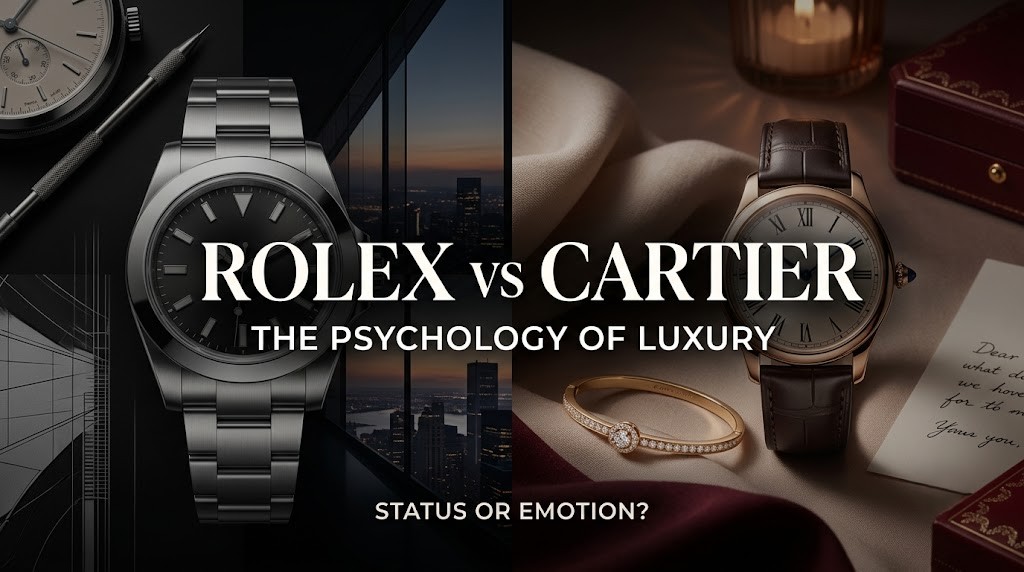
Rolex Sells Achievement. Cartier Sells Emotion.
Luxury is often discussed as if it were simply about price, craftsmanship, heritage, or exclusivity. But the world’s most powerful luxury brands understand something deeper: people rarely buy luxury products only for what they do. They buy them for what those products allow them to say about themselves.
That is where the comparison between Rolex and Cartier becomes particularly interesting.
Both are among the most recognizable names in luxury watches and jewellery. Both have decades of heritage, extraordinary craftsmanship, global cultural influence, and prices that place their products far beyond everyday purchases. Yet their brand strategies operate on very different psychological territories.
Rolex sells the achievement. Cartier sells the emotion.
A Rolex often represents a milestone: the first major promotion, the successful business, the career breakthrough, the deal that changed everything, or simply the moment someone feels they have finally reached a level they once dreamed about.
Cartier, on the other hand, often enters the story through meaning. A Love bracelet can represent a relationship. A Tank watch can become part of someone’s personal style and identity. A Panthère piece can express confidence, femininity, power, or individuality. Cartier does not need the customer to say, “Look at what I achieved.” Its products often invite a more personal statement: “This means something to me.”
Both approaches are powerful. But they reveal two completely different ways to build desire.
The bigger question for marketers and brand builders is not simply whether Rolex or Cartier has the better strategy.
It is this:
What does your brand make people believe about themselves when they buy it?
Rolex: The Brand of “I Made It”
Rolex has built one of the strongest associations in modern luxury: success.
The genius of the Rolex brand is that it has transformed a mechanical watch into a cultural symbol of accomplishment. A watch can tell time. A Rolex can tell a story before its owner says a word.
Think about the moments when Rolex tends to appear in real life. An entrepreneur buys one after selling a company. A professional rewards themselves after a major promotion. A parent gives one to a child at graduation. An athlete wears one after reaching the top of their sport.
The purchase is rarely positioned as practical.
Nobody needs a Rolex because their phone cannot tell the time.
That is exactly why the product works so well as a luxury symbol. Its value exists beyond utility.
When someone buys a Rolex Submariner, Daytona, or Date just, they are often buying into an identity that already exists in popular culture. The brand has spent decades connecting itself with exploration, motorsport, tennis, golf, achievement, precision, and high performance. Over time, Rolex has become associated with people who have reached a certain level.
The customer is not simply purchasing a watch.
They are purchasing a visible marker of progress.
This is one of the most powerful forms of brand psychology because achievement is aspirational. Many consumers do not necessarily buy Rolex because they are already at the top. Sometimes they buy it because the product represents the version of themselves, they are working toward.
The watch becomes symbolic.
It can represent discipline.
Ambition.
Persistence.
A reward for years of work.
That is why Rolex works so effectively in the luxury market. It has created a product that can function almost like a personal trophy.
The message is simple, even when the brand never says it directly:
You worked for this. You earned this.
And that emotional association has become incredibly difficult for competitors to replicate.
The Power of Rolex Is Not the Watch Alone
One of the strongest lessons from Rolex’s branding strategy is the importance of consistent cultural positioning.
Rolex does not need to constantly reinvent what it represents.
That consistency creates mental ownership.
When people think about luxury watches and professional success, Rolex is often one of the first brands that comes to mind. That association did not happen because of one campaign. It was built through decades of repetition.
Consider the Rolex Datejust. Its design has remained instantly recognizable across generations. Or the Daytona, which has become deeply connected to motorsport culture and later developed enormous cultural and collector value. The Submariner became one of the most recognizable luxury sports watches in the world.
Rolex understands that luxury consumers often value recognition as much as novelty.
A successful luxury product does not always need to look completely different every year. In fact, too much change can weaken the identity people have learned to recognize.
That is why Rolex’s strategy feels so powerful: the customer knows exactly what the brand represents.
The watch becomes a shorthand for achievement.
A person wearing a Rolex may have an entirely different life from another Rolex owner, but both can understand the cultural meaning attached to the object.
That is the power of a strong brand code.
Cartier: The Brand of Meaning
If Rolex is about the moment, you feel you have arrived, Cartier is often about the moments you never want to forget.
Cartier operates through a different emotional language.
Its products are deeply connected to relationships, personal expression, style, and storytelling. The brand has historically occupied the space between jewelry, fashion, art, and luxury craftsmanship, allowing it to become part of some of life’s most emotional occasions.
A Cartier purchase can be a gift.
An anniversary.
A celebration.
A reminder of a person.
A personal promise.
A symbol of independence.
The emotional value of the product can become more important than its material value.
Take the Cartier Love bracelet as a real example. Its design and locking mechanism helped create a powerful product story around commitment and connection. Over the years, it became more than a piece of jewellery. It became a recognizable symbol that people could attach to relationships and personal milestones.
That is important.
Rolex often asks, “What have you achieved?”
Cartier can ask, “What does this mean to you?”
Those are two very different conversations.
Cartier also understands the power of personal identity. The Cartier Tank, for example, is not simply marketed as a technical instrument. Its appeal comes from design, heritage, cultural associations, and the personalities who have worn it. The product fits naturally into conversations about taste and individuality.
The Panthère has a similar symbolic strength. It is not only an animal motif. It represents a recognizable Cartier universe of confidence, elegance, independence, and boldness.
Cartier does not need every customer to wear its products as a public announcement of financial success.
Sometimes the luxury is more personal.
That is precisely why its emotional positioning is so strong.
Rolex Builds Status. Cartier Builds Stories.
This comparison does not mean Rolex lacks emotion or Cartier lacks status.
Both brands contain both elements.
A Rolex can be deeply emotional when it is passed down from a parent to a child. A Cartier piece can absolutely function as a status symbol. Luxury brands are complex, and customers often attach their own meanings to products.
But the dominant brand associations are different.
Rolex has built an extraordinary connection with external recognition.
Cartier has built an extraordinary connection with internal meaning.
Rolex is often about the story the world sees.
Cartier is often about the story the owner feels.
This distinction matters because the best brands do not try to mean everything to everyone.
They choose a psychological territory and reinforce it repeatedly.
That is one reason why luxury branding is so difficult to copy.
A competitor can copy a product feature.
They can create a similar bracelet.
They can manufacture a similar watch.
They can even imitate a visual aesthetic.
But they cannot instantly copy decades of cultural meaning.
You cannot simply design a watch and expect consumers to associate it with success.
You cannot launch a bracelet and expect it to become a universal symbol of commitment.
Meaning has to be built.
Repeated.
Protected.
And reinforced over time.
Real Luxury Is Identity, Not Just Price
One of the biggest mistakes brands make is assuming that luxury is created by making something expensive.
Price alone does not create desire.
If it did, any company could launch a $10,000 product and call itself a luxury brand.
Real luxury operates through perception.
Why does someone want a particular logo, watch, handbag, car, or piece of jewelry when another product may perform the same function?
Because brands allow consumers to communicate identity.
A Rolex can communicate ambition and accomplishment.
A Cartier Love bracelet can communicate connection and personal meaning.
A Hermès bag can communicate rarity, craftsmanship, and access.
A Ferrari can communicate performance, passion, and status.
The physical product is only part of the experience.
The deeper value comes from what the customer believes the product represents.
This is where luxury marketing becomes incredibly interesting.
The strongest brands are not only asking customers, “Do you like our product?”
They are asking a much more powerful question:
“Do you like who you become when you own it?”
That is the real luxury play.
The Brand Psychology Behind Desire
From a marketing perspective, Rolex and Cartier demonstrate two powerful consumer motivations: aspiration and emotional attachment.
Rolex is highly effective at aspirational branding because it connects ownership with a future identity. The customer may see the product as a reward for reaching a goal or as a symbol of the success they intend to achieve.
This creates a powerful psychological loop.
The person works toward a goal.
The goal creates anticipation.
The purchase becomes the reward.
The product then becomes a physical reminder of the achievement.
Cartier operates more strongly through emotional association. A product becomes connected to a memory, relationship, occasion, or personal transformation.
This can create a different kind of long-term value.
A customer may remember exactly when they received a Cartier piece.
Who gave it to them.
What was happening in their life.
Why they chose that particular design.
The product becomes part of their personal history.
Both strategies create loyalty, but they create it through different emotional mechanisms.
Rolex can make customers feel successful.
Cartier can make customers feel connected.
One reinforces the identity you have built.
The other can preserve the emotions you want to remember.
Why Both Strategies Are Brilliant
The smartest part of the Rolex versus Cartier comparison is that neither brand is trying to win the same psychological battle.
That is what makes them so strong.
In competitive markets, many brands make the mistake of positioning themselves as a slightly better version of someone else. A new watch brand may try to be “more luxurious than Rolex.” A jewellery brand may try to be “more elegant than Cartier.”
But that approach creates a problem.
If the consumer already understands what the original brand represents, the competitor becomes difficult to remember.
Rolex and Cartier have created distinct mental territories.
Rolex owns achievement.
Cartier owns emotional significance and timeless expression.
Their products may overlap in the luxury space, but their stories are different enough to coexist.
This is a valuable lesson for every brand, whether it sells fashion, technology, beauty, travel, cars, or digital products.
You do not always need to create an entirely new category.
But you do need to create a reason for people to remember why you matter.
The Marketing Lesson: Sell the Transformation
The biggest takeaway from Rolex and Cartier is not about watches.
It is about transformation.
Customers do not always buy products because they need another object.
They buy because the object represents movement from one identity to another.
A fitness brand is not only selling workout clothes. It may be selling discipline and confidence.
A travel brand is not only selling flights or hotel rooms. It may be selling freedom, discovery, or transformation.
A technology company is not only selling a device. It may be selling creativity, productivity, or belonging to the future.
A beauty brand is not only selling skincare. It may be selling confidence and self-expression.
The product is the vehicle.
The identity is the destination.
Rolex understands this.
Cartier understands this.
That is why both brands have remained culturally relevant even as consumer trends continue to change.
Their products evolve carefully.
But the meaning remains recognizable.
So, Which Brand Has the Stronger Strategy?
If the question is about building a universal symbol of achievement, Rolex has created one of the strongest brand positions in the world.
The phrase “I bought myself a Rolex” carries meaning that extends far beyond the watch itself. It immediately suggests a milestone. A moment. A reward.
Rolex has made success visible.
But Cartier may have the advantage when it comes to emotional versatility.
A Cartier product can mark a relationship, a celebration, a personal achievement, a style choice, or an important memory. Its meaning can change depending on the person wearing it.
Cartier has made luxury personal.
So perhaps the better question is not:
Which brand strategy is stronger?
It is:
Which emotion is more powerful for the customer you want to attract?
Do they want the world to recognize what they have achieved?
Or do they want to own something that represents who they are and what they value?
Rolex says:
“I made it.”
Cartier says:
“This means something to me.”
Both are selling luxury.
But neither is really selling a watch.
They are selling identity.
And that is the lesson every ambitious brand should understand.
Final Thought
The most powerful brands do not compete only on features, prices, or products.
They compete for a place in the customer’s mind.
Rolex became more than a watch by becoming a symbol of achievement.
Cartier became more than jewelry and watches by becoming part of people’s stories.
The real opportunity for any brand is to move beyond asking:
“What are we selling?”
And start asking:
“Who does our customer become when they choose us?”
Because products can be copied.
Features can be improved.
Prices can be matched.
But a powerful identity?
That is much harder to replace.
Rolex sells the achievement. Cartier sells the emotion.
The strongest brands know that the product is only the beginning.
The real thing they are selling is the person their customer wants to become.
Now over to you: Which luxury brand strategy is more powerful — Rolex’s “I made it” or Cartier’s “This means something to me”? And which other brand do you think has mastered the psychology of identity better than both?