
For travellers considering a cruise holiday, choosing the right cruise line can be almost as important as choosing the destination itself. A cruise is not simply a way of getting from one port to another; it is an experience built around accommodation, dining, entertainment, excursions, service and the atmosphere created on board. Costa Cruises has established a distinctive position in this market by bringing an unmistakably Italian character to the cruise experience.
With a history stretching back more than seven decades, Costa Cruises has grown from an Italian shipping company into an international cruise brand serving travellers across multiple continents. Today, the company operates nine ships and is part of Carnival Corporation & plc, one of the world’s largest cruise groups. Costa also describes itself as the only cruise company flying the Italian flag.
But does the brand still deliver the kind of experience travellers expect from an established cruise company? And what makes Costa Cruises different from the many other cruise lines competing for holidaymakers? This editorial review takes a closer look at Costa Cruises’ services, onboard experience, destinations, brand identity, sustainability efforts and customer trust.
Costa Cruises: A Strong Italian Identity
One of Costa Cruises’ biggest strengths is its identity. Rather than attempting to imitate the style of every other international cruise line, Costa has built much of its brand around Italian hospitality, food, design and culture.
The company traces its modern cruise history to 1948, when its first voyage, aboard the Anna C, sailed from Genoa to Buenos Aires. Costa also highlights the Franca C, introduced in 1957, as the world’s first ship built specifically for cruising. Over the decades, the company evolved alongside the cruise industry while retaining its Italian roots.
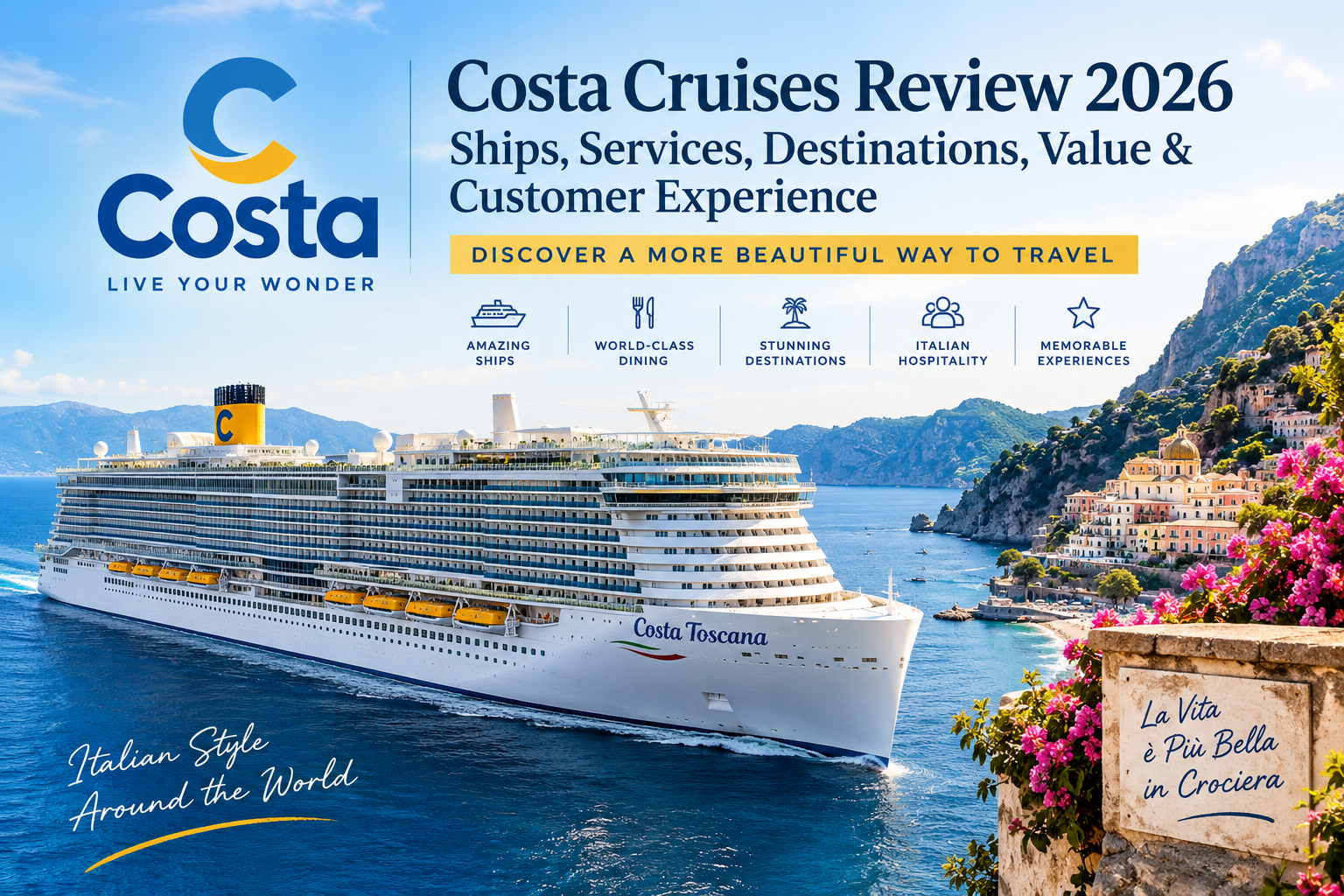
That heritage remains visible across the fleet. Ships such as Costa Smeralda and Costa Toscana are designed around contemporary interpretations of Italian lifestyle and culture. Costa describes Costa Smeralda as an expression of the Italian “dolce vita”, while Costa Toscana takes inspiration from the art, culture and character of Tuscany.
For travellers who enjoy a lively, social and distinctly European atmosphere, this identity can be an important part of the appeal.
Costa Cruises Ships and Onboard Experience
A modern Costa cruise is designed to function almost like a resort at sea. The company’s ships combine accommodation with restaurants, bars, theatres, entertainment spaces, wellness facilities and activities, giving passengers plenty to do between port visits.
Costa’s current fleet includes nine ships in service, with Costa Toscana listed as its largest ship. The fleet ranges from newer, technologically advanced vessels to refurbished ships with more traditional cruise interiors.
The onboard experience is particularly suited to travellers who enjoy having variety throughout the day. Guests can move from breakfast to a shore excursion, return for lunch, spend the afternoon around the ship, enjoy entertainment in the evening and finish the night in one of the ship’s bars or entertainment venues.
Costa also places significant emphasis on entertainment. Depending on the ship and itinerary, passengers can expect theatre performances, music, activities, parties and family-oriented entertainment. There are also facilities focused on sport, beauty and relaxation, making the cruise experience more than simply a sightseeing trip.
Dining: An Important Part of the Costa Experience
Food is naturally one of the major considerations when choosing a cruise line, and this is an area where Costa’s Italian heritage becomes particularly relevant.
The company promotes a combination of Italian specialities, international dishes and destination-inspired cuisine. Costa says its onboard offering includes Michelin-starred cuisine alongside typical dishes from different parts of the world. For many passengers, the appeal is not necessarily fine dining at every meal, but the sheer variety available during a cruise. Restaurants and bars form an important part of the social experience, allowing guests to choose between casual meals, more formal dining and drinks or entertainment later in the evening.
However, prospective passengers should pay attention to exactly what is included in their selected fare. Depending on the booking and package, certain drinks, speciality dining and other services may carry additional charges. Costa’s current cruise listings, for example, separately identify gratuities on some fares.
Understanding inclusions before booking is therefore an important part of getting good value from a Costa cruise.
Costa Cruises Destinations and Itineraries
Another major reason travellers choose Costa Cruises is the breadth of destinations available. The cruise line operates itineraries across regions including the Mediterranean, Northern Europe, the Caribbean, North and Central America, South America, the Arab Emirates and parts of Asia.
The Mediterranean remains particularly important to the Costa Cruises experience. Travellers can combine several destinations in a single holiday rather than arranging separate hotels, transfers and domestic journeys.
Costa’s destination portfolio also includes Northern European itineraries, Caribbean cruises, Canary Islands and African Atlantic routes, Asia, the Middle East and world cruises.
For travellers who prefer longer journeys, Costa also offers World Cruise itineraries. Its 2026 World Cruise programme includes journeys across multiple continents, while selected itineraries feature dozens of destinations and extended stays.
This variety makes Costa relevant to different types of cruise travellers, from first-time passengers looking for a Mediterranean getaway to experienced cruisers interested in longer international journeys.
Shore Excursions and Experiences Beyond the Ship
A cruise is ultimately about the destinations, and Costa increasingly presents its itineraries as opportunities to experience local culture rather than simply ticking ports off a list.
The company promotes organised land experiences designed around the destinations visited by its ships. It also describes its approach as one focused on discovering local communities, culture and authentic experiences.
This can be particularly useful for first-time visitors who want a structured way to explore a destination within the limited time available during a cruise stop.
At the same time, experienced travellers may prefer arranging independent excursions. The right choice depends on the destination, available time and individual comfort level.
Sustainability and Responsible Tourism
Sustainability has become increasingly important in the travel industry, and cruise companies face particular scrutiny because of the environmental footprint associated with large ships.
Costa Cruises has made responsible tourism a visible part of its brand strategy. The company highlights differentiated waste collection, reducing plastic use, responsible water consumption and the use of advanced technologies on its ships. It also states that it recycles 100% of its waste.
Food waste is another area of focus. Costa says it has rethought more than 500 recipes with considerations including seasonality, raw-material availability and nutritional value, while also working to reduce food waste and donating meals through Food Bank initiatives.
These initiatives do not eliminate the broader environmental questions surrounding cruise travel, but they demonstrate that sustainability is becoming an increasingly visible component of Costa’s corporate and customer-facing strategy.
Customer Trust: What Do Reviews Tell Us?
Brand reputation is one of the most complicated aspects of reviewing Costa Cruises because customer experiences can vary considerably.
Costa has the advantage of scale, longevity and the backing of Carnival Corporation. Its long operating history and international presence provide a level of familiarity that can reassure travellers who prefer established cruise companies. The brand also has a substantial fleet and operates across a wide range of international markets.
However, customer-review platforms present a much more mixed picture. At the time of writing, Trustpilot’s costacruises.com profile has a low overall rating, with a significant proportion of recent reviews being critical. At the same time, the platform also contains positive reviews from passengers praising the ships, food, entertainment and staff.
This contrast is worth highlighting rather than ignoring. Online review scores should not automatically be treated as a complete representation of the experience because reviews are self-selected and can be heavily influenced by particularly positive or negative experiences. Trustpilot itself notes that the Costa Cruises profile has not historically invited customers to leave reviews, meaning the sample may not be representative.
For a potential passenger, the sensible approach is to read recent reviews while also considering the specific ship, itinerary, cabin category and package being booked.
Is Costa Cruises Good Value for Money?
Value is ultimately subjective. Costa Cruises can appeal to travellers who want a large selection of destinations and onboard activities without choosing a luxury-only cruise line.
The biggest advantage is the ability to combine transportation, accommodation, dining, entertainment and sightseeing into one holiday. Instead of changing hotels every few days, passengers unpack once and wake up somewhere different throughout the itinerary.
The important consideration is understanding the total cost. Cruise fares may not cover every service passengers eventually want, and extras can include certain drinks, speciality restaurants, excursions, gratuities and other onboard purchases. Costa’s own current fare information explicitly separates some additional charges from advertised cruise prices.
For this reason, comparing the headline cruise fare alone can be misleading. A better comparison considers the complete holiday budget.
Who Should Choose Costa Cruises?
Costa Cruises is likely to appeal most to travellers who enjoy an energetic and social cruise environment, international destinations and an Italian-inspired approach to hospitality.
Families can benefit from the wide range of onboard activities, while couples and groups can enjoy the restaurants, entertainment and destination-focused itineraries. Travellers who particularly enjoy European culture and Mediterranean destinations may find Costa’s identity especially attractive.
It may be less suitable for someone looking for an ultra-luxury, highly personalised experience where every aspect of the journey is designed around exclusivity and individual service. Costa is fundamentally a large-scale cruise operation, and that comes with both advantages and compromises.
Final Verdict: Should You Consider Costa Cruises?
Costa Cruises remains an important name in the global cruise industry for good reason. Its combination of Italian heritage, extensive destinations, modern ships, onboard entertainment and broad holiday options gives it a clear identity in an increasingly competitive market.
The brand’s strongest differentiator is arguably its personality. Costa does not simply sell transportation across the sea; it sells an Italian-inspired way of experiencing a cruise, from food and design to entertainment and hospitality.
There are also areas where prospective passengers should exercise caution. Customer reviews are mixed, and recent online feedback includes complaints about service, communication, additional charges and individual onboard experiences. That does not necessarily mean every Costa cruise will produce the same experience, but it does make careful research worthwhile.
Overall, Costa Cruises is best viewed as a mainstream international cruise line with a strong Italian personality rather than a traditional luxury cruise brand. For travellers who value destination variety, lively entertainment, European atmosphere and the convenience of seeing multiple countries on one holiday, Costa can be an attractive choice.
The smartest approach is to select the cruise based not only on the Costa name but also on the specific ship, itinerary, cabin, inclusions and recent passenger feedback. When those factors align with your expectations, a Costa cruise can offer a memorable way to explore the world while enjoying the distinctive character of one of Italy’s best-known cruise brands.