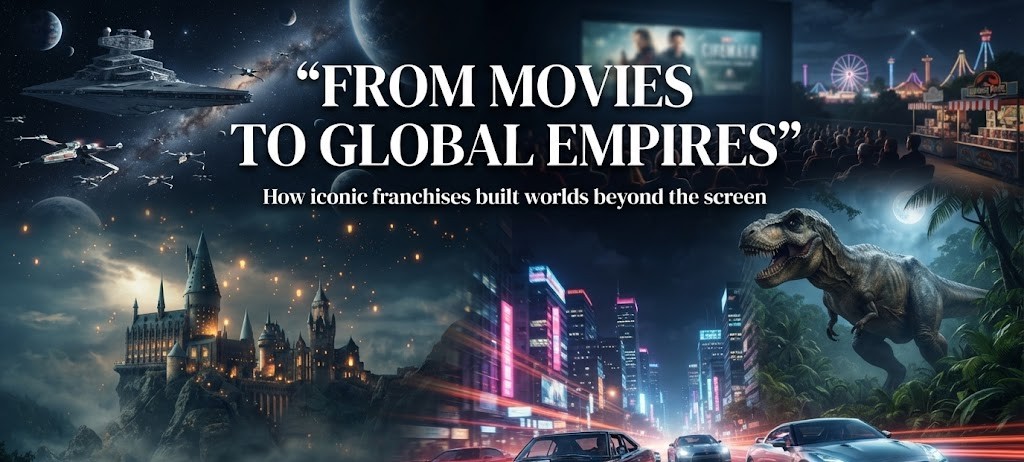
A successful movie can dominate the box office for a few weeks, generate headlines for a season and eventually disappear into the endless library of modern entertainment. A successful movie franchise works differently. It does not simply sell tickets; it builds a world that audiences can continue buying into long after the credits roll. Characters become recognizable brands, fictional locations become tourist destinations, costumes become fashion statements, toys become collectibles, and individual scenes evolve into cultural references. Over time, the movie itself can become only one part of a much larger commercial ecosystem.
That transformation has become one of the defining stories of the modern entertainment business. Hollywood studios increasingly think beyond theatrical releases, looking at intellectual property as something that can generate value across streaming, gaming, consumer products, licensing, attractions and live experiences. Industry data reflects just how large these ecosystems have become: franchises such as Star Wars, Harry Potter, Fast & Furious and Jurassic Park collectively represent billions of dollars in global box-office business, while their wider commercial footprints extend considerably further.
Some franchises are obvious examples of this phenomenon. Others have expanded so naturally that it is easy to overlook just how much of everyday entertainment and consumer culture they occupy. Here are five movie franchises that demonstrate how a story originally designed for the screen can evolve into something much closer to a global entertainment empire.
1. Star Wars: From Space Opera to a Consumer Culture Phenomenon
Few entertainment properties demonstrate the economics of intellectual property as clearly as Star Wars. When George Lucas introduced audiences to a galaxy far, far away in 1977, the central attraction was a science-fiction adventure filled with memorable characters, spaceships and an instantly recognizable mythology. What followed was something much bigger: a franchise that helped redefine how Hollywood understood merchandising, licensing and fan communities.
The commercial significance of Star Wars has never been limited to ticket sales. Guinness World Records has documented the extraordinary scale of its merchandising business, noting estimates of approximately $12 billion in toy-licensing revenue between 1977 and 2015, alongside major additional merchandise revenue connected to later releases. Earlier estimates also placed the broader value of the Star Wars franchise dramatically above its theatrical earnings, illustrating how merchandise, games and home entertainment became fundamental parts of the business model.
The genius of Star Wars is that almost every element of its universe can become a product or experience. Lightsabers become collectibles. Droid characters become toys. Fictional planets become settings for games. Iconic costumes become Halloween staples. Theme-park attractions turn passive spectators into participants. Disney’s expansion of the property has only strengthened that model, demonstrating how an established cinematic universe can continue generating commercial opportunities across generations.
The result is a franchise that does not depend entirely on releasing a new movie every year. Its mythology can remain active through merchandise, television, games, attractions and fan culture. That is the real meaning of becoming an entertainment empire: the audience does not have to be sitting in a cinema for the brand to remain commercially alive.
2. Harry Potter: When a Fictional World Becomes a Destination
Harry Potter began as a publishing phenomenon before becoming a global film franchise, but the movies transformed the Wizarding World into something audiences could see, collect and eventually physically enter. The eight-film Harry Potter series created a visual identity around Hogwarts, Diagon Alley, Hogsmeade, house colors, wands and magical creatures that could be translated into experiences far beyond the screen.
The box-office footprint alone is substantial. Box Office Mojo currently lists J.K. Rowling’s Wizarding World among the major franchise properties in North American theatrical history, with the Harry Potter and Fantastic Beasts films forming a large cinematic universe of their own. But the more interesting story is what happened outside movie theatres.
Universal has transformed the Wizarding World into a major theme-park attraction, with three distinct Harry Potter lands across Universal Orlando’s theme parks: Hogsmeade, Diagon Alley and the Ministry of Magic. Visitors can explore environments inspired by the films, eat themed food, purchase merchandise and interact with attractions designed around the fictional universe.
That strategy turns fandom into physical tourism. Someone who grew up watching Harry Potter can eventually spend money not simply to watch the story again but to walk through its world. A wand becomes more than merchandise because it becomes part of an interactive attraction. A robe becomes more than clothing because it allows a visitor to participate in the identity of a Hogwarts house. Even Butterbeer has moved from fictional curiosity to a recognizable themed experience.
The expansion is continuing geographically as well. A Harry Potter-themed land has been announced for Warner Bros. World Abu Dhabi, adding another physical destination built around the Wizarding World. This is where the franchise model becomes especially powerful: a story originally consumed through books and films can evolve into travel, retail, hospitality and experiential entertainment.
3. Fast & Furious: The Franchise That Turned Cars into a Global Lifestyle
Fast & Furious has always looked different from fantasy-heavy franchises such as Star Wars and Harry Potter. Its starting point was comparatively grounded: street racing, modified cars, underground culture and the adrenaline of automotive competition. Yet over more than two decades, the series transformed itself into a global action brand with a reach far beyond car enthusiasts.
The franchise’s evolution is particularly interesting because it gradually changed its own identity without abandoning the visual language that made it recognizable. What began with street racing expanded into international heists, espionage, military-style action and globe-spanning adventures. The cars remained central, but the scale became increasingly cinematic. The result was a property that could appeal not only to automotive fans but also to mainstream action audiences across different markets.
Its theatrical performance reflects that international reach. Worldwide franchise tracking places Fast & Furious among the highest-grossing film series in cinema history, with more than $6 billion in cumulative worldwide box-office revenue across the core franchise and related releases.
But its influence extends into automotive culture, video games, collectibles, clothing and branded experiences. The franchise effectively turned car customization into entertainment content for a much broader audience. Vehicles associated with the films became objects of fascination in their own right, while the visual vocabulary of modified cars, neon-lit streets, racing sequences and high-performance vehicles became part of global pop culture.
There is also an important business lesson in the franchise’s longevity. Fast & Furious did not remain successful simply by repeating the same movie. It widened its audience by changing the scale of the story while keeping recognizable themes of cars, loyalty, family and spectacle. That ability to evolve without completely abandoning its original identity is one of the most valuable characteristics of a long-running entertainment brand.
4. Jurassic Park: How Dinosaurs Became a Permanent Business
Few fictional creatures have demonstrated the commercial power of nostalgia as effectively as the dinosaurs of Jurassic Park. Steven Spielberg’s 1993 film turned dinosaurs into a modern blockbuster attraction, combining scientific curiosity with suspense and visual spectacle. Decades later, the franchise continues to operate across movies, merchandise, games, attractions and theme-park experiences.
The cinematic numbers are impressive. Jurassic Park and Jurassic World together represent one of the major long-running blockbuster properties, with franchise box-office totals measured in billions of dollars. Box Office Mojo lists Jurassic Park among the major franchise performers in North America, while worldwide franchise tracking places it among cinema’s biggest properties.
Yet the real empire exists in the way dinosaurs can be commercialized without requiring audiences to remember every movie. A Tyrannosaurus rex is instantly recognizable even to someone who has not watched the latest installment. That makes the property unusually adaptable to toys, clothing, video games, collectibles and family entertainment.
The theme-park dimension makes the strategy even more powerful. A dinosaur is naturally suited to an attraction because the appeal is not only narrative; it is sensory. Visitors want to see something enormous, hear it roar and experience the illusion of being close to a prehistoric creature. That turns a movie concept into an immersive experience.
Jurassic Park therefore illustrates a different kind of franchise economy. Star Wars sells an expansive mythology Harry Potter sells a magical world and Fast & Furious sells an adrenaline-fuelled lifestyle. Jurassic Park sells wonder and controlled danger. Its core concept is simple enough to survive multiple generations, which is precisely what makes it commercially durable.
5. Transformers: From Toy Shelf to Global Blockbuster Machine
Transformers may be one of the clearest examples of a franchise that existed as a commercial ecosystem before becoming a modern movie phenomenon. The concept of transforming robots had already established itself through toys and animated entertainment, but the live-action films dramatically increased its global visibility and turned characters such as Optimus Prime and Bumblebee into recognizable cinematic icons.
The franchise’s theatrical footprint is significant, with worldwide box-office tracking placing Transformers among the major modern movie series. Its appeal comes partly from an unusually simple visual proposition: cars become giant robots. That idea crosses language barriers almost effortlessly. Audiences do not need a detailed explanation to understand the spectacle of a familiar vehicle transforming into a towering machine.
This simplicity also makes Transformers exceptionally adaptable. The same characters can exist as toys, collectibles, video-game avatars, animated figures, apparel designs and cinematic heroes. In commercial terms, the franchise does not have to rely exclusively on the story. The characters themselves have become pieces of intellectual property that can travel between categories.
That is ultimately what separates a movie series from a global entertainment brand. A film can create awareness, but an adaptable character can create a business ecosystem. Transformers demonstrate how entertainment and consumer products can reinforce one another: the movies increase the visibility of the characters, while merchandise keeps those characters present between theatrical releases.
The Bigger Story: When Movies Stop Being the Product
The most fascinating thing about these franchises is not simply how much money they have generated. It is how fundamentally the definition of a movie franchise has changed. The traditional model was relatively straightforward: make a film, sell tickets, release it on home entertainment and eventually move on to the next project. The modern franchise model is much more interconnected.
A successful fictional universe can now operate simultaneously as a cinema property, streaming brand, gaming platform, merchandise portfolio, tourism attraction and social-media phenomenon. A new film can drive searches and merchandise sales; a theme-park experience can renew interest in older films; a collectible can introduce a younger audience to a character; and a video game can keep an inactive franchise culturally visible between major releases.
This is why the strongest entertainment properties increasingly behave like consumer brands. Their value is not concentrated in one product. It is distributed across an ecosystem of experiences. The audience does not simply watch the franchise. They wear it, play it, collect it, visit it, discuss it and sometimes even travel for it.
And that may be the quiet secret behind the biggest movie franchises of the modern era. The blockbuster itself is only the beginning. The real empire begins when audiences no longer need a new movie to remain connected to the world.