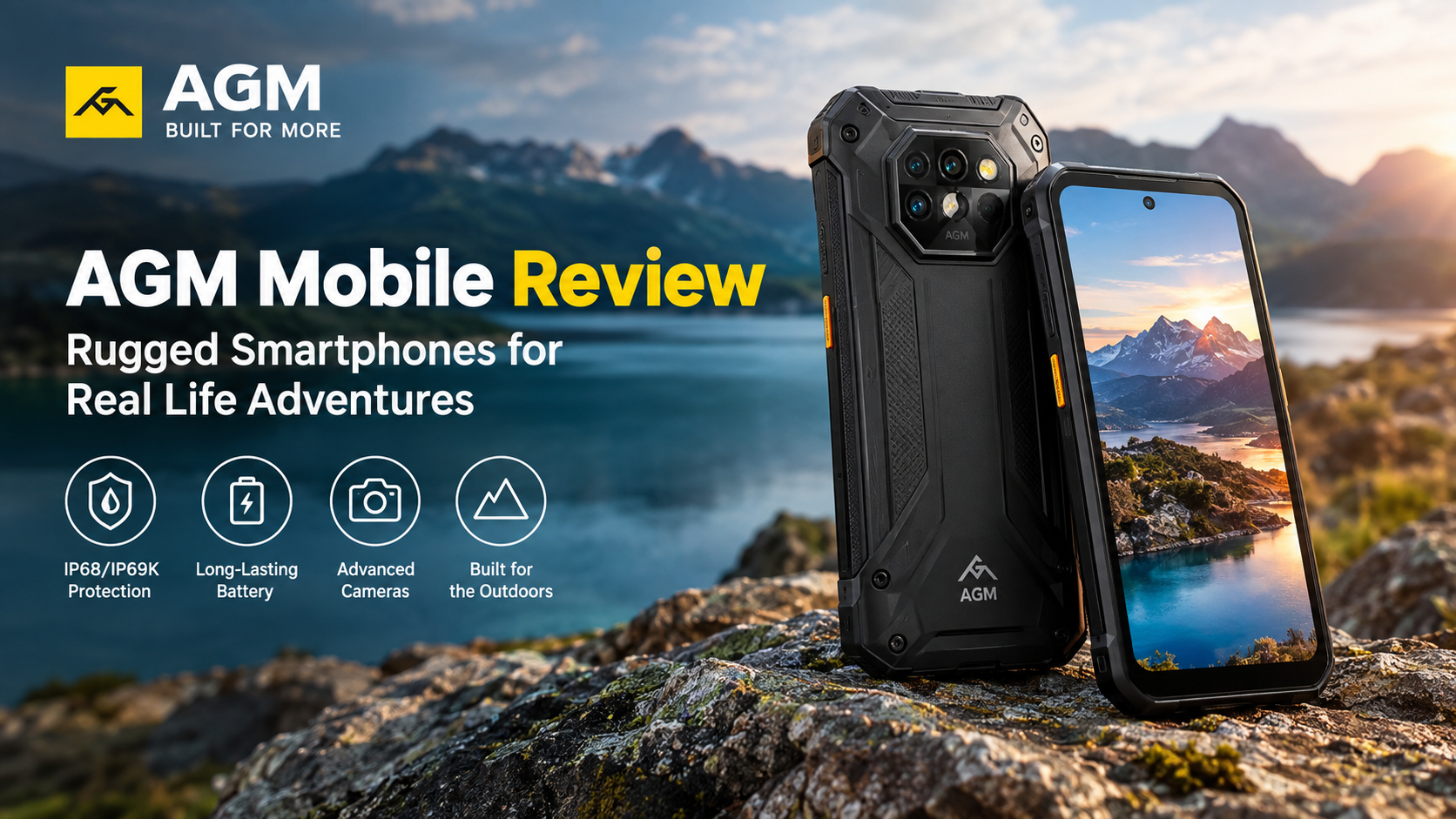
Smartphones have become increasingly powerful, but most modern phones still have one obvious weakness: they are not particularly good at dealing with harsh environments. A fall onto concrete, prolonged exposure to water, dust, extreme temperatures or rough daily handling can turn an expensive smartphone into a very costly problem. This is where AGM Mobile takes a different approach.
AGM Mobile has built its reputation around rugged smartphones designed for people who need more durability than a conventional handset can provide. Instead of competing directly with Apple, Samsung or Google on ultra-thin designs and premium lifestyle features, AGM focuses on toughness, large batteries, outdoor functionality and practical hardware. The company says it has been developing rugged mobile devices since 2008, with a product history that includes rugged phones, tablets and feature phones.
But does AGM Mobile actually offer a compelling alternative to mainstream smartphones? And are AGM rugged phones worth considering if you spend a lot of time outdoors or work in demanding environments?
After looking closely at AGM’s current range and the features across its G, H and M series, there is a clear argument for the brand. AGM is not trying to make a rugged phone that simply looks tough. Its products are designed around specific problems that outdoor workers, adventurers and professionals may encounter.
What Is AGM Mobile?
AGM Mobile is a technology company focused primarily on rugged mobile devices. Its portfolio includes rugged smartphones, feature phones, tablets, smartwatches and audio products, although rugged phones remain at the heart of the brand.
The company’s current smartphone lineup includes models such as the AGM G3 Pro, AGM G3, AGM G2 Guardian, AGM Glory, AGM H Max and AGM H6. There are also more basic feature phones such as the M series.
AGM’s philosophy is relatively straightforward: build phones that can survive situations where a normal smartphone might struggle.
That means durability is not simply an additional feature. It is central to the design of the products.
The company’s history also helps explain its position in the market. AGM says it launched the ROCK V5 in 2011, introduced the X1 in 2016 as a 4G rugged flagship, followed that with the X2, which it describes as a rugged smartphone capable of floating on water, and later introduced the X5 with 5G connectivity. Its more recent products have moved further into specialist territory, including thermal imaging and extreme-temperature functionality.
AGM Rugged Phones: What Makes Them Different?
The biggest reason to consider an AGM phone is durability.
According to AGM, its phones comply with IP68 standards and are tested against the MIL-STD-810H standard. The company also says it applies an internal OEPT, or Outdoor Environments Performance Test, to its devices.
For an everyday smartphone user, those specifications might not mean much. For someone working outdoors, hiking, cycling, fishing, construction, engineering or travelling through difficult environments, they can be considerably more relevant.
IP68 protection is designed to provide resistance against dust and water under specified testing conditions, while IP69K represents a higher level of protection against high-pressure and high-temperature water jets. MIL-STD-810H, meanwhile, is associated with environmental testing designed around demanding conditions.
It is worth remembering that certification does not make a phone indestructible. Real-world conditions vary, and water resistance can also be affected by wear, physical damage and improper use. Nevertheless, the emphasis on protection gives AGM an important advantage over many conventional smartphones.
AGM G3: A Strong All-Rounder
The AGM G3 is one of the company’s most interesting current rugged smartphones because it combines conventional smartphone functionality with hardware designed specifically for outdoor use.
The phone is listed with 12GB of RAM, 512GB of storage, a 10,000mAh battery, a 120Hz display, wireless charging and IP68/IP69K protection. AGM also highlights a 5W 116dB speaker and a 50MP front camera on its current product listing.
The 10,000mAh battery immediately stands out.
Battery life is one of the biggest practical concerns when using a smartphone away from a power outlet. Someone spending a full day hiking, travelling, working outdoors or camping may not have the same charging opportunities as someone sitting in an office.
A 10,000mAh battery gives the G3 considerably more capacity than the typical mainstream smartphone. The trade-off is obvious: this is not going to be the kind of lightweight phone you barely notice in your pocket. AGM is prioritising endurance over minimal size.
The large speaker is another unusual feature. AGM rates the G3’s speaker at 116dB, making it particularly interesting for users who need audible alerts or audio in noisy outdoor environments.
The inclusion of wireless charging is also useful. AGM has positioned wireless charging as a practical solution for rugged environments, particularly because repeated use of a physical charging port can be inconvenient when the device is exposed to dust, dirt or moisture.
AGM G3 Pro: For More Specialist Users
If the standard G3 is aimed at users who want a tough everyday smartphone, the AGM G3 Pro takes the concept further.
The G3 Pro combines a 10,000mAh battery, 12GB RAM and 512GB storage with thermal imaging, a 120Hz display, a 116dB speaker and wireless charging. The current listing also identifies MIL-STD-810H and IP68/IP69K protection.
Thermal imaging is arguably the feature that separates the G3 Pro from most ordinary rugged smartphones.
A thermal camera can detect heat differences rather than simply capturing conventional images. That can have practical applications in areas such as equipment inspection, maintenance, outdoor activities and certain professional applications.
This is particularly interesting for engineers, technicians and workers who need to inspect equipment or identify temperature differences. It can also appeal to outdoor enthusiasts who want specialist functionality rather than simply a durable phone.
The G3 Pro is therefore not really competing with standard smartphones purely on specifications. It is competing on utility.
That distinction is important.
If you only need a phone for messaging, social media and photography, paying extra for thermal imaging may not make sense. But if the feature can replace or supplement a separate specialist device for your work, the equation becomes much more attractive.
AGM’s Approach to Battery Life
Battery capacity is one of AGM Mobile’s strongest themes.
Several current models feature unusually large batteries. The G3 and G3 Pro, for example, are equipped with 10,000mAh batteries. The H Max also carries a 10,000mAh battery according to AGM’s current product lineup.
This is one of the areas where rugged smartphones can offer a genuine advantage over mainstream devices.
Long battery life matters particularly when a phone is being used for navigation, photography, GPS tracking, communication and other demanding tasks away from reliable charging infrastructure.
There is, however, a trade-off. Large batteries require physical space, and rugged protection adds further bulk. AGM phones are therefore designed for users who value endurance and durability more than an ultra-thin profile.
That is not necessarily a disadvantage. It simply means AGM phones have a different design priority.
Display and Everyday Usability
Rugged phones used to have a reputation for sacrificing too much in the name of durability. AGM’s newer models suggest that the category is moving beyond that compromise.
The G3 and G3 Pro feature 120Hz displays, while models such as the H6 use a 90Hz panel.
A higher refresh rate makes scrolling, animations and general navigation feel smoother. This is particularly useful because it means an AGM phone does not necessarily feel like a basic industrial device when used for everyday smartphone tasks.
The G3 also uses a 6.72-inch FHD+ display according to AGM’s published specifications, alongside 5G and Wi-Fi 6 connectivity.
That combination makes the G3 much more interesting as an everyday smartphone. It is not simply a backup phone designed to sit in a toolbox. It is intended to function as a primary mobile device while offering protection beyond what most mainstream phones provide.
Cameras: Useful Rather Than Camera-First
Camera performance is one area where prospective buyers should think carefully about their priorities.
AGM includes capable camera hardware in its recent smartphones, with the G3 listing a 50MP front camera and the published G3 specifications referencing a 64MP triple-camera system.
However, AGM’s selling point is not computational photography.
If your primary reason for buying a smartphone is taking the best possible portraits, night photographs or social-media content, a flagship from Apple, Samsung or Google will probably remain the more obvious choice.
AGM’s cameras make more sense in the context of the phone itself. They provide users with a way to document jobs, trips, equipment, landscapes and everyday activities without needing to worry as much about damaging a fragile handset.
And in the G3 Pro, thermal imaging adds a completely different type of visual capability that conventional smartphone cameras simply cannot provide.
AGM H Series: More Affordable Rugged Smartphones
Not everyone needs a flagship rugged phone.
This is where the AGM H series becomes important.
The current lineup includes the H Max, H6 and H6 Lite. The H Max combines rugged construction with a 10,000mAh battery, 8GB RAM and 256GB storage, while the H6 is positioned as a thinner rugged model with a 6.56-inch 90Hz display and 8GB RAM plus virtual memory expansion.
The H series is arguably the more practical choice for buyers who want durability without paying for specialist features such as thermal imaging.
The H6 is particularly interesting because AGM markets it as an ultra-thin rugged phone. This addresses one of the traditional weaknesses of rugged devices: excessive thickness.
AGM’s H series therefore gives the brand a broader appeal. You do not necessarily have to be a professional working in extreme conditions to consider one.
AGM G Series vs H Series
The easiest way to understand AGM’s smartphone range is to think about how much rugged functionality you actually need.
The G series is designed for people who want more advanced hardware and specialist outdoor features. Models such as the G3 and G3 Pro combine large batteries, high storage capacities, high-refresh-rate displays and additional outdoor functionality. The G3 Pro takes this further with thermal imaging.
The H series is more focused on delivering rugged protection at a more accessible level. It makes sense for users who primarily want a durable smartphone without necessarily needing every specialist feature.
That differentiation is useful because not every customer needs a $600-plus rugged phone.
AGM Feature Phones: A Different Kind of Smartphone Alternative
AGM also offers feature phones such as the M series.
These devices are aimed at a very different audience. Someone may want a basic phone for outdoor activities, work sites, travel or situations where a traditional smartphone is unnecessary.
The current AGM website lists several M-series models, including the M11, M10, M9, M8 Flip and M7.
This is an interesting part of AGM’s strategy because it means the company is not exclusively targeting people who want the biggest and most advanced smartphone.
For some users, simplicity can actually be an advantage.
Build Quality and Outdoor Use
The most compelling reason to buy an AGM phone is ultimately the physical construction.
AGM says its devices undergo testing involving heat, cold, water, dust and drops. The company has also built its brand around outdoor users and professionals who operate in challenging environments.
The rugged construction typically means reinforced bodies, protective materials and designs intended to withstand more abuse than standard smartphones.
This can make AGM phones attractive to construction workers, field engineers, mechanics, outdoor professionals, hikers, campers, cyclists, hunters, anglers and travellers.
It is also worth noting that AGM’s product range has increasingly focused on specialised outdoor tools. Thermal imaging, high-output speakers, huge batteries and enhanced protection are not features added simply for marketing. They address specific problems that can arise outside conventional office environments.
Software and Connectivity
AGM has also kept its newer devices reasonably current in terms of smartphone connectivity and operating systems.
The G3 supports 5G and Wi-Fi 6, while AGM’s current product range includes newer models running Android 16, including the X7 and X7 Pro.
The company also sells globally, although network compatibility is something buyers should check carefully before ordering. AGM itself advises customers to verify supported network standards and frequency bands for their country.
This is particularly important with less mainstream smartphone brands. A phone can have impressive specifications on paper but still provide a poor experience if it does not fully support the cellular bands used by your carrier.
Customer Support and Warranty
AGM currently states that its devices come with at least a one-year guarantee, while its official store advertises a 12-month free repair warranty.
The official store also advertises free shipping and customer service availability for 12 hours a day, five days a week.
Buyers should still check the specific warranty, return and shipping terms applicable to their country before purchasing. This is particularly important when ordering specialist smartphones internationally.
AGM sells through its own website as well as marketplaces and other channels, including Amazon, eBay and AliExpress, according to its FAQ.
Who Should Buy an AGM Mobile Phone?
AGM phones make the most sense for people who actually benefit from rugged hardware.
If you spend a lot of time hiking, camping, fishing, cycling or travelling outdoors, a rugged phone can offer peace of mind. Likewise, construction workers, engineers, mechanics and field technicians may appreciate a phone that is designed to tolerate more physical abuse.
The G3 Pro is particularly interesting for professional users who can take advantage of thermal imaging.
For someone who simply wants the thinnest, lightest and most fashionable smartphone, AGM is probably not the obvious choice.
This is a phone brand built around practicality.
Who Should Avoid AGM?
There are also good reasons not to buy an AGM smartphone.
If camera quality is your number-one priority, mainstream flagship phones remain stronger choices. Likewise, people who value an extremely thin and lightweight design may find the rugged construction inconvenient.
You should also consider software support, regional network compatibility and after-sales service before purchasing any lesser-known smartphone brand.
And there is an important question of value. A rugged phone can be excellent value if you genuinely need its durability and specialist hardware. If you do not, you may be paying for features you will rarely use.
Final Verdict: Is AGM Mobile Worth It?
AGM Mobile occupies an interesting position in the smartphone market because it does not try to be everything to everyone.
Instead, the company has developed a clear identity around rugged smartphones, large batteries and outdoor functionality. Its latest products demonstrate how far the rugged-phone category has evolved. The AGM G3 combines a 10,000mAh battery, 120Hz display, high storage capacity, wireless charging and substantial durability features, while the G3 Pro adds thermal imaging for users who need more specialist functionality.
The H series provides a more affordable entry into AGM’s rugged ecosystem, while the M series gives buyers simpler feature-phone options.
The biggest strength of AGM is therefore not one particular specification. It is the overall philosophy behind the devices.
These phones are designed for people who need their smartphone to work in situations where a conventional handset may be vulnerable.
That makes AGM a compelling choice for outdoor enthusiasts and professionals who prioritise durability, battery life and practical features over ultra-slim designs and camera-first performance.
Overall, AGM Mobile is worth considering if ruggedness is a genuine requirement rather than simply a nice-to-have feature. For the right buyer, an AGM phone can offer a combination of durability, battery capacity and specialist outdoor functionality that is difficult to find in mainstream smartphones. For everyone else, a conventional flagship may still provide a better balance of design, cameras, software and everyday refinement.
The key is to choose the AGM model according to your needs. The G3 is a strong all-round rugged option, the G3 Pro is aimed at users who can benefit from thermal imaging and advanced outdoor features, while the H series offers a more straightforward route into rugged smartphones.
In other words, AGM is not trying to convince everyone that they need a rugged phone. It is building phones for the people who already know why they need one — and that focused approach is arguably what makes the brand stand out.