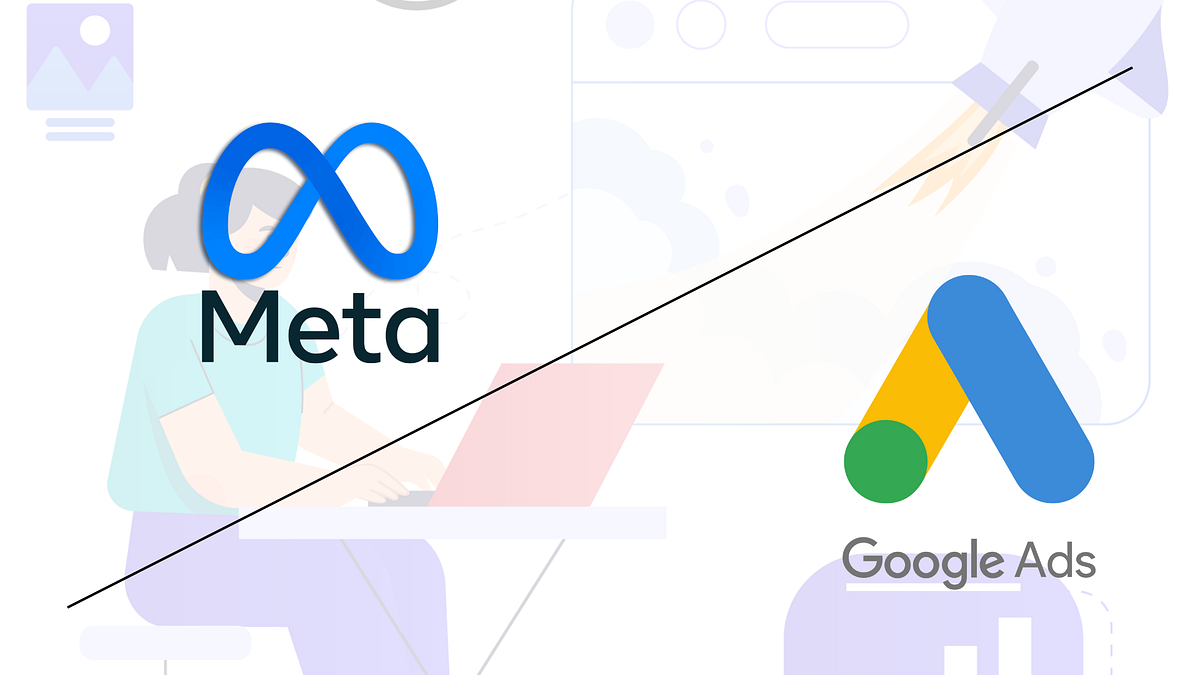
Digital advertising is no longer simply about putting a product in front of as many people as possible. The real challenge is understanding when people are ready to discover something, what makes them stop scrolling, and what ultimately pushes them to take action. This is where two of the biggest names in digital advertising—Google Ads and Meta Ads take very different approaches. Both can generate traffic, leads, sales, app installs, and brand awareness, but the way they find audiences and influence decisions is fundamentally different.
At a surface level, the distinction seems straightforward: Google captures people who are searching, while Meta reaches people while they are browsing social platforms. But the difference goes much deeper than that. Google operates heavily around intent, whereas Meta is built around interest, behavior, discovery, and attention. One often meets the consumer when a need has already emerged; the other can introduce the consumer to a product before they have even realized they want it. Understanding that difference is essential for marketers deciding where to invest their advertising budget.
Google Ads: Advertising at the Moment of Intent
Google Ads is fundamentally connected to what people are already looking for. When someone types a query into Google, they are communicating a certain level of intent. A person searching for “best running shoes for marathon training” is behaving very differently from someone casually watching a fitness video or scrolling through a fashion feed. The search itself provides a valuable signal: there is already a question, problem, need, or desire behind the interaction.
This makes Google particularly powerful for businesses that can connect their offering directly to an existing demand. Search campaigns can place advertisements near the top of results when users are actively looking for relevant products or services. If someone searches for “business accounting software,” for example, an accounting platform can appear at precisely the moment that potential customer is exploring solutions. The advertiser is not necessarily creating the initial demand; it is competing for attention at the point where that demand has become visible.
The Google advertising ecosystem, however, extends well beyond traditional search results. Businesses can also advertise across Google’s broader network, including YouTube, apps, websites, shopping environments, and other placements. This allows advertisers to work across different stages of the customer journey, from introducing a product to reconnecting with someone who previously interacted with the brand.
One of the biggest strengths of Google Ads is therefore its connection to high-intent behavior. A consumer searching for a specific service may be considerably closer to making a purchase than someone encountering that product for the first time in a social feed. That does not mean every search converts, of course. Competition, keyword pricing, landing-page quality, offer strength, brand reputation, and user experience all influence performance. But the underlying signal—the fact that someone is actively searching—can be extremely valuable.
Meta Ads: Creating Demand Through Discovery
Meta Ads work from a different starting point. Instead of waiting for someone to search for a solution, Meta can introduce products, services, brands, and ideas while people are spending time on platforms such as Facebook and Instagram.
This creates a very different advertising environment. A user may open Instagram intending to look at travel content, watch Reels, check messages, or browse a friend’s post. They may not have any immediate intention to buy a skincare product, book a hotel, subscribe to a service, or purchase a new pair of shoes. Yet a visually compelling advertisement can capture their attention and create curiosity.
That is the heart of Meta advertising: discovery.
Meta’s advertising system uses signals related to people’s interactions and behavior to help advertisers reach audiences that may be relevant to their objectives. Marketers can work with demographic information, interests, behaviours, engagement signals, website activity, customer lists, and other available signals, depending on the campaign setup and privacy environment.
This makes Meta particularly interesting for brands where visual storytelling plays an important role. Fashion, beauty, food, travel, consumer technology, fitness, lifestyle, entertainment, and e-commerce brands can use imagery and short-form video to communicate an idea before asking the audience to make a purchase.
The creative itself becomes part of the targeting strategy. A strong advertisement does not simply tell people what a product is; it gives them a reason to care. A beautifully produced travel campaign can make someone imagine their next holiday. A skincare advertisement can introduce a routine they had never considered. A technology brand can demonstrate a feature that solves a problem the viewer did not know could be solved.
In that sense, Meta often works less like a digital version of a search engine and more like a discovery engine for brands and products.
The Biggest Difference: Intent vs. Attention
The most useful way to understand Google Ads and Meta Ads is to look at the psychology behind the interaction.
Google often begins with a question.
Meta often begins with attention.
Imagine a consumer who needs a new laptop. On Google, they might search for “best laptop for graphic design,” compare models, read reviews, and eventually click an advertisement from a retailer. The advertiser is entering an existing research process.
On Instagram, that same person might encounter a video showing a sleek new laptop being used by a designer. The advertisement could highlight its display, performance, battery life, or creative features. The consumer was not necessarily searching for a laptop at that exact moment, but the advertisement can stimulate interest and move them toward researching the product.
Neither approach is inherently better in every situation. They simply operate at different points in the decision-making process.
This distinction also explains why the creative requirements can be so different. Google Search ads need to communicate relevance quickly because the user is already scanning results for an answer. Meta advertisements have to compete with entertainment, creators, friends, trends, and an endless stream of visual content. The first few seconds or even the first visual frame—can determine whether the user keeps watching or scrolls away.
Targeting Works Differently on Both Platforms
Audience targeting is another major area where the two ecosystems differ.
Google can use search queries and keywords as powerful indicators of intent. Someone searching for “luxury hotel in Paris” is providing an immediate contextual signal. Advertisers can also use audience segments, geographic targeting, device signals, demographics, remarketing approaches, and other campaign settings.
Meta, meanwhile, has historically been strongly associated with audience-based targeting. Advertisers can build campaigns around audience characteristics, interests, behaviors, previous interactions, and first-party data where appropriate. The platform’s machine-learning systems can then help identify people who are likely to complete the advertiser’s chosen objective.
Modern advertising platforms have increasingly moved toward automated optimization, meaning marketers are no longer manually controlling every individual audience interaction. Instead, they provide campaign objectives, creative assets, budgets, conversion signals, and other inputs, allowing the platform’s systems to determine where and to whom advertisements should be delivered.
That shift means successful advertising is becoming less about finding a tiny audience manually and more about giving the algorithm strong inputs to work with.
Creative Plays a Different Role
Creative is important on both platforms, but its job changes depending on the environment.
A Google Search advertisement has to be clear, relevant, and aligned with the user’s search intent. If the consumer is searching for “online project management software,” the advertisement needs to immediately communicate why the product is relevant. The landing page then has to continue that conversation.
Meta gives advertisers more room to tell stories. A single image, carousel, Reel, testimonial, product demonstration, creator-style video, or lifestyle scene can communicate a brand personality that would be difficult to express through a short search advertisement.
This is why brands often need different creative strategies for each platform. A headline that performs well in a search campaign may not make an effective Instagram hook. Likewise, a visually dramatic social advertisement may generate curiosity but fail to satisfy a consumer who is searching for a very specific solution.
The strongest advertisers understand that platform-native creative matters. They do not simply resize the same advertisement and distribute it everywhere.
Measuring Performance: The Numbers Tell Different Stories
Both Google and Meta provide extensive campaign data, but marketers need to interpret that data within the context of the platform.
Metrics such as impressions, clicks, click-through rate, cost per click, conversions, conversion rate, and return on advertising spend can appear across campaigns, but their meaning depends heavily on the customer journey.
A Google campaign generating conversions from high-intent searches may have a very different economics profile from a Meta campaign introducing a product to a cold audience. One campaign might be harvesting existing demand, while the other is creating new consideration.
This is why comparing the platforms purely by cost per click can be misleading. A cheaper click is not automatically a more valuable click. What matters is what happens after that interaction. Does the visitor purchase? Submit a lead? Start a trial? Return later? Become a repeat customer?
The real performance question is therefore not simply “Which platform has cheaper traffic?” but “Which platform is producing valuable customer actions for this particular business?”
Google Ads vs Meta Ads: Which Businesses Use Them?
The answer depends heavily on the business model and customer journey.
Google can be particularly useful for businesses where consumers actively search for solutions. Local services, professional services, software, travel, education, finance, healthcare-related searches where advertising is permitted, home services, and e-commerce can all have strong search-driven demand.
Meta can be especially useful for brands that benefit from discovery and visual storytelling. Consumer products, fashion, beauty, food, lifestyle, travel, entertainment, mobile apps, and emerging brands can use social advertising to build awareness and stimulate interest.
For many businesses, however, the choice does not have to be either-or.
A customer might first discover a brand on Instagram, visit the website, leave without purchasing, later search for the brand on Google, read reviews, and eventually complete the purchase through a search or shopping interaction. The customer’s journey does not recognize the boundaries between advertising platforms.
Smart marketing strategies therefore increasingly look at the entire customer journey rather than treating each platform as an isolated channel.
The Case for Using Google and Meta Together
The most interesting opportunity often appears when the two platforms complement each other.
Meta can help create awareness and introduce a product to audiences who may not yet be actively searching. Google can capture some of that resulting demand when people begin researching the brand, product, or category. Remarketing and first-party data strategies can then help reconnect with people who interacted but did not convert.
Consider a new direct-to-consumer fashion label launching internationally. Meta could introduce the brand through visual campaigns, creator-style content, and product storytelling. Someone who discovers the brand might later search for its name, look for reviews, compare products, or visit the website again. Google can then become part of the demand-capture process.
The two platforms can therefore play different roles within one marketing ecosystem: Meta can help start the conversation, while Google can help capture existing intent.
That relationship is not guaranteed, and attribution is rarely as simple as assigning one platform all the credit. Customer journeys involve multiple touchpoints, and measurement can be affected by privacy changes, attribution windows, device switching, and offline interactions. Marketers need to look at broader business outcomes rather than relying on a single dashboard metric.
The Future of Paid Advertising Is Less About Platforms—and More About Strategy
The Google-versus-Meta debate can sometimes become too focused on which platform is “better.” In reality, the more useful question is what the business needs the advertising to accomplish.
If the goal is to capture people already searching for a solution, search-led advertising can be highly relevant. If the goal is to introduce a product, build awareness, demonstrate a lifestyle, or create demand among potential customers, social advertising can provide a different route into the consumer’s attention.
The smartest strategy starts with the customer rather than the platform. Where does the customer discover the problem? Where do they research it? What makes them trust a solution? Where do they compare options? And what finally persuades them to act?
Once those questions are answered, the role of Google and Meta becomes much clearer.
Google Ads and Meta Ads are not simply two competing advertising tools. They represent two different ways of reaching consumers: one deeply connected to existing intent, the other deeply connected to discovery and attention. Modern marketers need to understand both because today’s customer journey rarely happens in one place.
The real advantage comes from knowing when to capture demand, when to create it, and how to connect the two without losing sight of the customer. In an increasingly crowded digital marketplace, that strategic understanding matters far more than simply choosing a platform and increasing the budget.
Affiliate Disclosure: This article may contain affiliate links. If you purchase a product or sign up for a service through one of these links, we may earn a commission at no additional cost to you. Our reviews and opinions are based on our editorial assessment and are not influenced solely by affiliate compensation.