Introduction
Artificial intelligence has become one of the biggest forces reshaping the automotive industry. While AI-powered autonomous driving often dominates headlines, another transformation is quietly changing how cars are bought and sold. From personalized recommendations and intelligent pricing to AI-powered virtual assistants and predictive customer insights, leading automotive brands are using artificial intelligence to make the car-buying experience faster, smarter, and more personalized.
Today’s customers expect the same seamless digital experience when purchasing a vehicle as they receive while shopping online for electronics or fashion. They want personalized recommendations, transparent pricing, instant answers to their questions, and the ability to complete most of the buying journey online. Automotive companies have recognized this shift and are investing heavily in AI technologies that improve customer engagement while increasing dealership efficiency and sales conversions.
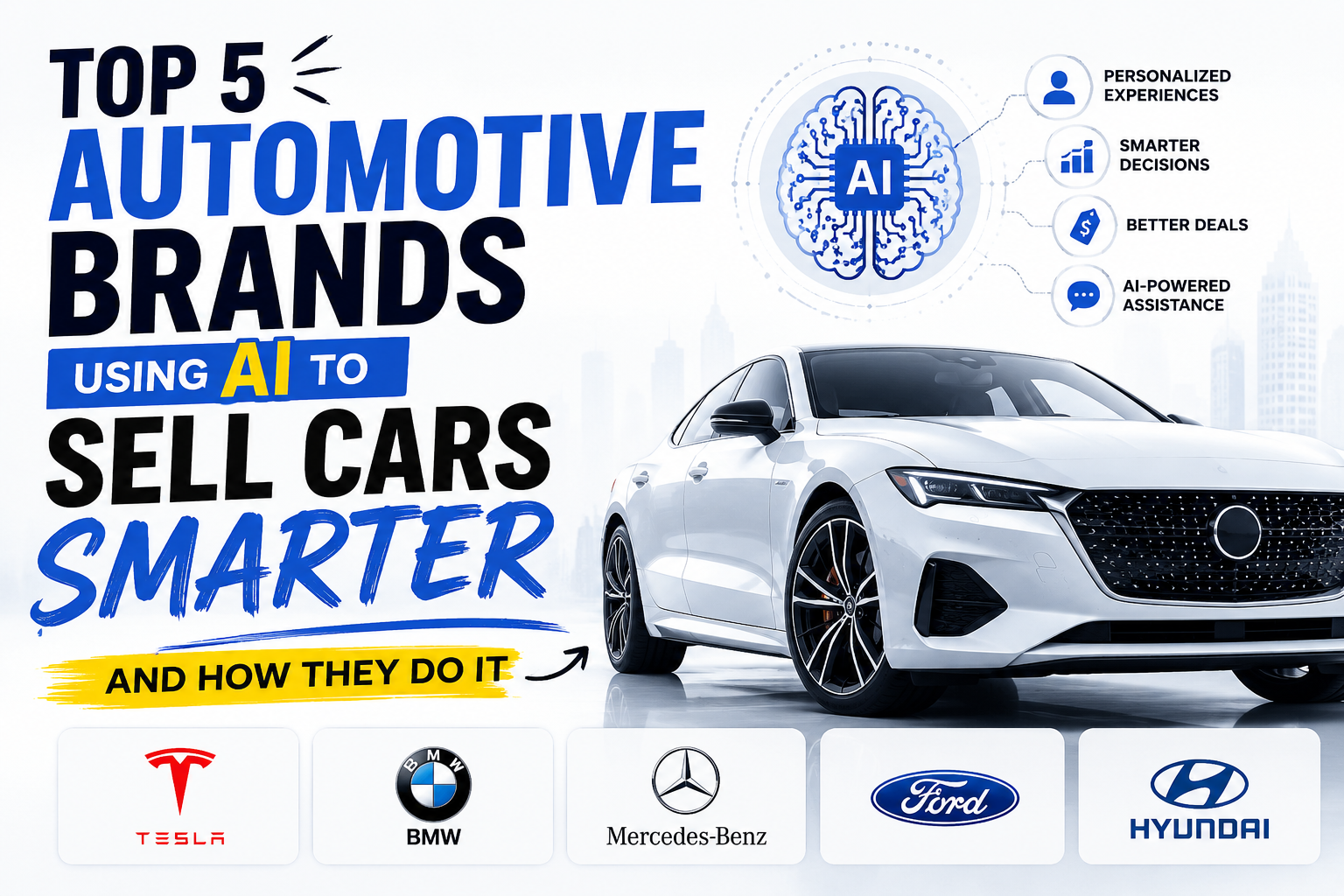
In this article, we explore five global automotive brands that are using AI to sell cars smarter and examine how these innovations are redefining automotive retail.
1. Tesla – AI-Powered Direct Sales and Personalized Ownership Experience
Tesla has revolutionized more than electric vehicles it has transformed how customers purchase them. Unlike traditional automakers that rely heavily on dealerships, Tesla combines artificial intelligence with a direct-to-consumer sales model that creates a highly personalized buying experience.
Tesla’s AI analyses customer preferences, browsing history, location, and previous interactions to recommend vehicle configurations that match individual needs. Buyers can customize every aspect of their vehicle online while AI-powered systems provide intelligent suggestions for battery options, wheel designs, interior packages, and software upgrades.
Another major advantage is Tesla’s predictive inventory management. AI forecasts regional demand, helping Tesla allocate vehicles efficiently and reduce delivery times. This not only improves customer satisfaction but also minimizes inventory costs.
After the purchase, AI continues to enhance the ownership experience through over-the-air software updates, predictive maintenance alerts, and personalized feature recommendations. This ongoing digital relationship increases customer loyalty and creates opportunities for future upgrades.
Tesla demonstrates how AI is no longer limited to manufacturing—it has become a critical sales and customer engagement tool.
2. BMW – Intelligent Customer Personalization Through AI
BMW has embraced artificial intelligence to create premium customer experiences both online and inside dealerships. The company uses machine learning algorithms to understand customer behavior throughout the buying journey.
Whenever customers visit BMW’s digital platforms, AI evaluates browsing patterns, preferred vehicle categories, budget ranges, and lifestyle preferences. Instead of displaying generic vehicle listings, BMW presents personalized recommendations that closely match individual interests.
BMW also integrates AI-powered virtual assistants capable of answering product questions instantly. These assistants provide information about financing options, available inventory, maintenance plans, and vehicle specifications, reducing waiting time and helping customers make informed decisions.
Inside dealerships, AI helps sales consultants prepare personalized recommendations before customers even arrive. Sales teams receive valuable insights about likely interests, increasing the chances of successful conversions while delivering a more premium buying experience.
The combination of digital intelligence and human expertise enables BMW to build stronger customer relationships and improve sales efficiency.
3. Mercedes-Benz – AI Virtual Assistants Creating Luxury Buying Experiences
Luxury automotive customers expect exceptional service, and Mercedes-Benz is using artificial intelligence to deliver exactly that.
The Mercedes-Benz digital ecosystem incorporates AI-powered assistants that guide customers throughout the purchase process. These virtual assistants answer questions about vehicle features, financing options, trim levels, available offers, and ownership benefits around the clock.
AI also powers intelligent customer relationship management systems that analyse previous purchases, service history, and online interactions. As a result, Mercedes-Benz can recommend new models or upgrade opportunities that genuinely match customer needs instead of relying on generic marketing campaigns.
Another important AI application involves lead scoring. Machine learning identifies customers who are most likely to complete a purchase, allowing sales representatives to prioritize high-quality leads and provide faster responses.
Mercedes-Benz also uses predictive analytics to forecast regional demand, helping dealerships maintain the right inventory mix and avoid shortages or excess stock.
These AI-driven improvements create a luxury buying experience that feels highly personalized from the first website visit to final vehicle delivery.
4. Ford – AI Enhancing Digital Retail and Dealer Intelligence
Ford has invested heavily in artificial intelligence to modernize its retail operations while strengthening relationships between customers and dealerships.
Ford’s AI-powered digital retail platform allows customers to compare vehicles, estimate financing, calculate trade-in values, and receive personalized recommendations based on their preferences.
One of Ford’s strongest AI capabilities lies in predictive analytics. Machine learning models examine market demand, seasonal buying behavior, and local inventory to help dealerships stock the right vehicles. This reduces unsold inventory while ensuring popular models remain available.
Ford also uses AI to analyse customer communication across websites, emails, social media, and service centers. These insights enable marketing teams to create highly targeted campaigns that resonate with specific customer groups.
AI further improves after-sales engagement by predicting maintenance requirements and sending timely service reminders. This ongoing relationship strengthens customer loyalty and increases repeat purchases over time.
Ford’s AI strategy demonstrates that successful automotive retail depends not only on selling cars but also on building long-term customer relationships.
5. Hyundai – AI Driving Smarter Customer Engagement
Hyundai has rapidly emerged as one of the automotive industry’s most innovative adopters of artificial intelligence in sales and marketing.
The company uses AI-powered chatbots that assist customers throughout the buying process by answering questions about vehicle availability, financing options, pricing, and dealership appointments. These intelligent assistants significantly reduce response times while improving customer satisfaction.
Hyundai also leverages AI for personalized marketing campaigns. By analysing customer demographics, online behavior, browsing history, and purchase intent, AI recommends relevant vehicle models that align with each buyer’s lifestyle and budget.
Another significant application is dynamic pricing and promotional optimization. AI evaluates regional demand, competitor pricing, inventory levels, and seasonal trends to recommend promotional offers that maximize sales without sacrificing profitability.
Hyundai’s AI systems also support dealership operations by forecasting demand and identifying high-potential sales opportunities, enabling more efficient resource planning and inventory management.
Through intelligent automation and data-driven personalization, Hyundai is making vehicle purchasing faster, easier, and more customer-centric.
How AI Is Changing Automotive Sales
Artificial intelligence is transforming every stage of the automotive buying journey.
Customers now receive personalized vehicle recommendations instead of browsing hundreds of models manually. AI-powered recommendation engines analyse budgets, driving habits, family size, preferred features, and purchase history to present the most suitable options.
Conversational AI has also become a valuable sales assistant. Intelligent chatbots provide instant responses to customer inquiries 24 hours a day, reducing frustration while improving lead generation.
Machine learning helps dealerships predict future demand more accurately, allowing manufacturers to optimize production and inventory allocation. This minimizes excess inventory while reducing waiting periods for customers.
Dynamic pricing algorithms analyse competitor prices, market demand, and inventory levels to recommend competitive pricing strategies that increase profitability without losing customers.
AI also improves financing approvals by evaluating multiple financial indicators quickly and accurately, allowing buyers to receive loan decisions in minutes rather than days.
Perhaps most importantly, predictive analytics enables automotive brands to identify customers who are likely to purchase, upgrade, or return for another vehicle. Sales teams can focus their efforts where conversion potential is highest, improving efficiency across the entire organization.
Benefits of AI for Automotive Brands
The adoption of artificial intelligence delivers measurable advantages across the automotive retail ecosystem.
Customers enjoy faster responses, personalized recommendations, transparent buying experiences, and convenient digital services.
Dealerships benefit from improved lead quality, better inventory planning, increased sales efficiency, and reduced operational costs.
Manufacturers gain deeper customer insights, stronger brand loyalty, more accurate production forecasting, and higher long-term profitability.
AI also enables continuous learning. Every customer interaction generates valuable data that helps algorithms become increasingly accurate, creating an ongoing cycle of improvement that benefits both businesses and consumers.
Challenges Automotive Brands Still Face
Despite impressive progress, implementing AI at scale is not without challenges.
Data privacy remains a major concern, as automotive companies collect large amounts of customer information. Brands must comply with evolving privacy regulations while maintaining customer trust.
Another challenge involves integrating AI systems with legacy dealership infrastructure. Many dealerships still rely on older software that requires modernization before advanced AI capabilities can be fully utilized.
Human interaction also remains essential. While AI can automate repetitive tasks and provide intelligent recommendations, purchasing a vehicle often involves emotional decisions that require experienced sales professionals. The most successful automotive brands combine AI efficiency with personalized human service.
The Future of AI in Automotive Sales
The next generation of automotive retail will become even more intelligent. Generative AI will create personalized buying experiences where customers receive customized product explanations, financing options, and ownership recommendations based on natural conversations.
Voice assistants will become central to online vehicle shopping, allowing customers to search, compare, and configure cars through simple voice commands.
Augmented reality and AI will work together to create immersive virtual showrooms where buyers can explore vehicle interiors, customize features, and experience realistic demonstrations from home.
Predictive customer analytics will become increasingly sophisticated, enabling manufacturers to anticipate customer needs long before they begin actively shopping for a new vehicle.
As connected vehicles continue generating valuable data, AI will help brands deliver highly personalized ownership experiences that extend well beyond the initial purchase.
Conclusion
Artificial intelligence has evolved from a futuristic concept into a competitive necessity for the automotive industry. Brands such as Tesla, BMW, Mercedes-Benz, Ford, and Hyundai are proving that AI can do far more than improve manufacturing it can transform the entire customer journey.
By combining personalized recommendations, predictive analytics, intelligent chatbots, dynamic pricing, and data-driven sales strategies, these companies are making vehicle purchases faster, smarter, and more engaging. The result is a better experience for customers, improved operational efficiency for dealerships, and stronger business performance for manufacturers.
As AI technology continues to advance, the automotive brands that invest in intelligent, customer-first digital experiences will be best positioned to lead the future of car sales. For consumers, this means greater convenience, more personalized service, and a buying process that is as innovative as the vehicles themselves.