
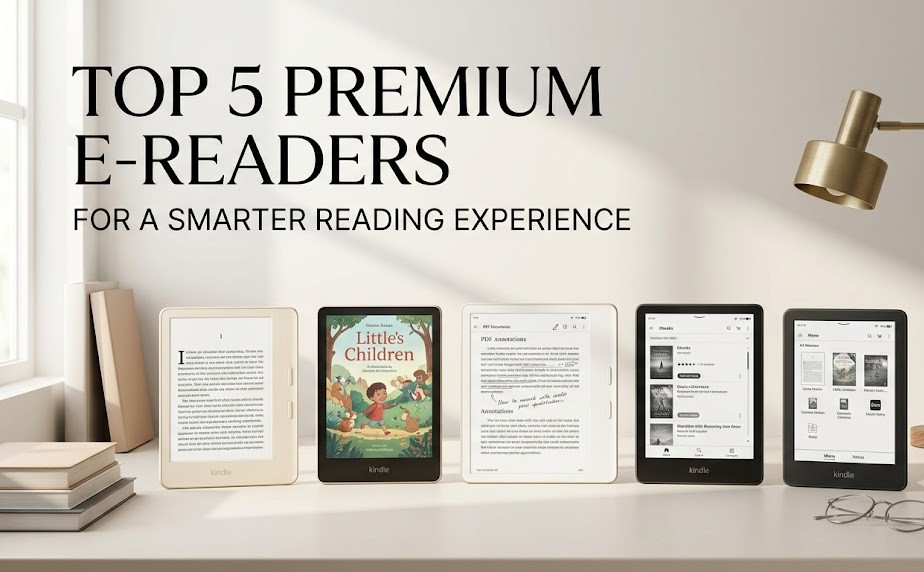
Reading has changed dramatically over the past decade. What once meant carrying a paperback or hardcover everywhere can now involve a slim device capable of holding an entire personal library. Yet premium e-readers have moved beyond simply replacing books. The latest models combine high-resolution displays, adjustable lighting, distraction-free interfaces, long battery life, waterproof construction and, in some cases, note-taking capabilities that make them useful for both leisure and professional reading.
For readers who spend hours with novels, biographies, research papers or business books, the difference between an ordinary e-reader and a premium model can be significant. Screen quality affects reading comfort, storage determines how easily a library can be carried, while software and ecosystem support influence how effortlessly books can be discovered and managed.
The premium segment is particularly interesting because manufacturers are taking different approaches to the reading experience. Some focus on a beautifully refined hardware design, others emphasize writing and productivity, while some build their experience around an extensive digital bookstore. Here are five premium e-readers that stand out for readers looking for a more sophisticated way to read.
1. Amazon Kindle Paperwhite Signature Edition
Amazon’s Kindle Paperwhite Signature Edition remains one of the most balanced choices for readers who want a premium experience without moving into an oversized note-taking device. Its appeal comes from refinement rather than unnecessary complexity. The device is designed primarily for reading, and almost every element—from its display to its lighting system supports that purpose.
The 7-inch Paperwhite display provides a sharp, paper-like reading experience, while the adjustable warm light allows readers to shift from a cooler white tone during the day to a warmer amber tone in the evening. This is particularly useful for people who read before bed or spend long periods reading indoors. The automatic brightness adjustment also reduces the need to constantly change settings manually.
Storage is another advantage. The Signature Edition offers enough capacity for an extensive digital library, making it suitable for readers who collect books rather than simply finishing one title at a time. Wireless charging support adds another premium convenience, while its waterproof construction makes it practical for reading beside a pool, at the beach or during a relaxing bath.
What ultimately makes the Paperwhite Signature Edition compelling is its simplicity. There are no social media notifications, endless applications or distracting browser experiences competing for attention. It is a device deliberately designed to make reading the central activity. For someone deeply invested in the Kindle ecosystem, that focused approach remains difficult to beat.
2. Kobo Libra Colour
The Kobo Libra Colour takes a different approach to the modern e-reader by introducing colour without abandoning the advantages of E Ink technology. Its 7-inch colour display opens up possibilities that traditional monochrome e-readers cannot easily replicate, particularly for graphic novels, illustrated books, magazines, children’s content and books that make meaningful use of coloured highlights.
The colour display is not intended to compete with a smartphone or tablet for vividness. Instead, its purpose is to add another layer of information while preserving the low-distraction character of an E Ink screen. For readers who annotate books or frequently use highlights, this can make the reading experience more expressive and organized.
Its physical page-turn buttons are another feature that differentiates the Libra Colour. Rather than relying entirely on touchscreen gestures, readers can turn pages using dedicated controls, which can be especially comfortable during long reading sessions. The ergonomic design also makes the device easy to hold in one hand.
Kobo’s ecosystem gives the Libra Colour a distinct identity as well. The company has traditionally positioned its devices around flexibility, customization and broad reading formats. Support for Kobo’s reading ecosystem, along with library-focused features in supported markets, makes the device attractive to readers who want alternatives to Amazon’s platform.
The Libra Colour is particularly interesting for readers who want their e-reader to do more than display black text on a white background. It occupies a space between a conventional e-reader and a more visually engaging digital reading device, making it a strong choice for modern, visually oriented readers.
3. Kindle Colorsoft
Amazon’s Kindle Colorsoft represents the company’s move into colour E Ink and brings a new dimension to the Kindle experience. Rather than changing the fundamental philosophy of Kindle, it extends the platform into areas where colour can genuinely improve the experience.
For conventional novels, colour is not essential. Black text on an E Ink background remains perfectly effective. However, colour becomes much more valuable when readers encounter book covers, illustrations, maps, charts, highlighted passages or visual reference material. This makes the Colorsoft particularly appealing to readers whose libraries extend beyond straightforward text-heavy fiction.
The display technology is designed to retain the comfortable, reflective characteristics associated with E Ink rather than turning the device into another tablet. That distinction matters. A premium e-reader is ultimately about reducing the visual and digital distractions associated with conventional screens, and colour E Ink attempts to introduce richer visuals without abandoning that philosophy.
Amazon’s greatest advantage remains its ecosystem. Kindle has one of the most established digital reading platforms, giving users access to a huge catalogue of titles and established Kindle features. Readers already purchasing books through Amazon can also benefit from the familiarity of having their library and reading progress connected across compatible devices.
The Colorsoft is therefore less about reinventing the Kindle and more about expanding what a Kindle can display. For readers who value Amazon’s ecosystem but want a more visually capable screen, it offers an intriguing premium alternative to traditional monochrome models.
4. Kobo Sage
The Kobo Sage is designed for readers who want something larger and more capable than a conventional compact e-reader. Its 8-inch display provides additional screen real estate, which can make a meaningful difference when reading PDFs, academic material, graphic content or books with complex formatting.
The larger screen also creates a more spacious reading environment. Text can be displayed at a comfortable size without requiring excessive page turns, and readers who prefer larger fonts can take advantage of the extra display area. This makes the Sage particularly relevant for people who spend substantial amounts of time reading rather than simply using an e-reader occasionally.
One of its defining characteristics is support for Kobo’s stylus ecosystem, which gives the device a stronger note-taking and annotation orientation. That makes it more versatile than a basic reading device. A reader can move from consuming information to marking passages, writing notes and organizing ideas without switching immediately to another device.
This distinction makes the Kobo Sage interesting for professionals, students and serious readers. Someone researching a subject, reviewing documents or studying nonfiction can benefit from having reading and annotation tools in the same environment.
The trade-off is its larger physical footprint. Readers who primarily want a compact device for commuting may prefer a smaller model, while those who value screen space and productivity may find the larger format worthwhile. The Sage demonstrates how premium e-readers are increasingly evolving from digital book readers into focused information-consumption tools.
5. reMarkable Paper Pro
The reMarkable Paper Pro takes the premium e-reader concept in a very different direction. Rather than competing directly with Kindle or Kobo as a digital bookstore device, it is built around the broader idea of a distraction-free paper replacement.
Its large colour display is designed for reading, writing, sketching and annotation. This makes the device particularly appealing to people who consume substantial amounts of professional or academic material and need to interact with what they are reading. Instead of simply turning pages, users can write notes, organize documents and develop ideas in the same digital workspace.
The minimalist interface is central to the reMarkable experience. There are intentionally fewer conventional tablet-style distractions, which can be valuable for users who want a dedicated environment for focused work. The writing experience is also a major part of its identity, giving it a role that sits somewhere between an e-reader, digital notebook and document workspace.
For book-focused readers, however, the reMarkable Paper Pro is not necessarily a direct substitute for a Kindle or Kobo. Its strength lies in documents, handwriting and focused productivity rather than simply accessing the largest possible commercial ebook catalogue.
That difference is important when considering a premium e-reader. The best device depends not only on how much someone reads, but also on what they read and what they want to do with that information. For professionals and students who regularly annotate documents or take handwritten notes, the reMarkable approach can be considerably more useful than a conventional ebook reader.
What Makes a Premium E-Reader Worth Buying?
Premium e-readers justify their higher prices through a combination of hardware, software and convenience rather than a single specification. Display quality is one of the most important factors because the screen is the part of the device readers interact with continuously. Higher resolution, improved front lighting and better contrast can make long reading sessions considerably more comfortable.
Size is another consideration that is often overlooked. A compact seven-inch device is convenient for commuting and one-handed reading, while a larger eight-inch or more display can be better suited to PDFs, professional documents and note-taking. Neither format is universally better; the ideal choice depends on the reader’s habits.
The ecosystem also deserves careful consideration. Buying an e-reader means choosing more than hardware. Kindle, Kobo and other platforms have different approaches to bookstores, subscriptions, file formats, library access and device synchronization. Someone with an existing digital library should check compatibility before making the switch.
Battery life, waterproofing and storage may appear secondary compared with display technology, but they have a major impact on everyday ownership. A premium e-reader should largely disappear into the background. The less often a reader needs to charge it, adjust settings or manage storage, the more naturally it becomes part of a reading routine.
Choosing the Right E-Reader for Your Reading Style
There is no single premium e-reader that suits every reader because the definition of a “better” reading experience varies significantly. Someone who reads bestselling novels every evening may value simplicity, battery life and a mature ebook ecosystem above everything else. A reader interested in comics, illustrations and colour-coded highlights may have very different priorities.
For focused mainstream ebook reading, the Kindle Paperwhite Signature Edition offers a refined and straightforward experience. Readers interested in colour and ergonomic page-turn controls may find the Kobo Libra Colour more aligned with their habits, while Amazon’s Kindle Colorsoft brings colour into the established Kindle environment.
Readers who frequently work with larger documents and handwritten notes may prefer the Kobo Sage or a device such as the reMarkable Paper Pro. These products demonstrate the expanding definition of an e-reader, where reading is increasingly connected with research, annotation and productivity.
Ultimately, the smartest upgrade is not necessarily the device with the longest specification sheet. It is the one that fits naturally into the way you already read. Premium e-readers are at their best when they remove friction—making books easier to carry, pages easier to read and ideas easier to capture—while keeping the experience focused on the content itself.
The Future of Premium Reading
The e-reader market is gradually moving beyond the basic formula of a monochrome screen and a digital bookstore. Colour E Ink, advanced note-taking tools, larger displays and improved lighting systems are expanding what these devices can do while preserving their most important advantage: a focused reading environment.
That evolution does not mean traditional e-readers are becoming obsolete. Instead, the category is becoming more diverse. Some devices are optimized for novels, others for visual content, and others for professional documents and handwritten work. This gives readers more control over how they consume information.
As digital reading continues to mature, premium e-readers are likely to become increasingly specialized. The most successful devices will not necessarily try to replace tablets entirely. Instead, they will continue doing something tablets often struggle with: creating an environment where reading is the primary activity rather than one option among hundreds.
For readers who value that kind of focus, a premium e-reader can be more than another piece of technology. It can become a modern library that fits into a bag, a distraction-freeworkspace, and a comfortable way to spend hours with the ideas that matter most.
Affiliate Disclosure: This article may contain affiliate links. If you purchase a product or sign up for a service through one of these links, we may earn a commission at no additional cost to you. Our reviews and opinions are based on our editorial assessment and are not influenced solely by affiliate compensation.