Imagine waking up one morning and controlling your smartphone, computer, or even a robotic device without touching a single button. You simply think about an action, and the machine understands your intention. A message is typed, a command is executed, or a digital world opens — all through the power of your thoughts.
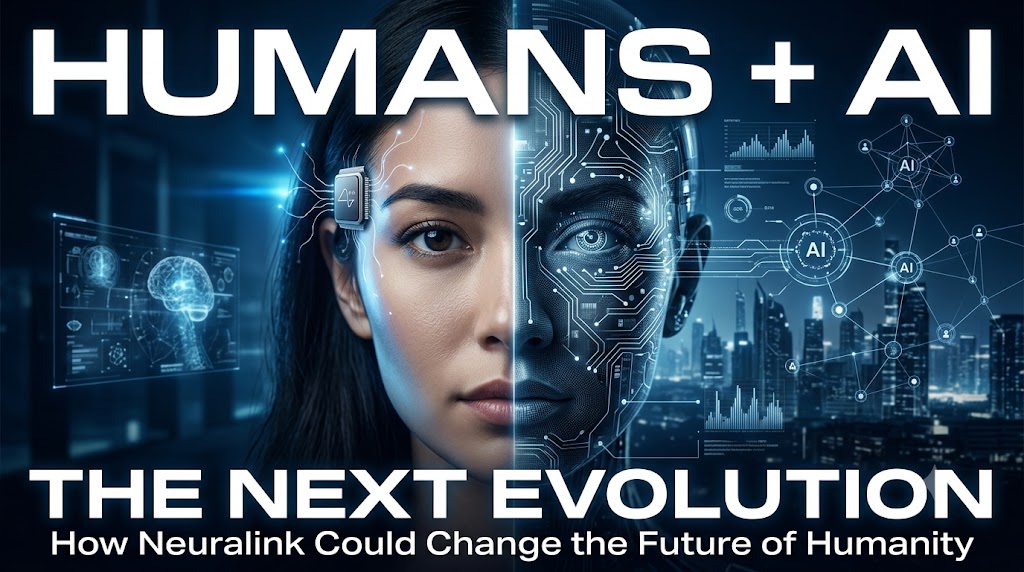
This may sound like science fiction, but companies like Neuralink are working to make this possibility a reality. The idea behind Neuralink is simple yet revolutionary: create a direct connection between the human brain and computers, allowing humans and artificial intelligence to communicate in ways that were once unimaginable.
For decades, humans have used external tools to enhance their abilities. The internet expanded our knowledge, smartphones connected us globally, and artificial intelligence transformed how we work. Neuralink represents the next step moving from using technology outside our bodies to integrating technology directly with our minds.
But the biggest question remains: Will Neuralink help humans unlock their full potential, or will merging with AI create new challenges for humanity?
The Story Behind Neuralink: From Science Fiction to Reality
For most of human history, the brain was considered the final frontier. Scientists understood how neurons worked, but translating thoughts into digital signals seemed almost impossible.
Think about a person who loses the ability to move due to a spinal cord injury. Their brain can still create the intention to move, but the connection between the brain and body is damaged. What if technology could capture those brain signals and use them to control a machine?
This idea became the foundation of brain-computer interfaces (BCI).
In 2016, Elon Musk founded Neuralink with a bold vision: create technology that allows humans to communicate directly with computers. The long-term goal was not only to treat neurological conditions but also to create a future where humans can compete and collaborate with advanced artificial intelligence.
Musk has often warned that AI could become more powerful than humans. His solution? Instead of fighting AI, humans may need to enhance themselves by becoming closer to it.
This concept is known as human-AI symbiosis a future where biology and technology work together.
How Does Neuralink Actually Work?
At the heart of Neuralink’s technology is a tiny brain implant designed to read and interpret neural activity.
The human brain contains approximately 86 billion neurons. These neurons communicate through electrical signals, creating everything from physical movements to memories, emotions, and thoughts.
Neuralink’s implant, known as the Link, contains thousands of tiny electrodes that are designed to detect these signals. These signals are then processed using advanced algorithms and artificial intelligence to understand what the brain is trying to communicate.
For example, imagine a person thinking about moving a computer cursor. Normally, the brain sends signals to the hand, which moves the mouse. With a brain-computer interface, those signals could potentially be captured directly and translated into digital commands.
The person does not physically move anything. Their thoughts become the input.
This technology could completely change how humans interact with machines.
A Life-Changing Possibility: Helping People with Disabilities
While the idea of humans merging with AI sounds futuristic, one of the most immediate benefits of Neuralink could be improving the lives of people with disabilities.
Consider someone who became paralyzed after an accident. They may still have dreams, ideas, and intelligence, but their ability to communicate or interact with the world may be limited.
Now imagine that person being able to control a computer, write messages, operate devices, or interact with others simply through brain signals.
A technology that restores independence could transform millions of lives.
For example, a person who cannot move their hands could potentially use a brain implant to type emails, browse the internet, or control smart home devices. Someone who lost communication abilities could regain a voice through technology that converts thoughts into speech.
This is where Neuralink’s impact could be most meaningful not by creating superhumans first, but by helping humans overcome physical limitations.
The Bigger Vision: Humans Becoming More Powerful With AI
The future vision of Neuralink goes beyond medical applications.
Imagine a world where learning a new language does not require years of study. Instead, information could potentially be transferred or accessed through advanced brain-computer systems.
Imagine professionals solving complex problems by instantly accessing digital information. Imagine artists creating music, designs, or virtual experiences through direct brain interaction.
The possibilities are enormous.
Today, humans communicate with technology through keyboards, touchscreens, and voice assistants. But these methods create a gap between human thoughts and digital systems.
Neuralink aims to remove that gap.
The relationship between humans and technology could shift from:
Human → Device → Digital World
to:
Human → Digital World
This could represent one of the biggest technological transformations in history.
The AI Competition: Why Neuralink Matters More Than Ever
Artificial intelligence is advancing rapidly. Modern AI systems can write content, create images, analyse data, and perform tasks that previously required human intelligence.
As AI becomes more capable, many experts are discussing an important question:
How will humans remain relevant in an AI-driven world?
One possible answer is augmentation.
Instead of replacing humans, AI could become an extension of human intelligence. Neuralink represents this idea giving humans new ways to interact with AI systems.
Think about how smartphones changed human behavior. A person today can instantly access knowledge that previous generations spent years collecting.
Now imagine taking that connection one step further, where access to technology becomes part of the human experience itself.
The smartphone revolution connected humans to information.
Neuralink could potentially connect humans directly to intelligence.
Real Challenges: The Ethical Questions Around Brain Technology
Every revolutionary technology comes with important concerns.
If humans begin connecting their brains to computers, questions about privacy, security, and control become extremely important.
Who owns brain data?
Your thoughts and neural signals are among the most personal information possible. Protecting this data would become a major challenge.
Another concern is cybersecurity. If technology becomes connected to the brain, protecting these systems from hacking would become critical.
There are also social concerns.
Would enhanced humans have advantages over others?
Could brain-computer technology create a divide between people who can afford upgrades and those who cannot?
These questions show that the future of Neuralink is not only about engineering. It is also about philosophy, ethics, and society.
Neuralink and the Future of Work
The workplace of the future could look completely different because of human-AI integration.
Today, employees use computers as tools. In the future, technology may become a direct extension of human thinking.
A designer could create concepts faster by interacting directly with creative software. Engineers could solve complex problems with AI assistance connected to their thought processes. Researchers could analyse massive amounts of information more efficiently.
However, this does not necessarily mean humans will become less important.
The most valuable human skills may shift toward creativity, emotional intelligence, decision-making, and imagination.
AI may provide information, but humans will still provide purpose and meaning.
The Psychological Impact: What Happens When Technology Enters the Mind?
The human brain is not just a processor. It is connected to identity, emotions, memories, and personality.
This creates a deeper question:
If technology becomes part of our brain, where does the human end and the machine begin?
For centuries, humans have used tools to extend their abilities. Glasses improve vision. Hearing devices improve communication. Smartphones extend memory.
Neuralink represents a much deeper form of enhancement.
It challenges us to rethink what it means to be human in the digital age.
The future may not be about humans versus machines.
It may be about humans and machines becoming something new together.
A Future That Once Felt Impossible
The history of technology is filled with ideas that once seemed unrealistic.
Flying machines were impossible until airplanes changed transportation.
Global communication seemed impossible until the internet connected billions of people.
Artificial intelligence seemed like fantasy until modern AI systems became part of everyday life.
Neuralink belongs to this same category of ambitious ideas.
Whether it becomes a mainstream technology in the next decade or takes much longer, one thing is clear: the relationship between humans and technology is changing forever.
The question is no longer only:
“Can machines become intelligent?”
The bigger question may be:
“How will humans evolve alongside intelligent machines?”
Final Thoughts: Are Humans Ready to Merge With AI?
Neuralink represents one of the most fascinating possibilities of the future a world where the boundaries between biology and technology become increasingly blurred.
It could help people regain abilities they lost. It could create new ways of learning, working, and communicating. It could redefine the relationship between humans and artificial intelligence.
But technology alone cannot decide the future.
The future of human-AI integration will depend on how responsibly we develop and use these innovations.
The next major evolution of humanity may not happen through changing our bodies naturally.
It may happen through connecting our minds with the technology we created.
And perhaps the most interesting question is not whether humans will merge with AI.
.