The electric vehicle revolution is often told through the stories of cars: longer ranges, faster acceleration, futuristic interiors and increasingly sophisticated software. But there is another part of the transformation that matters just as much, and it rarely receives the same attention the charging network.
An electric car is only as useful as the infrastructure supporting it. The freedom to take an EV across a city, between states or through multiple countries depends on whether a driver can find a compatible charger, whether that charger is available when they arrive, and whether it can deliver enough power without turning a short stop into a long wait. In other words, the charging station is becoming the new equivalent of the petrol station, but with a very different technological backbone.
That infrastructure is expanding rapidly. ChargePoint reported that the number of charging sessions enabled on its network increased 34% in 2025, while new charging ports grew by 16%, highlighting how quickly charging demand is developing.
Across North America and Europe, several companies are building networks designed to make long-distance electric travel increasingly practical. Some are closely associated with a particular automotive ecosystem, while others operate as open networks serving drivers across multiple vehicle brands.
Here are five charging networks that illustrate where the global EV charging industry is heading.
1. Tesla Supercharger : The Network That Made Long-Distance EV Travel Feel Possible
When Tesla began expanding its Supercharger network, the company was not simply selling electricity. It was attempting to solve one of the biggest psychological barriers to EV ownership: the fear that the battery would run out somewhere inconvenient.
Today, the Supercharger network has grown into one of the world’s largest fast-charging networks, with Tesla reporting more than 80,000 global Superchargers. The network is positioned along major travel routes and is often integrated directly into the driving experience through Tesla’s navigation system.
That integration is one of the most important parts of Tesla’s approach. The charging experience does not exist separately from the vehicle. A Tesla can estimate battery requirements, suggest charging stops and display charger availability as part of the journey-planning process. The company says its Superchargers can add up to 275 kilometres of range in 15 minutes under suitable conditions.
The significance of the Supercharger network goes beyond the number of charging points. It helped establish the idea that an EV road trip could be planned around fast charging rather than around petrol stations.
Tesla has also increasingly opened parts of its charging ecosystem to other EVs and charging standards in different markets, reflecting a broader shift in the industry. As EV adoption grows, charging infrastructure is gradually becoming less about which car a driver owns and more about whether the network can provide accessible, reliable energy.
The bigger lesson from Tesla is simple: charging became part of the product experience rather than an afterthought.
2. ChargePoint : Building the Charging Layer Beyond the Car
If Tesla helped popularise the idea of the seamless EV road trip, ChargePoint represents another side of the charging revolution: a network built around broad accessibility and a large ecosystem of charging locations.
ChargePoint describes itself as a global EV charging solutions provider, and its model extends beyond simply operating highway fast-charging sites. Drivers can use the ChargePoint app to locate publicly accessible charging locations across the ChargePoint network as well as through roaming partners. Its listed roaming ecosystem includes networks such as EVgo, FLO, IONITY, Allego and others.
That approach matters because the future of EV charging is unlikely to depend on one company owning every charger. Instead, interoperability and roaming can make different networks feel increasingly connected from the driver’s perspective.
ChargePoint’s 2026 industry report offers another useful glimpse into the changing market. The company analysed more than 100 million charging sessions and reported that charging-session growth was outpacing the expansion of new ports. It also reported that more than one million EV drivers use ChargePoint each month.
The implication is important for the industry. Building chargers is no longer simply about reaching a target number of plugs. Operators must consider utilisation, location, reliability and the actual behaviour of EV drivers.
A charger sitting in the wrong location is not necessarily valuable simply because it exists. The future network will be judged increasingly by how intelligently it connects drivers with energy when and where they need it.
ChargePoint’s role therefore represents something larger than a charging-station brand. It reflects the emergence of charging as a digital infrastructure layer—part hardware, part software and part mobility service.
3. IONITY : Creating a European Fast-Charging Highway
Europe presents a particularly interesting environment for EV charging because cross-border travel is common and national charging infrastructure can vary considerably. IONITY was created with a distinctly European ambition: build a high-power charging network that can support electric travel across the continent.
As of 2026, IONITY lists 892 locations across 24 European countries, with more locations under construction. Its network page lists thousands of high-power charging points across its operating markets.
The company’s ownership structure also gives it an unusual position within the automotive industry. IONITY’s partners include major automakers such as BMW Group, Ford, Hyundai Motor Group, Kia and Mercedes-Benz, alongside financial investor BlackRock.
This makes IONITY more than a collection of charging stations. It is part of a wider attempt by the automotive industry to develop the infrastructure required for electric mobility at continental scale.
For a European EV driver, the value of such a network is particularly visible during long-distance journeys. A trip that crosses borders should not feel like a completely different charging experience every time the vehicle enters a new country.
IONITY’s emphasis on high-power charging also reflects the changing expectations of EV owners. Early electric vehicles often required drivers to think carefully about charging time. Newer EVs, faster chargers and improved battery technology are shifting that expectation toward shorter stops that fit naturally into a journey.
The ambition is not simply to make charging possible. It is to make it feel normal.
4. Electrify America : Scaling Fast Charging Across North America
In the United States, Electrify America has been building one of the country’s major open fast-charging networks. Its current website lists more than 5,600 Hyper-Fast EV chargers across more than 1,080 charging stations in North America.
The network is particularly focused on highway and long-distance travel, giving EV drivers access to charging along major routes. Electrify America’s current strategy is also increasingly connected to the transition in charging connectors. In 2026, the company is running a phased NACS pilot at selected locations while continuing to support CCS vehicles already on the road.
That transition illustrates one of the industry’s biggest challenges: charging technology is not standing still.
As vehicle manufacturers adopt different connector standards and new generations of EVs demand higher charging power, networks have to upgrade hardware while keeping existing drivers moving. Electrify America’s current investment programme therefore includes both new station construction and upgrades to existing infrastructure. Its national Cycle 4 plan specifically identifies reliability improvements and next-generation chargers as priorities.
The company is also exploring battery energy storage systems at charging locations, with its current website noting that more than 170 stations feature BESS installations. These systems can help charging sites manage grid constraints and support higher-power charging.
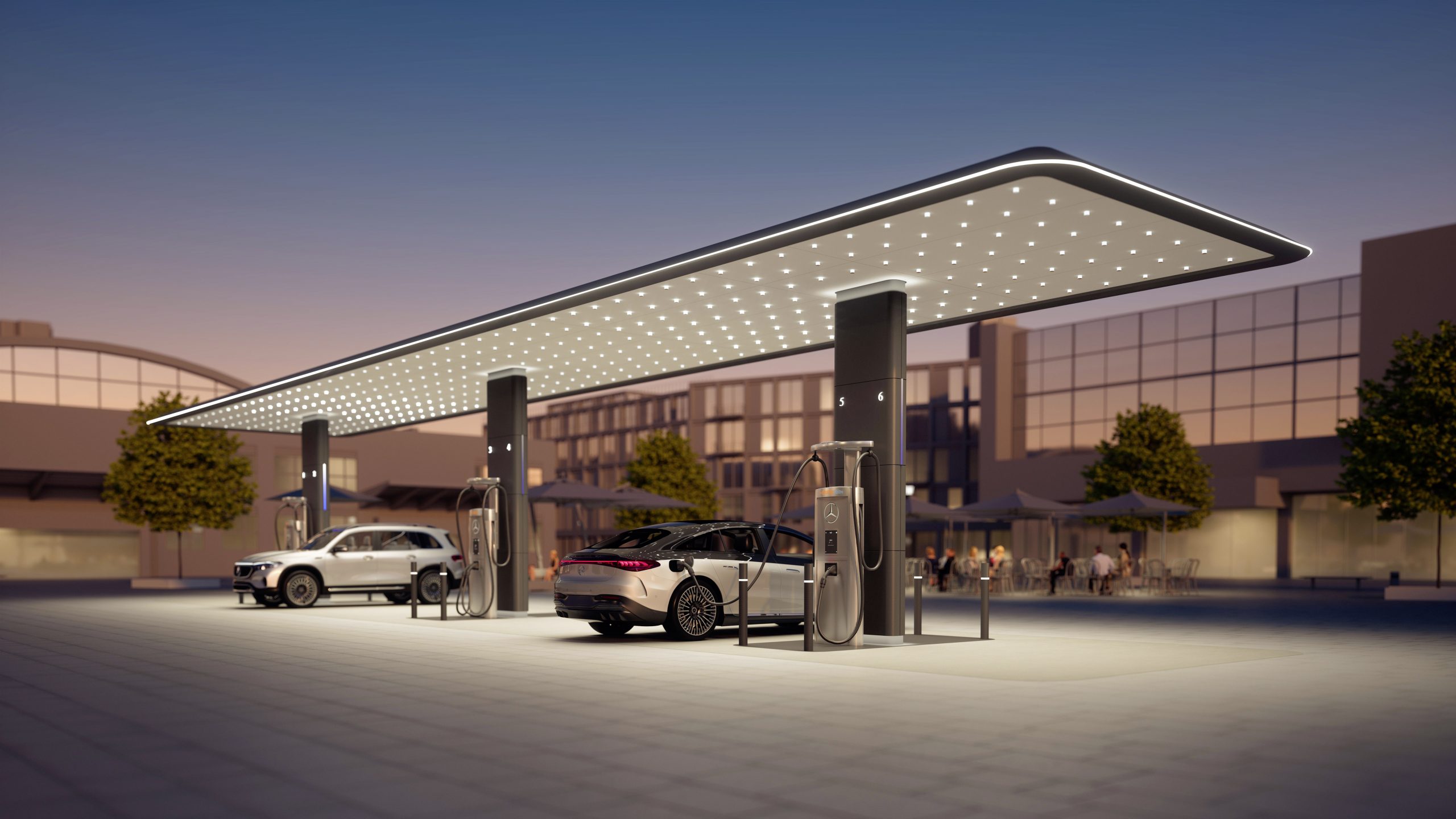
This is where the charging station of the future starts to look very different from a petrol station. It is not simply a place where energy is dispensed. It can become a combination of high-power electronics, software, energy storage, renewable-energy integration and retail infrastructure.
5. Fastned : Turning the Charging Stop Into a Destination
Fastned has taken a particularly distinctive approach to European charging. Rather than trying to blend charging infrastructure into every possible location, the company focuses heavily on purpose-built fast-charging stations positioned along important travel routes.
As of June 30, 2026, Fastned reported 434 operational stations across nine European countries, including the Netherlands, Belgium, France, Germany, the United Kingdom, Switzerland, Denmark, Italy and Spain. The company has set a long-term ambition of reaching 1,000 stations across Europe by 2030.
Its philosophy is centred around making charging feel more like a comfortable travel stop. Fastned highlights convenient locations, fast charging, reliable equipment and customer-focused station design as key parts of the experience.
That focus is significant because the charging experience is increasingly becoming part of a brand’s identity.
A driver does not remember only the number of kilowatts delivered. They remember whether the station was easy to find, whether the charger worked, whether there was enough space, whether the waiting area was comfortable and whether the entire process felt predictable.
Fastned’s expansion demonstrates how charging operators are beginning to think beyond the charger itself. In the first half of 2026, the company opened 28 new stations, taking its network to 434 operational locations. It also reported 4.1 million charging sessions during the period.
The company’s long-term European expansion shows that the charging network is becoming a destination category of its own.
The Bigger Race Is Not Just About Speed
Looking at these five networks, one thing becomes clear: the future of EV charging will not be defined by a single number.
Charging speed matters, but so does reliability. Network size matters, but so does station location. Compatibility matters, but so does payment simplicity. And as more drivers switch to EVs, the quality of the entire experience will increasingly influence how people perceive electric mobility.
The industry is also moving toward a more interconnected model. Roaming agreements, apps, vehicle navigation systems and shared charging standards are gradually reducing the friction between separate networks. A driver should ideally not need to understand the corporate ownership structure behind every charger they use.
At the same time, the growth of EVs is creating a new infrastructure challenge. ChargePoint’s 2026 data suggests that charging usage is growing faster than charging infrastructure in its network, while companies such as Fastned and Electrify America continue investing heavily in new sites and upgrades.
That means the next phase of the EV transition will be less about proving that electric cars can travel long distances and more about building an infrastructure system capable of supporting millions of journeys simultaneously.
Charging Is Becoming Part of the Driving Experience
The most interesting change may be cultural rather than technological.
For decades, drivers planned journeys around petrol stations. In the electric era, that behaviour is being redesigned around charging networks, battery levels, navigation software and strategically placed fast-charging hubs.
Tesla has integrated charging into route planning. ChargePoint is connecting networks through software and roaming. IONITY is building a high-power European corridor. Electrify America is expanding and upgrading North American fast charging while adapting to evolving connector standards. Fastned is designing charging stations as destinations rather than simply pieces of roadside equipment.
They are different approaches to the same fundamental problem: making electric mobility convenient enough that drivers stop thinking about charging as a limitation.
The winners of the charging era will not necessarily be the companies with the most chargers alone. The defining factor may be how effectively each network turns energy infrastructure into a dependable part of everyday mobility.
Because ultimately, an EV charging network is not really selling electricity.
It is selling something much more valuable: confidence that the road ahead is still open.
“The future of electric driving will not be defined by how far a battery can go alone, but by how confidently a driver can keep going.”