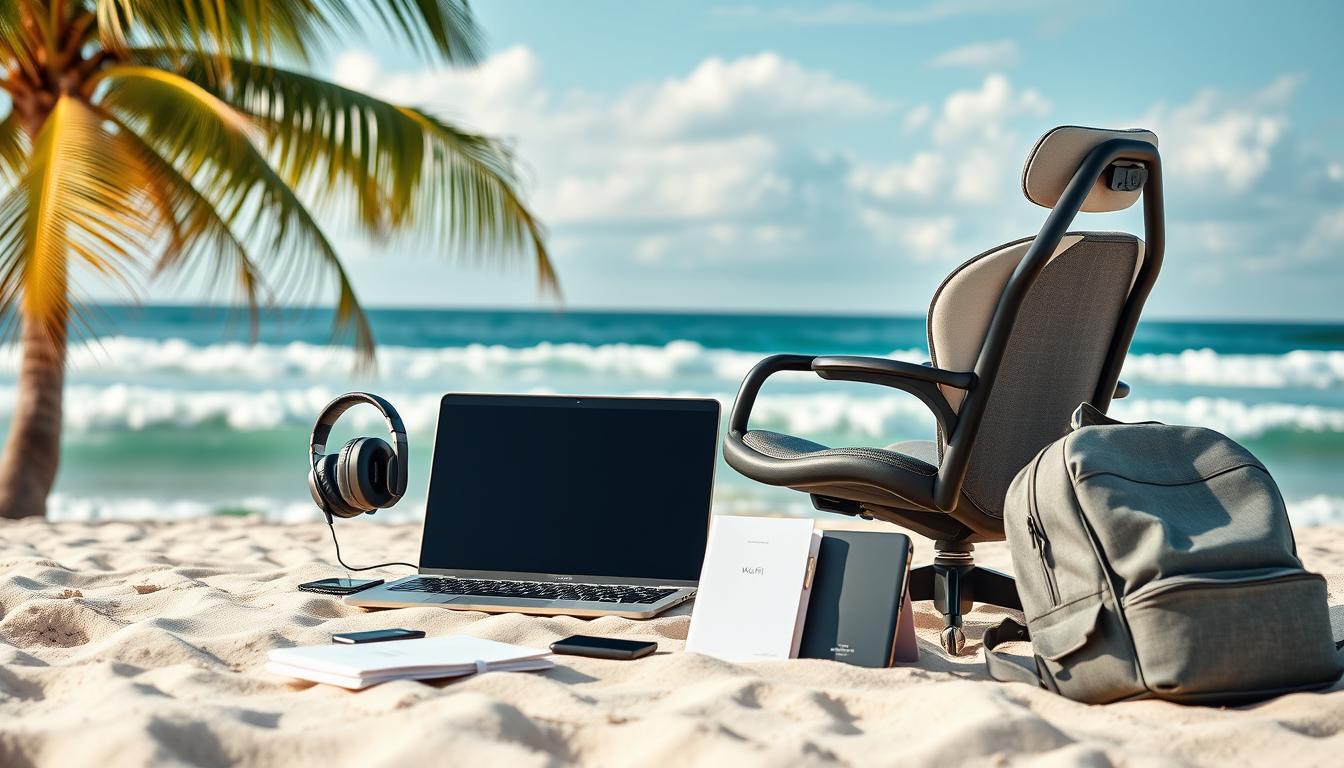
Your office could be a beachside café, a hotel balcony or a quiet corner of an airport lounge. These five smart gadgets make working from anywhere easier, lighter and far more reliable.
The idea of being a digital nomad sounds wonderfully simple: pack your laptop, book a flight and work wherever your next adventure takes you. In reality, working while travelling comes with its own set of challenges. Unreliable Wi-Fi, dying batteries, noisy cafés, unfamiliar power outlets and limited workspace can turn a dream workday into a frustrating one.
That is where the right technology makes a difference.
A successful digital nomad setup is not about owning dozens of gadgets. It is about choosing a few dependable devices that solve genuine problems without filling your backpack with unnecessary weight. From staying connected during a long train journey to joining a client meeting from a busy airport, the right gadgets can make remote work considerably more comfortable.
Whether you are freelancing from different countries, running an online business, creating content while travelling or working remotely for an international company, these five gadgets deserve a place in your travel tech kit.
1. A Lightweight Laptop That Can Keep Up With You
For most digital nomads, the laptop is the centre of everything. It is the office, communication hub, research tool, creative workstation and sometimes even the entertainment system.
That makes choosing the right laptop one of the most important decisions for anyone building a portable workspace. The ideal machine needs to strike a balance between performance and portability. A laptop that weighs several kilograms may offer impressive specifications, but carrying it through airports, train stations and unfamiliar streets every few days can quickly become inconvenient.
A lightweight laptop with strong battery life is often a more practical solution. Professionals working primarily with email, presentations, spreadsheets, browser-based platforms and video conferencing may prefer a thin productivity-focused machine. Designers, developers, video editors and other creative professionals may require additional processing power, memory and storage.
Battery life deserves particular attention. Digital nomads cannot always assume that a convenient power socket will be available. You might find yourself working from a café where every outlet is occupied, travelling on a train without accessible charging or sitting outside while waiting for your next appointment. A dependable battery gives you the freedom to keep working without constantly searching for a charger.
Port selection is another small detail that can make a surprisingly big difference. USB-C, USB-A, HDMI and other connectivity options can reduce the need to carry multiple adapters.
The goal is simple: choose a laptop that is powerful enough for your work but light enough that you never think twice about putting it in your bag.
2. Noise-Cancelling Headphones for Your Own Personal Office
There is one thing almost every digital nomad eventually discovers: the world is noisy.
A café that looks perfect for working may suddenly become crowded. An airport lounge can turn into a constant stream of announcements and conversations. A hotel room may be located next to a busy road. Even a beautiful outdoor workspace can come with traffic, construction or crowds in the background.
Noise-cancelling headphones can transform that experience.
Modern active noise cancellation technology helps reduce unwanted ambient sound, allowing you to focus more easily on work, music or podcasts. For people who spend several hours writing, designing, researching or analysing data, reducing background distractions can make a noticeable difference to the working environment.
They are particularly valuable for remote meetings. Instead of worrying about every conversation happening around you, you can create a more controlled audio environment for calls with colleagues, clients and customers.
However, sound quality is only part of the equation. Comfort matters just as much when headphones are going to be worn for hours. A lightweight design, comfortable ear cushions and intuitive controls can make a major difference during long work sessions or international flights.
Battery life is another feature worth checking. The last thing you want is for your headphones to die halfway through a presentation or during a long journey.
For a digital nomad, good headphones essentially create a portable bubble of concentration. Wherever you are, you can make your surroundings feel a little quieter and your workspace a little more private.
3. A Universal Travel Adapter to Solve the Outlet Problem
There is a particular kind of panic that happens when you arrive in another country, open your laptop bag and realise your charger does not fit the wall socket.
Different countries use different electrical outlet designs, which means the charger that worked perfectly at home may be useless at your destination without an adapter.
A universal travel adapter is one of the smallest items in a digital nomad’s bag, but it can become one of the most valuable.
Instead of carrying separate plug adapters for different countries, a universal model can support multiple outlet configurations in one compact device. Many newer options also include USB-A and USB-C ports, allowing travellers to charge smartphones, tablets, headphones and other accessories without needing several separate charging bricks.
For people travelling with modern laptops and USB-C devices, Power Delivery support can be especially useful. A compatible charger can potentially reduce the number of charging accessories you need to carry.
The best part is that this gadget does not require much space. It can sit quietly in your backpack for weeks without being touched—and then suddenly become the most important object you own when you arrive somewhere new.
Before international travel, however, check voltage compatibility and the electrical requirements of your devices. An adapter changes the physical connection; it does not necessarily convert electrical voltage.
For frequent international travellers, that small distinction can prevent an expensive mistake.
4. A High-Capacity Power Bank for Life Between Power Outlets
Your smartphone is probably doing far more work than simply making calls.
It may be your boarding pass, navigation system, translation tool, banking device, camera, communication platform and authentication key—all at the same time. For a digital nomad, losing access to a phone because of a dead battery can create much more than a minor inconvenience.
That is why a reliable power bank belongs in almost every remote worker’s travel bag.
A good portable charger can provide emergency power when you are travelling between destinations, exploring a new city or working somewhere without convenient electrical outlets. It can also reduce the pressure of constantly looking for a café with an available charging socket.
USB-C charging is particularly useful because it can support multiple modern devices. Depending on the model and device compatibility, a sufficiently powerful power bank may recharge everything from your smartphone and wireless earbuds to a tablet or even a laptop.
Capacity matters, but bigger is not automatically better. A massive power bank may offer more energy while adding significant weight to your luggage. Frequent travellers should consider the balance between battery capacity, charging speed and portability.
And there is one important travel consideration: airline restrictions. Power banks containing lithium-ion batteries are generally subject to specific rules for air travel, and limits can vary by airline and jurisdiction. Always check the latest requirements before flying.
Think of your power bank as emergency infrastructure. You may not need it every day, but when your battery reaches 5 percent in the middle of nowhere, you will be glad it is there.
5. A Reliable Mobile Wi-Fi Solution for Staying Connected
For a digital nomad, internet access is essentially part of the office.
A beautiful hotel with terrible Wi-Fi is not necessarily a suitable workspace. Neither is a stylish café where the connection disappears every time you join a video call.
Reliable connectivity can therefore be one of the most important parts of a remote work setup.
A portable mobile hotspot, eSIM-compatible device or local mobile data solution can provide an alternative when traditional Wi-Fi is unavailable or unreliable. The right option depends on your destination, travel frequency, data requirements and mobile carrier availability.
Someone who primarily sends emails and works on cloud documents may need relatively little data. A video editor uploading large files or a content creator publishing high-resolution videos can consume significantly more.
Having mobile data as a backup is particularly valuable when an important meeting or deadline cannot wait for the hotel router to start working again.
It can also be useful when travelling through destinations where public Wi-Fi is limited. Instead of planning your entire day around finding a reliable internet connection, you can have greater flexibility about where you work.
Security should also be considered. Public Wi-Fi networks can expose users to various security risks, so remote professionals should use sensible security practices, keep devices updated and protect important accounts.
For someone whose income depends on being online, a backup connection is more than a travel convenience. It is a way of protecting productivity.
The Perfect Digital Nomad Setup Isn’t About More Gadgets
There is a temptation to build an elaborate travel workstation filled with keyboards, monitors, tablets, cameras, chargers, hubs and accessories.
But minimalism is one of the biggest advantages of the digital nomad lifestyle.
Every extra device has a cost beyond its purchase price. It adds weight to your luggage, another cable to organise, another battery to charge and another item to worry about losing.
The smartest approach is to build your technology kit around the problems you actually encounter.
If you frequently work in noisy environments, prioritise headphones. If you travel internationally, a universal adapter becomes essential. If your phone constantly runs out of power, invest in a dependable power bank. If your work depends on uninterrupted internet access, create a reliable mobile connectivity backup.
Your laptop remains the centre of the setup, while the other gadgets support it by solving the practical problems that appear between destinations.
Technology Should Give You Freedom, Not More Things to Carry
The appeal of digital nomadism has never really been about technology itself. It is about freedom—the freedom to change cities, explore new cultures and design a working life that is less tied to one physical location.
Technology simply makes that freedom possible.
A lightweight laptop gives you a portable office. Noise-cancelling headphones give you a quieter workspace. A universal adapter keeps you powered across countries. A power bank protects you from unexpected battery emergencies, while mobile connectivity helps keep your work online.
Together, these five gadgets create a practical foundation for working remotely while travelling.
You do not need a backpack packed with every new piece of technology. You need a small collection of dependable tools that work when you need them.
Because the real luxury of being a digital nomad is not having more gadgets.
It is being able to open your laptop almost anywhere in the world—and get to work.
Affiliate Disclosure: This article may contain affiliate links. If you purchase a product or sign up for a service through one of these links, we may earn a commission at no additional cost to you. Our reviews and opinions are based on our editorial assessment and are not influenced solely by affiliate compensation.