The global automobile industry is at a defining crossroads. What was once a straightforward decision choosing between different petrol-powered models has evolved into a far more complex question: should you go electric or stick with petrol in 2026?
Electric vehicles (EVs) are no longer a futuristic concept. They are here, scaling rapidly, backed by policy support, technological advancement, and shifting consumer preferences. Meanwhile, petrol cars continue to dominate in terms of infrastructure, familiarity, and upfront affordability. The decision today is not about which technology is superior in isolation, but which one aligns better with your lifestyle, usage patterns, and long-term expectations.
This article breaks down the EV vs petrol debate across cost, performance, infrastructure, environmental impact, and future readiness helping you make a smart, future-proof choice.
The Big Shift: Why This Decision Matters Now
The urgency around choosing between EVs and petrol cars in 2026 stems from three major forces:
- Government push toward electrification (subsidies, stricter emission norms)
- Rising fuel prices and volatility
- Rapid improvement in EV technology and charging infrastructure
At the same time, internal combustion engine (ICE) vehicles are not disappearing overnight. In markets like India, they still account for the majority of vehicle sales, supported by a vast fuel distribution network and lower upfront costs.
This creates a transitional phase one where both technologies coexist, but the balance is gradually shifting.
Cost Comparison: Upfront vs Long-Term Value
Initial Purchase Cost
One of the biggest barriers to EV adoption remains the higher upfront price. Electric vehicles typically cost more than their petrol counterparts due to expensive battery systems.
However, this gap is narrowing. Government incentives, state subsidies, and reduced GST on EVs are making them more accessible.
Petrol cars still win on affordability at the entry level, making them attractive for first-time buyers or those with tight budgets.
Running Cost
This is where EVs clearly outperform petrol cars.
- Charging an EV is significantly cheaper than refuelling with petrol
- Cost per kilometre in EVs can be 60–80% lower than petrol vehicles
- Electricity prices are more stable compared to fuel price fluctuations
For daily commuters or high-usage drivers, the savings over time can be substantial.
Maintenance Cost
EVs have fewer moving parts:
- No engine oil
- No gearbox complexity
- Less wear and tear
This translates into lower maintenance costs over the vehicle’s lifespan.
Petrol cars, on the other hand, require regular servicing, oil changes, and more mechanical upkeep.
Total Cost of Ownership (TCO)
When you combine fuel savings, lower maintenance, and incentives, EVs often become more economical over a 5–7-year period, especially for urban users.
Performance & Driving Experience
Electric Vehicles
EVs offer:
- Instant torque (quick acceleration)
- Smooth and silent driving
- Minimal vibration
This makes them ideal for city driving, where stop-and-go traffic benefits from instant power delivery.
Petrol Vehicles
Petrol cars provide:
- Familiar driving feel
- Better performance consistency on highways
- No range anxiety
They are still preferred for long-distance travel and high-speed driving enthusiasts.
Range & Convenience
EV Range
Modern EVs in 2026 typically offer:
- 300–500 km range per charge (mid-range models)
- Higher-end models exceeding 600 km
However, real-world range depends on:
- Driving style
- AC usage
- Terrain
Petrol Range
Petrol vehicles offer:
- 600–800 km range per tank
- Refuelling in minutes
This makes them more convenient for long trips and unpredictable travel patterns.
Charging vs Fuel Infrastructure
EV Charging
Charging infrastructure is expanding rapidly, especially in urban areas. Key developments include:
- Fast-charging stations
- Home charging solutions
- Highway charging corridors
However, challenges remain:
- Limited rural coverage
- Charging time (30 minutes to several hours depending on charger type)
Petrol Infrastructure
Petrol pumps are:
- Widely available
- Fast and reliable
This remains one of the strongest advantages of petrol vehicles, particularly in developing regions.
Environmental Impact
Electric Vehicles
EVs produce:
- Zero tailpipe emissions
- Lower overall carbon footprint (especially with renewable energy)
However, concerns include:
- Battery production impact
- Recycling challenges
Petrol Vehicles
Petrol cars:
- Emit CO₂ and pollutants
- Contribute to urban air pollution
With stricter emission norms, newer petrol vehicles are cleaner, but they cannot match the zero-emission advantage of EVs.
Government Policies & Future Outlook
Governments worldwide, including India, are actively promoting EV adoption through:
- Subsidies and tax benefits
- Investment in charging infrastructure
- Gradual phase-out plans for ICE vehicles
While petrol cars will not disappear immediately, their long-term future is uncertain. Resale value and regulatory restrictions could become concerns over time.
Resale Value & Market Trends
Petrol cars currently have:
- Established resale markets
- Predictable depreciation
EV resale markets are still evolving, influenced by:
- Battery health
- Rapid tech upgrades
However, as EV adoption increases, resale dynamics are expected to stabilize.
Who Should Buy an EV in 2026?
EVs are ideal if you:
- Drive mostly in the city
- Have access to home or workplace charging
- Want lower running costs
- Are environmentally conscious
- Plan to keep the car for several years
Who Should Buy a Petrol Car in 2026?
Petrol cars make sense if you:
- Frequently travel long distances
- Lack access to reliable charging
- Prefer lower upfront cost
- Live in areas with limited EV infrastructure
The Hybrid Middle Ground
For those unsure, hybrid vehicles offer a balanced option:
- Better fuel efficiency than petrol
- Reduced emissions
- No dependency on charging infrastructure
However, they do not deliver the full cost benefits of EVs.
The Emotional Factor: Beyond Logic
Car buying is not purely rational. Factors like brand perception, driving feel, and personal comfort play a significant role.
Some buyers prefer the quiet sophistication of EVs, while others enjoy the sound and responsiveness of petrol engines. The “right” choice often depends on what feels right, not just what looks better on paper.
The 2026 Verdict: Which One Should You Choose?
There is no universal answer but there is a clear direction.
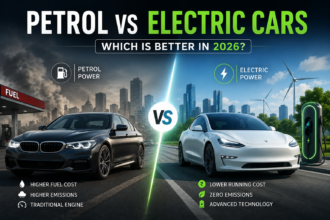
- EVs are the future, offering lower running costs, sustainability, and advanced technology
- Petrol cars are the present, providing convenience, familiarity, and flexibility
If your lifestyle supports it, an EV is a smart, forward-looking investment. If not, a petrol car remains a practical and reliable choice.
Final Insight
The EV vs petrol debate in 2026 is less about replacement and more about transition. We are in a hybrid era where both technologies coexist, each serving different needs.
The smartest decision is not to follow the trend blindly, but to align your choice with how you actually drive, live, and plan for the future.
Because in the end, the best car is not the most advanced one it’s the one that fits seamlessly into your life.