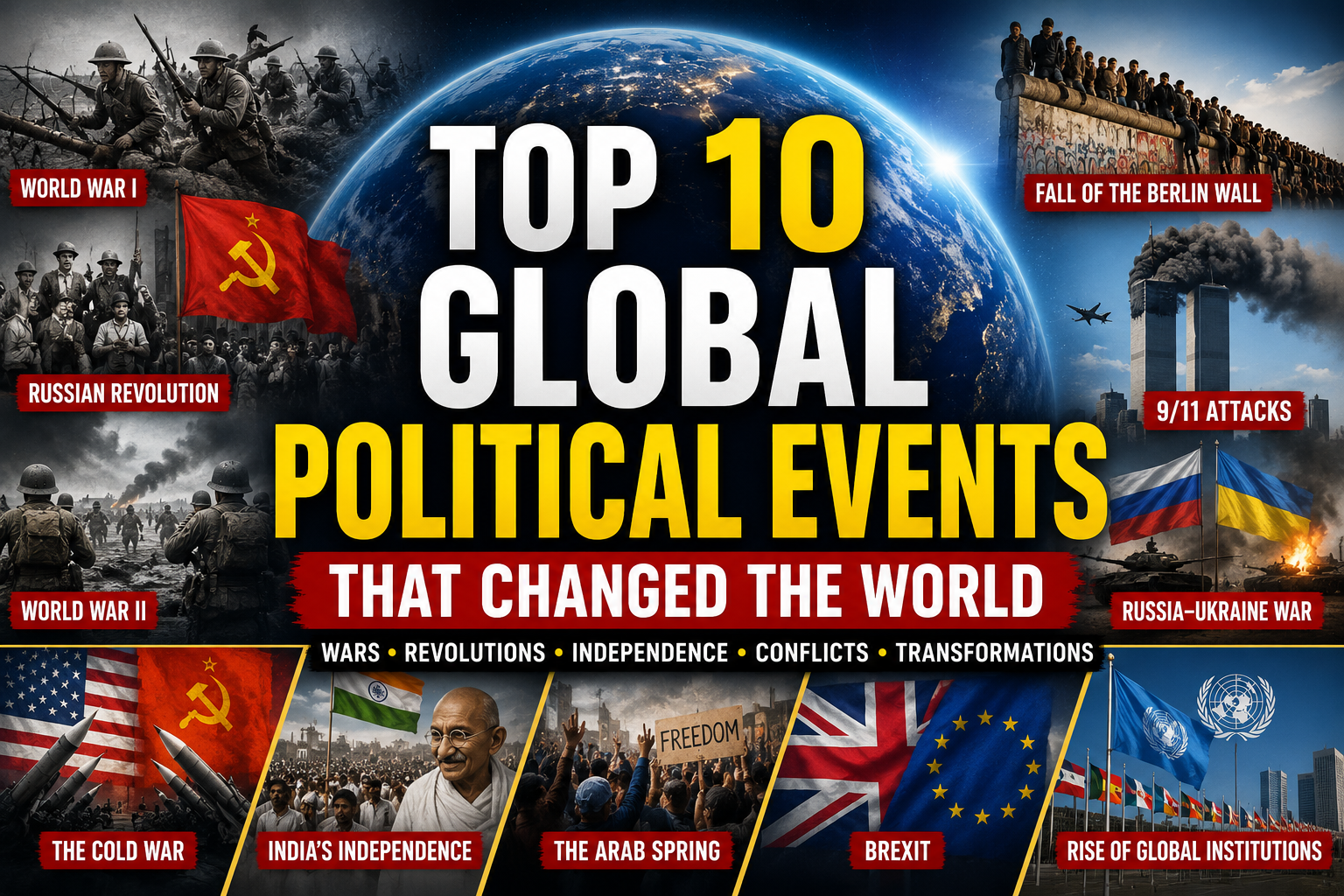
History is shaped by political events that redefine borders, transform economies, influence ideologies, and alter the lives of millions of people. Some political events remain limited to a particular nation, while others create ripple effects across continents and generations. From revolutions and wars to the collapse of empires and the rise of global institutions, these moments have changed the direction of human civilization.
Global political events do not merely affect governments; they reshape societies, international relations, trade systems, technology, security, and human rights. Many of the freedoms, alliances, and geopolitical tensions seen today are direct consequences of decisions and conflicts from the past century.
This article explores ten of the most influential global political events that changed the world forever. Each event not only transformed the political landscape of its time but also continues to influence modern international affairs.
1. World War I (1914–1918): The War That Reshaped Nations
World War I was one of the deadliest and most transformative conflicts in modern history. Triggered by the assassination of Archduke Franz Ferdinand of Austria-Hungary, the war quickly escalated into a global conflict involving major powers such as Britain, France, Germany, Russia, and the Ottoman Empire.
The war caused massive destruction and resulted in millions of deaths. However, its political consequences were even more significant. Several empires collapsed, including the Ottoman Empire, the Austro-Hungarian Empire, the German Empire, and the Russian Empire.
The Treaty of Versailles imposed harsh penalties on Germany, creating economic instability and political resentment that later contributed to the rise of Adolf Hitler and World War II. The war also led to the formation of the League of Nations, an early attempt to establish global peace through international cooperation.
World War I changed the global balance of power and laid the foundation for many future geopolitical conflicts.
2. The Russian Revolution (1917): The Rise of Communism
The Russian Revolution marked the end of the Romanov monarchy and the rise of communist rule under Vladimir Lenin and the Bolsheviks. This event transformed Russia into the Soviet Union, one of the most powerful political entities of the twentieth century.
The revolution introduced communism as a major global ideology challenging capitalism and democracy. It inspired communist movements across Asia, Europe, Latin America, and Africa.
The ideological struggle between communism and capitalism later became the foundation of the Cold War between the United States and the Soviet Union. Countries around the world were forced to align themselves with one of the two competing systems.
The Russian Revolution changed global politics by creating a divided world order that influenced international relations for decades.
3. World War II (1939–1945): The Deadliest Conflict in Human History
World War II was a global conflict involving most of the world’s major powers. It began after Nazi Germany invaded Poland in 1939 and rapidly expanded across Europe, Asia, and Africa.
The war resulted in the deaths of more than 70 million people and witnessed horrific events such as the Holocaust and the use of atomic bombs on Hiroshima and Nagasaki.
Politically, World War II completely reshaped international power structures. Germany and Japan were defeated, while the United States and the Soviet Union emerged as superpowers. Colonial empires weakened, leading to independence movements across Asia and Africa.
One of the most important outcomes was the creation of the United Nations in 1945, designed to prevent future global wars and encourage international cooperation.
World War II also accelerated technological advancement, military modernization, and economic transformation on a global scale.
4. The Cold War (1947–1991): A Global Ideological Battle
The Cold War was not a traditional war fought directly between the United States and the Soviet Union. Instead, it was a prolonged political, military, economic, and ideological rivalry between capitalism and communism.
The world became divided into two major blocs. NATO represented Western democratic nations led by the United States, while the Warsaw Pact represented communist states aligned with the Soviet Union.
The Cold War influenced nearly every region of the world through proxy wars, nuclear arms races, espionage, propaganda, and space exploration. Conflicts such as the Korean War, the Vietnam War, and the Cuban Missile Crisis were direct consequences of Cold War tensions.
One of the biggest fears during this period was nuclear warfare, as both superpowers accumulated massive arsenals capable of destroying humanity.
The Cold War ended in 1991 with the collapse of the Soviet Union, marking the victory of Western liberal democracy and capitalism. This event transformed global politics and established the United States as the dominant global power.
5. The Independence of India (1947): The End of Colonial Rule
India’s independence from British rule in 1947 became one of the most significant anti-colonial political events in history. Led by figures such as Mahatma Gandhi and Jawaharlal Nehru, India’s freedom movement inspired liberation struggles worldwide.
The end of British colonial rule weakened European imperialism and encouraged other colonies in Asia and Africa to fight for independence.
However, independence also came with the partition of India and Pakistan, resulting in one of the largest migrations and humanitarian crises in history.
India later emerged as the world’s largest democracy and an important voice among developing nations. Its independence changed the global political landscape by accelerating decolonization across the world.
6. The Fall of the Berlin Wall (1989): The Symbolic End of Division
The Berlin Wall was constructed in 1961 to divide communist East Germany from democratic West Germany. It became the most powerful symbol of the Cold War and ideological division in Europe.
In 1989, growing public protests and political reforms led to the fall of the Berlin Wall. Images of people tearing down the wall became symbolic of freedom and the collapse of communist control in Eastern Europe.
The event paved the way for German reunification and accelerated the collapse of the Soviet Union.
The fall of the Berlin Wall represented the triumph of democratic ideals and marked the beginning of a new political era in Europe.
7. The September 11 Attacks (2001): A Turning Point in Global Security
The terrorist attacks on September 11, 2001, changed global politics and security policies forever. Coordinated attacks by the extremist group al-Qaeda targeted the World Trade Center in New York and the Pentagon in Washington, D.C.
Nearly 3,000 people were killed, shocking the world and triggering a major shift in international relations.
In response, the United States launched the “War on Terror,” leading to military interventions in Afghanistan and Iraq. Governments worldwide strengthened anti-terror laws, increased surveillance, and expanded intelligence cooperation.
The attacks also intensified debates around religion, extremism, civil liberties, and foreign policy.
The political consequences of 9/11 continue to influence international security strategies today.
8. The Arab Spring (2010–2012): The Power of Public Protest
The Arab Spring was a wave of anti-government protests and uprisings that spread across the Middle East and North Africa. Beginning in Tunisia, the movement quickly expanded to countries such as Egypt, Libya, Syria, and Yemen.
Citizens demanded democracy, economic reform, and an end to authoritarian rule. Social media played a major role in organizing protests and spreading information globally.
Some governments were overthrown, while others responded with military force. The movement led to political instability, civil wars, refugee crises, and major geopolitical tensions.
The Arab Spring demonstrated how public movements and digital communication could challenge powerful political systems.
9. Brexit (2016): Britain’s Exit from the European Union
In 2016, the United Kingdom voted to leave the European Union in a historic referendum known as Brexit. The decision shocked global markets and triggered political debates across Europe.
Supporters argued that Brexit would restore national sovereignty and immigration control, while opponents warned of economic and diplomatic consequences.
Brexit significantly affected trade agreements, financial markets, immigration policies, and European unity. It also encouraged nationalist and populist movements in other countries.
The event highlighted growing political divisions within modern democracies and raised questions about the future of globalization.
10. The Russia–Ukraine War (2022–Present): A New Geopolitical Era
The Russia–Ukraine war became one of the most important geopolitical events of the twenty-first century. Russia’s invasion of Ukraine in 2022 triggered global condemnation, economic sanctions, military alliances, and humanitarian crises.
The conflict reshaped international diplomacy and revived NATO’s strategic importance. Western nations increased defense spending, while global energy markets experienced major disruptions.
The war also intensified tensions between Russia and Western powers, creating fears of a broader international conflict.
Additionally, the conflict accelerated discussions around cybersecurity, energy independence, and the future of global security alliances.
The Russia–Ukraine war continues to influence international politics, trade, military strategies, and global economic stability.
Conclusion
Political events shape the course of human history by influencing nations, ideologies, economies, and societies. The ten events discussed above transformed international relations and continue to impact the modern world.
From world wars and revolutions to independence movements and geopolitical conflicts, these moments changed how countries interact and how people understand power, freedom, and security.
Understanding these global political events is essential because history often explains present-day tensions, alliances, and policy decisions. Modern international politics is deeply connected to the lessons, consequences, and transformations created by these historical milestones.
As the world continues to face challenges such as technological competition, climate politics, economic instability, and regional conflicts, new political events will continue to shape the future of humanity.