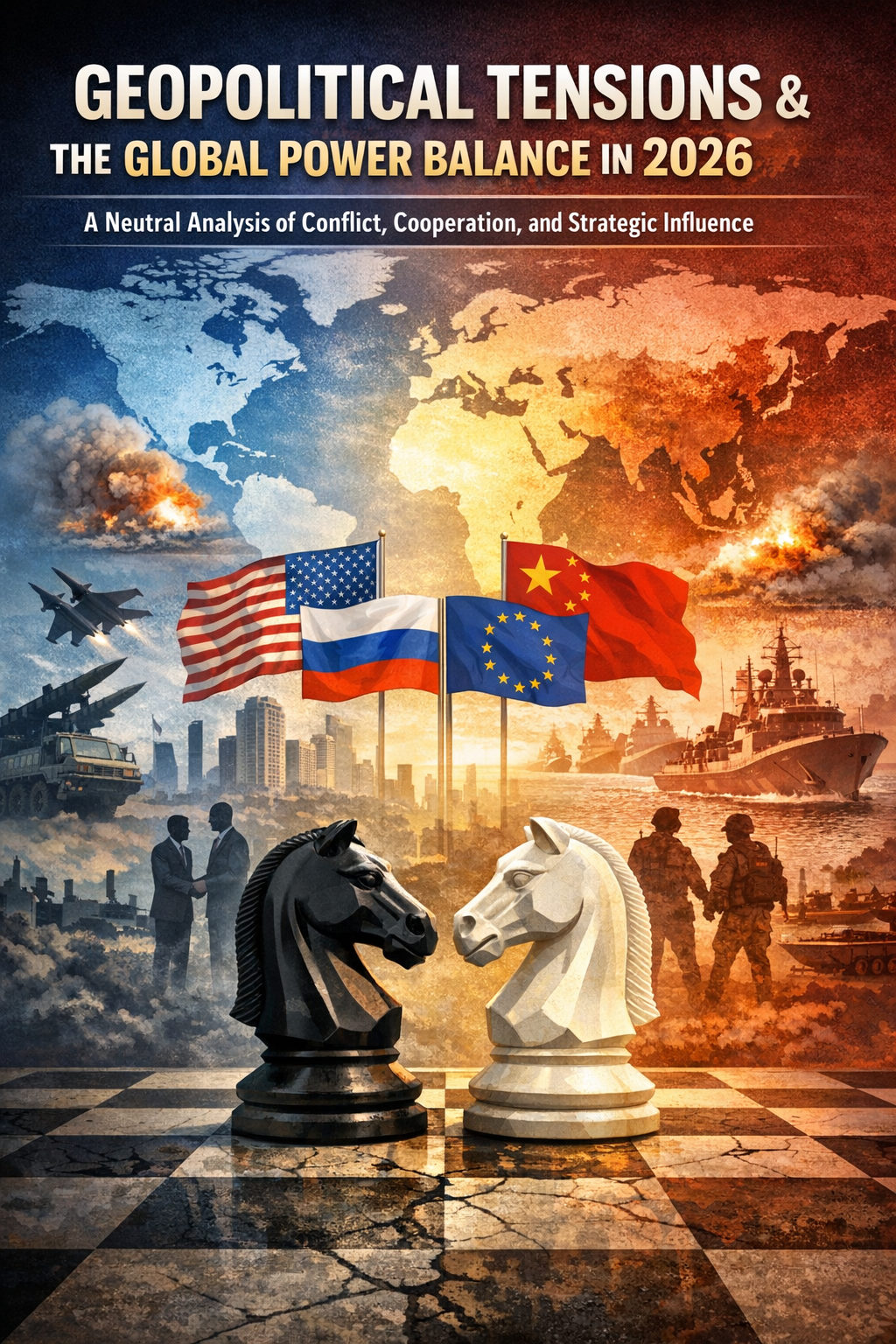
In 2026, the global political landscape is defined less by a single dominant power and more by a complex, evolving balance between multiple influential nations. The traditional unipolar moment that followed the Cold War has given way to a multipolar world, where strategic competition, regional conflicts, and shifting alliances are reshaping international relations.
At the center of this transformation are three major actors: the United States, China, and Russia. Each brings distinct strengths, ambitions, and strategies to the global stage. Their interactions whether cooperative, competitive, or confrontational are influencing everything from trade and technology to security and diplomacy.
This article offers a neutral, analytical perspective on geopolitical tensions in 2026, focusing on conflicts, diplomatic dynamics, and the evolving architecture of global power.
The Shift to a Multipolar World
For much of the late 20th and early 21st centuries, global power was largely concentrated. However, economic growth in Asia, renewed assertiveness from Russia, and regional power centers emerging across the globe have diluted this concentration.
Today’s world is characterized by:
- Multiple centers of influence
- Regional alliances with global implications
- Issue-based cooperation rather than fixed loyalties
This shift has introduced both opportunities and uncertainties. While it allows for more balanced global participation, it also increases the complexity of decision-making and conflict resolution.
The United States: Sustaining Influence in a Changing World
The United States remains one of the most influential global powers, with strengths spanning military capability, technological innovation, and financial systems.
Strategic Priorities
- Maintaining alliances in Europe and Asia
- Leading in advanced technologies like AI and defense systems
- Managing competition with China
Approach to Global Leadership
The United States continues to emphasize a rules-based international order, often working through alliances such as NATO and partnerships in the Indo-Pacific region.
However, its role is evolving. Rather than acting unilaterally, it increasingly relies on coalition-based strategies, reflecting both strategic necessity and changing global dynamics.
China: Expanding Economic and Strategic Reach
China has emerged as a central force in shaping the global power balance. Its rapid economic growth, technological advancements, and global investments have positioned it as a key competitor to the United States.
Key Areas of Influence
- Trade and manufacturing dominance
- Infrastructure investments through initiatives like the Belt and Road Initiative
- Expanding presence in Asia, Africa, and Europe
Strategic Outlook
China’s approach often combines economic engagement with long-term strategic positioning. Rather than direct confrontation, it focuses on building influence through trade, investment, and regional partnerships.
Russia: Strategic Assertiveness and Regional Influence
Russia continues to play a significant role in global geopolitics, particularly in security and energy sectors.
Core Strengths
- Military capability
- Energy exports
- Strategic geographic position
Global Role
Russia’s approach is often characterized by assertiveness in protecting its interests, particularly in neighbouring regions. Its actions have influenced global security discussions and contributed to shifts in alliances and defense strategies.
Key Areas of Geopolitical Tension
1. Regional Conflicts
Conflicts remain a central feature of geopolitical dynamics. While the nature and intensity vary, they often involve broader strategic interests of major powers.
These conflicts:
- Influence global markets
- Impact humanitarian conditions
- Shape diplomatic alignments
Major powers typically engage indirectly, supporting allies or pursuing negotiations to maintain balance without direct escalation.
2. Trade and Economic Competition
Economic competition is a defining feature of modern geopolitics.
Key aspects include:
- Trade policies and tariffs
- Supply chain control
- Currency influence
The relationship between the United States and China, in particular, reflects both interdependence and competition. While they are major trading partners, they also compete in areas such as technology, manufacturing, and global market access.
3. Technology and Digital Power
Technology has become a critical domain of geopolitical competition.
Areas of focus:
- Artificial intelligence
- Semiconductor production
- Cybersecurity
Control over technology not only drives economic growth but also enhances national security capabilities. As a result, countries are investing heavily in innovation while implementing regulations to protect their interests.
Strategic Alliances: The New Power Multipliers
Alliances continue to play a crucial role in shaping global influence. However, their nature is evolving.
Traditional Alliances
Organizations like NATO remain central to security cooperation, particularly in Europe.
Emerging Partnerships
New alliances are forming based on shared interests rather than geography. For example:
- Indo-Pacific partnerships
- Economic cooperation groups
- Technology-sharing agreements
These alliances are often flexible, allowing countries to collaborate on specific issues without long-term commitments.
The Indo-Pacific: A Strategic Focal Point
The Indo-Pacific region has become one of the most significant areas of geopolitical focus.
Reasons include:
- Major trade routes
- Economic growth centers
- Strategic maritime importance
Both the United States and China are heavily engaged in this region, seeking to strengthen partnerships and secure influence.
Energy Politics and Global Influence
Energy remains a powerful tool in geopolitics.
Key Dynamics
- Oil and gas supply chains
- Transition to renewable energy
- Energy security concerns
Countries that control energy resources or supply routes hold strategic advantages. At the same time, the global shift toward renewable energy is beginning to reshape these dynamics.
The Role of Middle Powers
While superpowers dominate discussions, middle powers are increasingly influential.
Countries across Asia, Europe, and the Middle East are:
- Acting as regional stabilizers
- Participating in multiple alliances
- Influencing global decisions through diplomacy
This adds another layer of complexity to the global power structure.
Diplomacy in a Fragmented World
Diplomacy remains essential in managing tensions and preventing escalation.
Modern Diplomatic Trends
- Multilateral negotiations
- Backchannel communications
- Economic diplomacy
Rather than relying solely on formal agreements, countries are using a mix of strategies to navigate complex relationships.
The Balance Between Competition and Cooperation
Despite tensions, cooperation continues in several areas:
- Climate change initiatives
- Global health efforts
- Trade agreements
This coexistence of competition and collaboration is a defining feature of modern geopolitics. Countries often compete in one domain while cooperating in another.
Risks and Uncertainties
The current geopolitical environment presents several risks:
- Escalation of regional conflicts
- Economic instability due to trade tensions
- Technological fragmentation
Managing these risks requires careful coordination and strategic foresight.
The Future of Global Power
Looking ahead, several trends are likely to shape the global power balance:
1. Continued Multipolarity
No single country is expected to dominate completely. Instead, influence will be distributed among multiple actors.
2. Technology as a Key Driver
Innovation will play a central role in determining economic and strategic power.
3. Flexible Alliances
Countries will increasingly form partnerships based on specific interests rather than long-term commitments.
Conclusion
The geopolitical landscape of 2026 reflects a world in transition. The balance of power is no longer defined by a single dominant nation but by the interaction of multiple influential players, including the United States, China, and Russia.
Conflicts, economic competition, and technological advancements are reshaping global dynamics, while alliances and diplomacy continue to evolve in response.
In this environment, neutrality and nuanced understanding are more important than ever. The ability to analyse trends without bias allows for clearer insights into a complex and rapidly changing world.
Ultimately, the future of global power will depend not only on competition but also on the capacity for cooperation. As nations navigate this intricate landscape, the challenge will be to balance strategic interests with collective stability ensuring that global progress continues despite underlying tensions.