
For decades, gold was treated as the financial equivalent of an emergency umbrella. You kept it because you might need it one day, not because you expected to use it every morning.
That perception is changing.
Central banks around the world are quietly adding gold to their reserves, even as the metal trades at historically high prices. This is important because central banks are not usually chasing trends. Their decisions are slow, strategic and designed to protect national wealth over decades rather than quarters.
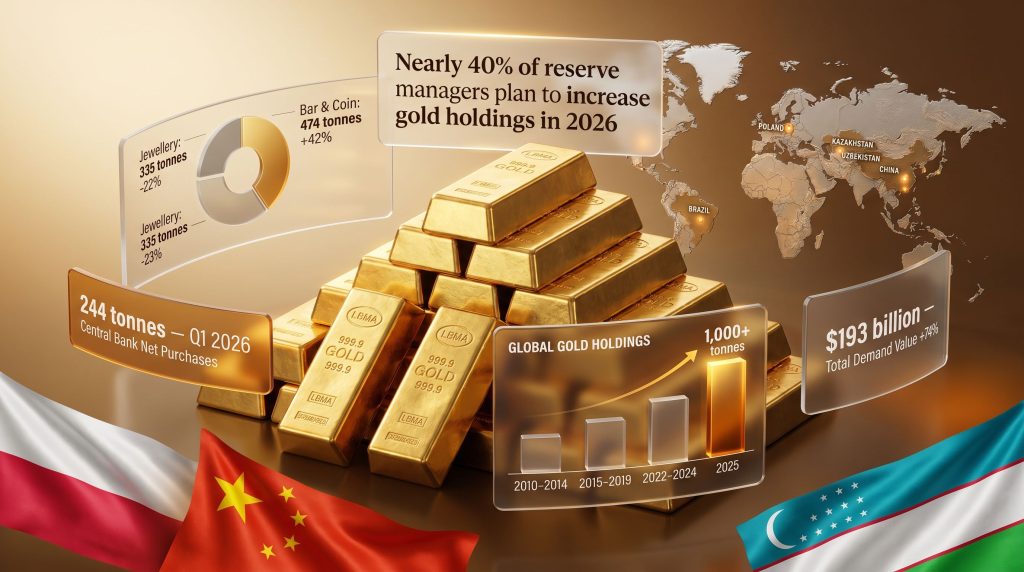
In 2025 alone, central banks added an estimated 863 tonnes of gold to their reserves. That was below the extraordinary 1,000-tonne-plus buying seen in each of the previous three years, but it was still historically elevated. And the momentum has continued into 2026. By the first half of the year, Poland had emerged as the largest reported buyer, followed by Uzbekistan, China and Kazakhstan
So why are governments buying gold when it is already expensive?
The answer is much bigger than the gold price.
Gold Is Becoming a Strategic Asset, Not Just a Safe Haven
The simplest explanation is that central banks want more options.
For years, foreign exchange reserves were heavily dominated by assets such as U.S. dollars and U.S. government securities. That system still matters enormously, and the dollar remains the world’s leading reserve currency. But central banks have increasingly shown interest in diversifying the assets behind their national reserves.
Gold offers something currencies and government bonds cannot quite replicate: it is not another country’s liability.
If a central bank holds a U.S. Treasury security, it is ultimately holding a claim connected to the U.S. financial system. If it holds another country’s currency, its value is influenced by that country’s monetary policy and economic conditions.
Gold is different.
A bar of gold sitting in a central-bank vault does not depend on another government promising to pay it back. It does not have a maturity date. It does not require a central bank to maintain a particular interest rate. And it has been recognized as a store of value across political systems and centuries.
That does not make gold risk-free. Its price can fall, it produces no interest income, and storing and managing physical bullion has costs. But for a country managing reserves measured in billions or trillions of dollars, those characteristics can still make gold valuable as a long-term form of diversification.
That is why this story is less about “gold going up” and more about how governments think about financial security.
Poland Is One of the Clearest Examples
Look at Poland.
The National Bank of Poland was the world’s largest central-bank gold buyer in both 2024 and 2025. In 2025 alone, it added 102 tonnes, taking its gold holdings to around 550 tonnes. Gold represented roughly 28% of its reserves, approaching a revised target of 30
But Poland’s strategy becomes even more interesting when you look at the longer-term reasoning behind it.
Poland has publicly discussed increasing its gold holdings further, with a target of around 700 tonnes. The country’s central bank has linked gold accumulation with national security.
That phrase matters.
A central bank does not normally buy hundreds of tonnes of gold because it thinks gold jewellery will become fashionable next summer. It is thinking about what happens when the global financial system becomes less predictable.
For countries that have experienced major geopolitical shifts within their own region, reserve diversification can take on an additional strategic dimension.
Gold sitting in a country’s reserves can therefore serve as more than an investment. It can become part of the country’s financial insurance policy.
China Is Playing the Long Game
China provides another fascinating example.
The People’s Bank of China continued adding gold to its reserves through 2025 and into 2026. It added 27 tonnes during 2025, bringing reported holdings to approximately 2,306 tonnes
The interesting part is not simply the amount.
It is the consistency.
In 2026, China’s reported purchases continued, with the World Gold Council noting that the country had maintained a long buying streak. By the first half of 2026, China had added 40 tonnes according to publicly reported data
This does not mean China is suddenly abandoning the dollar. That would be an oversimplification.
Instead, it suggests something more subtle: major economies are increasingly interested in having a broader reserve toolkit.
Think of it like an investor.
If someone has their entire portfolio concentrated in one asset, even a very strong asset, they carry concentration risk. Diversification does not necessarily mean believing the original asset is bad. It means recognizing that depending entirely on one asset creates vulnerability.
Central banks appear to be applying a similar logic at a national scale.
The Dollar Question Is More Complicated Than “Gold vs. Dollar”
This is where many discussions about gold become unnecessarily dramatic.
You will often hear that central banks are buying gold because they want to “replace the U.S. dollar.”
The reality is more complicated.
The dollar remains deeply embedded in global trade, financial markets, debt markets and international reserves. Gold is nowhere near replacing it as the primary medium of international finance.
But central banks do not have to choose between the two.
They can own dollars and gold.
That distinction is important.
The shift taking place may be less about replacing the dollar and more about reducing excessive dependence on any single reserve asset.
Gold can sit alongside currencies, government bonds and other reserve assets.
And that makes the trend much more interesting than a simple anti-dollar story.
It is really a story about financial optionality.
Geopolitical Risk Has Changed the Conversation
Another reason gold has become attractive is the uncomfortable reality of geopolitics.
Wars, sanctions, trade disputes, political tensions and changes in international relationships can have direct consequences for financial assets.
A reserve manager therefore has to ask a difficult question:
What happens to our reserves if the global political environment changes dramatically?
Gold cannot solve every problem. But it can provide an asset that is not issued by another government.
This becomes particularly relevant when countries worry about sanctions, asset restrictions or the political risks associated with holding large amounts of foreign assets.
Again, this does not mean gold makes a country financially untouchable.
It simply gives policymakers another layer of protection.
And when governments manage national reserves, even a small additional layer of protection can matter.
Turkey Shows That Central-Bank Gold Strategies Are Not One-Way
There is another side to this story that often gets ignored.
Central banks are not blindly buying gold forever.
Turkey, for example, was among the largest reported sellers in the first half of 2026, while Russia also reduced its holdings.
This is an important reminder that gold reserves are part of active financial management.
Central banks can buy when they want greater exposure to gold. They can sell when domestic conditions, liquidity requirements or reserve-management considerations change.
That makes the global gold market much more dynamic.
The story is not “every central bank is buying.”
The story is that gold has become important enough to be actively managed as a strategic reserve asset.
Czechia Is Another Quiet Example
The Czech National Bank has also been steadily increasing its gold holdings.
It added around 20 tonnes in 2025, bringing its total reserves to roughly 72 tonnes, with a stated target of 100 tonnes by 2028
There is something revealing about examples like this.
The gold story is not limited to enormous economies such as China.
Smaller and mid-sized countries are also thinking about reserve diversification.
That suggests the movement is broader than a single country’s geopolitical strategy.
Central banks with very different economies, currencies and political priorities are reaching a similar conclusion: having some gold in the reserve portfolio can provide useful diversification.
And Central Banks Are Not Losing Interest in 2026
Perhaps the strongest signal comes from what reserve managers themselves are saying.
The World Gold Council’s 2026 Central Bank Gold Reserves Survey found that 89% of surveyed reserve managers expect global central-bank gold holdings to increase over the next 12 months. Even more strikingly, 45% expected their own institution’s gold holdings to increase — the highest share recorded in the survey
That is a significant shift in sentiment.
It suggests the recent gold-buying cycle is not simply a reaction to one year’s price movement.
Reserve managers are increasingly viewing gold as part of their longer-term allocation strategy.
And there is a fascinating contradiction here.
Central banks are buying gold even though they know it is expensive.
Normally, investors prefer to buy assets when prices are low.
Central banks appear to be saying something different:
The strategic value of owning gold may matter more than trying to perfectly time the price.
That is a very different mindset from ordinary speculation.
The Price Is Part of the Story — But Not the Whole Story
Gold had an extraordinary 2025.
According to the World Gold Council, the metal reached 53 new all-time highs during the year. The average gold price for 2025 was around $3,431 per ounce, up 44% from the previous year. Total global gold demand surpassed 5,000 tonnes for the first time.
Yet central banks continued buying.
That tells us something.
If central banks were purchasing gold purely because they expected the price to rise next month, their behavior would look much more like speculation.
Instead, the buying continued despite record prices.
For reserve managers, the calculation appears to be longer term.
They are not necessarily asking, “Will gold be higher next quarter?”
They are asking, “What assets do we want to own if the global financial environment looks very different five or ten years from now?”
Those are completely different questions.
Gold’s Role Could Become More Important in a Fragmenting World
The global financial system is becoming more complicated.
Trade is being reshaped. Countries are building alternative payment arrangements. Geopolitical alliances are evolving. Inflation remains a concern in many economies. Currency movements can quickly change the value of foreign reserves.
None of these developments guarantees that gold will dominate the financial system.
But they create an environment in which an asset with no issuing government becomes more attractive.
That may be gold’s biggest advantage today.
It does not need to become the world’s dominant currency.
It simply needs to remain useful as a neutral reserve asset.
And history gives it a powerful advantage: central banks have trusted gold for generations.
The Bigger Question Isn’t “Will Gold Keep Rising?”
That may actually be the wrong question.
The more interesting question is:
Why are some of the world’s most conservative financial institutions changing the way they think about gold?
Because central banks operate on a completely different time horizon from everyday investors.
They are not building portfolios for a five-year-old’s college fund. They are managing national wealth through wars, recessions, currency crises, political transitions and economic cycles.
When institutions with that responsibility decide they want more gold, it deserves attention.
Poland is buying.
China is buying.
Czechia is building toward a higher target.
Uzbekistan and Kazakhstan have also been significant buyers in 2026. Meanwhile, other countries have sold gold, demonstrating that reserve strategies remain highly individual.
The common thread is not that every country believes gold is going to explode in price.
It is that gold is increasingly being treated as a strategic financial asset.
And perhaps that is the real comeback.
Gold isn’t simply returning because investors are afraid.
It is returning because central banks are reconsidering what financial security should look like in an increasingly uncertain world.
The next chapter of the global financial system may not be about one asset replacing another.
It may be about countries wanting more choices.
And in that world, the oldest reserve asset of them all still has a surprisingly important seat at the table.